Monday, October 01, 2012

Play Those 78s

Sept 12, 2012

One more clutch of central-northeastern Wisconsin pictures. While visiting Appleton, I looked around two antique stores. One mostly specializing in fine vintage furniture, the other an “antique mall” with an endless variety of intriguing old stuff. I found some postcards there at reasonable prices.


At the fine vintage furniture store, the Harp Gallery, I saw more old record players than I’ve ever seen in one place. Somehow, I had to take pictures. These are only three of the dozen or so.


I didn’t make notes, so I can’t comment on the exact models. But maybe it’s enough to know that people listened to their “Yes, We Have No Bananas” 78s on machines like these.

Labels: , ,

Fox Valley Waters

Sept 11, 2012

The Fox River connects Lake Michigan, near Green Bay, with Lake Winnebago, the largest inland lake in Wisconsin. This is the view from a spot near Vulcan Heritage Park, Appleton, on the river.


Vulcan in this case is named for the Vulcan Street Power Plant, the hydroelectric plant that provided power in the 1880s, as mentioned last week. (The Oneida St. Bridge is the one in the picture.) A little further along the river -- actually it might be part of Lake Butte des Morts, it's hard to tell from the maps -- is a small inlet near the river's meeting with Lake Winnebago, home to boats in the warm months. A view from the aptly name Riverside Park in Neenah.


Not far away is Lakeshore Ave. in Neenah, with its view of the large, shallow Lake Winnebago.


Labels:

Handcuff Harry and Tailgunner Joe

 Sept 10, 2012

I knew this was coming up, but I'd forgotten that Saturday marked the exact day when Jimmy Carter bested Herbert Hoover as the president with the longest life after his presidency. As the Atlantic article points out, September 8, 2012, was President Carter's 11,544th day as former President Carter, or nearly 32 years. Here's hoping he has some more post-presidential days.

The History Museum at the Castle in Appleton, Wisconsin, started out as a Masonic Temple, but now focuses on local history. Such as the previously mentioned Harry Houdini, master of escape and self-promotion, who has a whole floor devoted to him and his illusions. How is it that the former Erik Weisz (Ehrich Weiss) called Appleton his hometown? "Houdini came to America as a four-year-old boy in 1878," the museum web site says. "His parents moved him and his brothers to Appleton because of a job opening. Houdini's father, Meyer Samuel Weiss, became the community's first rabbi."

But the young Ehrich Weiss left Appleton with his family when he was only seven, after his father lost his job, moving to New York. So "hometown" is a bit of a stretch, but apparently Houdini claimed the town as his own, even asserting that he'd been born there instead of Budapest. Still, Appleton's a good place for such an exhibit, and the museum does well with it, featuring photos of Houdini during his performances, but also more casual shots; handbills and posters; and plenty of Houdini equipment, such as handcuffs and shackles and confining spaces, like a milk can and a simulated Chinese water torture box.

Various exhibits discuss how some of the escapes were done, which apparently upset some current illusionists -- such as David Copperfield, who owns a lot of Houdini artifacts himself -- as if all the information was somehow not on the Internet. There was also an exhibit, complete with seance table, explaining how some of those tricks were done, just as spiritualist debunker Houdini did during his lifetime.

The museum isn't all Houdini. The lower floors feature exhibits about local history, including an assortment of machines made or used in the area. One was a genuine early 20th-century Linotype machine. Considering how ubiquitous they once were, it's odd how few of them I've run across. Maybe I'm not looking in the right museums.

Right at the foot of the stairs in the basement is a bronze bust in a clear display case. "People ask us why we keep a bust of Joseph McCarthy," our guide said, anticipating the question. "Like him or not, he's part of our history." Sounds reasonable; he was born in Grand Chute, near Appleton, and is buried at St. Mary's Parish Cemetery in Appleton, which wasn't on my press tour. No point in pretending he didn't exist.

Labels: , , , , ,

Bergstrom-Mahler and Its Paperweights

Sept 9, 2012

Whenever I see glasswork that's a few centuries old -- and that's always in a museum -- I wonder, how could those items survive that long? Maybe they could under the care of a museum, but the likes of  enameled beakers, covered goblets and engraved tumblers from 17th- and 18th-century Germany (for example) were made to be used, even if they were expensive items in their time. Gravity has been continuous every moment since then, and so has the unpredictable motion of people, animals or waves of energy, such as when your city is bombed.

The Bergstrom-Mahler Museum in Neenah, Wisconsin, has some fine examples of centuries-old Germanic glassware, all clearly survivors of time and random motion. It also features interesting newer glass as well, plus temporarily exhibits. And then there's the paperweight collection, which includes more than 3,000 objects: whirls of color and shapes embedded in glass globes.

I've only ever seen its like once before, the Arthur Rubloff paperweight collection at the Art Institute of Chicago (1,500+ objects). I understand Rubloff gallery has been expanded recently after some years mostly in storage, but I remember when some of the paperweights were exhibited near the front of the museum.

Paperweight collecting sounds eccentric, and maybe it is, but there are some astonishingly beautiful paperweights in the world, if the Bergstrom-Mahler collection is any indication. Click on the
thumbnails
for a better view, but photos displayed on line really don't do the three-dimensional, well-lit objects much justice.


Labels: , , ,

Fried Twinkie, Al Fresco

Sept 6, 2012

On Saturday mornings during the warm months, Appleton, Wisconsin, closes College Ave. from Appleton St. to Durkee St. and holds a farmers’ market, which it calls a Farm Market. It has vendors, of course, both fresh food and handcrafts, including some that sell from trucks, such as this one brimming with corn.


There’s a bit of live music, too.


And some prepared food from food trucks. Note that Anthony’s has deep-fried Twinkies. I’d heard of such, but never had one. This was my opportunity, for a mere two-spot, to try it. So I did.


It was a lot like the fried dough you find at carnivals, except that it had creme in the center, all gooey and hot. Another member of our party spotted me ordering it, and later asked me how it was. “Fried death,” I told her, to conform to prevailing opinion about such a deep-fried creation. But I figured that one wasn’t going to shorten my life any more than the time it took to eat it, and that one deep-fried Twinkie per lifetime was probably enough anyway.

Labels: , ,

Hearthstone Historic House Museum

 Sept. 5, 2012

The Hearthstone Historic House Museum in Appleton, Wisconsin, was once a well-designed, well-appointed late Victorian mansion, but that's not its signal distinction. Back in the early 1880s, one Henry James Rogers, manager of the Appleton Pulp and Paper Mill, had the house built in a bluff overlooking the Fox River and across from the paper mill that he managed. He was also overseeing the mills' electrification in the summer of '82, just as his new house was being built, so naturally he wanted electricity for the house too.

According to the Wisconsin Historic Society: "The first electricity offered for public sale flowed through wires in Appleton, Wisconsin, to light the paper mills and homes of that Fox River city. Henry J. Rogers... supplied the world's first commercial electrical power in the summer of 1882, in downtown Appleton -- before it was available in Boston, New York, Washington, or Chicago." Electric wires at Hearthstone ran through the pipes meant to carry gas for lighting.

There's a charming sign in the front parlor of the house that says: "This Room is Equipped With Edison Electric Light. Do not attempt to light with match. Simply turn key on wall by the door. The use of Electricity for lighting is in no way harmful to health, nor does it affect the soundness of sleep."

Of course, they were merely assuming that electric light wasn't harmful to health, but we can give them that. As for affecting the soundness of sleep, I think we can all report that electric light has affected our sleep at some point, especially when switched on unexpectedly. That's hindsight anyway. Apparently people came specifically to see the light bulbs in action when the house was new, since it was a marvel of the age.

Our guide said that the voltage was low -- good thing, since at first the current essentially traveled through uninsulated copper wire -- and so the lights would look dim to modern eyes. But for all I know, the new lights might have been every bit as illuminating as gas lights or kerosene lamps or candles were. Just how bright non-electric lights were is one of those familiarities of daily life lost to time and improved technologies, I think. Not even a highly accurate dramatization of the period could probably convey what it would be like to live day-to-day with pre-electric technologies as your source of light. (Though I suspect the damn things would be inconsistent.)

This is what one of the aforementioned "keys on the wall" looks like, because the Hearthstone Historic House Museum still has all of the ones that Edison's men came to town to install.

Our guide told us that they still work. But he didn't demonstrate, probably for good reason. Touch them too often and they might break, always a risk with tech, high or low. If they break, none of Edison's men are around any more to fix them.

The power was incredibly expensive at first. I forget the exact numbers, but in true Gilded Age style, Rogers spent more to light each of his bulbs every year than he would have paid one of his workers for the year, or some such. Unsurprisingly, Rogers died deep in debt in the late 1890s, though probably electricity was only one of his extravagances, and the Panic of 1893 compounded his losses. In any case, his heirs sold the house and most of the contents, so the museum's furnishings aren't Rogers'. But the modern curators have done a good job at finding 1880s period pieces, so besides the back story of electrification, the place has some charms as a house museum.

Labels: , ,

Greater Appleton, 2012

Sept 4, 2012

Back in June 2008, I was invited to go on an August press trip to see some for-sale residential properties in Sandpoint, Idaho, which would have been a fine little excursion. But it was cancelled, because by that summer all the air was already rushing out of the housing market like the popped bubble it was, even for resort-style properties in picturesque settings. I'm surprised the invitations got out at all.

Then came the Panic of 2008, after which I was pretty sure that press trips were things of the past, at least for me. Fast forward to this summer, and to my surprise I was invited on one that took place August 23-26. Also to my surprise, it was to a place I'd never spent much time in before, despite all the many places I've been in Wisconsin: Appleton, a town of 72,000 or so on the northern shores of Lake Winnebago.

Actually not just Appleton, but the cluster of small cities and towns in that area collectively known as the Fox Cities, since they're also near the Fox River, which runs from Lake Winnebago to Lake Michigan. Other Fox Cities include the Wisconsin-sounding Kaukauna, Menasha and Neenah, and the charmingly named Little Chute and the curiously named Combined Locks. Nineteen communities in all, population about 220,000.

We packed a lot in: a museum devoted to glass objects, another devoted to industrial paper making, long a local industry, and yet another with an entire floor devoted to Houdini. If that's not a cool museum subject, I don't know what is. Pictured: a bust of Houdini that the museum tells us is "said to be haunted." By whom, it didn't say. You'd think the ghost of Houdini wouldn't inhabit anything as confining as a piece of stone.

We visited shops that sold antiques, cheese, books and more -- and I saw a shop on Appleton's lively main street that seemed to sell Egyptian-theme New Age merch, but it was closed for the day, or maybe for the birthday of Ra-Horakhty. We toured a Victorian mansion electrified in 1882 using equipment bought from Edison. We went to a building that had been a brewery in the 19th century, was something else for part of the 20th, and is now a brewpub with a restaurant in the cellar, where we drank beer and ate cheese. And a Scotch egg.

Somehow or other I'd never had a Scotch egg before. While looking into it, I found this charming bit of unsourced information that makes Wiki the unpredictable thing that it is: "Scotch Eggs have recently grown greatly in popularity in the Marshall Islands [citation needed]." In any case, the Stone Cellar Brew Pub serves tasty Scotch eggs, and a variety of satisfying brews from their own stainless steel vessels.

The tour featured plenty of other food, as these tours do, showcasing a variety of excellent fare. Except for the fired haddock I had on Friday night, which is just about as Wisconsin as you can get, I also ate at a Mexican, Italian and Japanese restaurants. Some of my dinner companions were food bloggers (restaurant critics, really), so many dishes were photographed before they vanished. On the whole, the other members of the tour were well-traveled, well-read people, so our conversations wandered far afield.

Probably in all of our travels, however, none of us had ever met a professional cheese sculptor. I know I hadn't. Early in the tour, we were introduced to Troy Landwehr, professional cheese sculptor. He's also the proprietor of Kerrigan Brothers Winery. He told us that he thought that maybe a total of three people carve cheese for money -- he does weddings and other events -- and that he likes young cheddar as a medium.

Labels:

Monday, April 02, 2012

Yerkes Observatory

We went to southern Wisconsin on Saturday not to discover monuments to long-forgotten fictional characters (see yesterday) -- though that's always a bonus in traveling -- but to get a look at the University of Chicago's Yerkes Observatory, which is in the town of Williams Bay, Wisconsin. We'd visited and taken the tour before, almost 10 years ago, but I was sure Lilly didn't remember and even more sure about Ann, who was in utero at the time.


I didn't mind going again. Once in a lifetime's not quite enough when it comes to seeing the world's largest refracting telescope, a 40-inch marvel. I learned this time around, or maybe relearned, that every part of the telescope except its lens had been displayed in the Manufacturers Building at the Columbian Exposition of 1893 before it was installed at the new Yerkes Observatory. So not only can you stand under an important telescope in the history of astronomy, it's an artifact of the Chicago world's fair. No doubt fairgoers appreciated it as a marvel of the age.


The guided tour was fairly short. The guide first talked about the design of the observatory, which was the work of Henry Ives Cobb. According to the University of Chicago, Cobb "was fond of ornamentation rooted in classic mythology. At Yerkes, he let his imagination roam: everywhere in the structure, both inside and out, the viewer finds hundreds of ornate, often playful representations of animals real and fanciful, signs of the Zodiac, phases of the Moon, and many other embellishments."


Such embellishments included swastikas, which the guide commented on. "We had them before the Nazis," he said, pointing them out with his laser pointer. The ones at Yerkes were non-Nazi anyway, pointing the other direction and featuring a square at the center, which is a variation I'd never seen before.


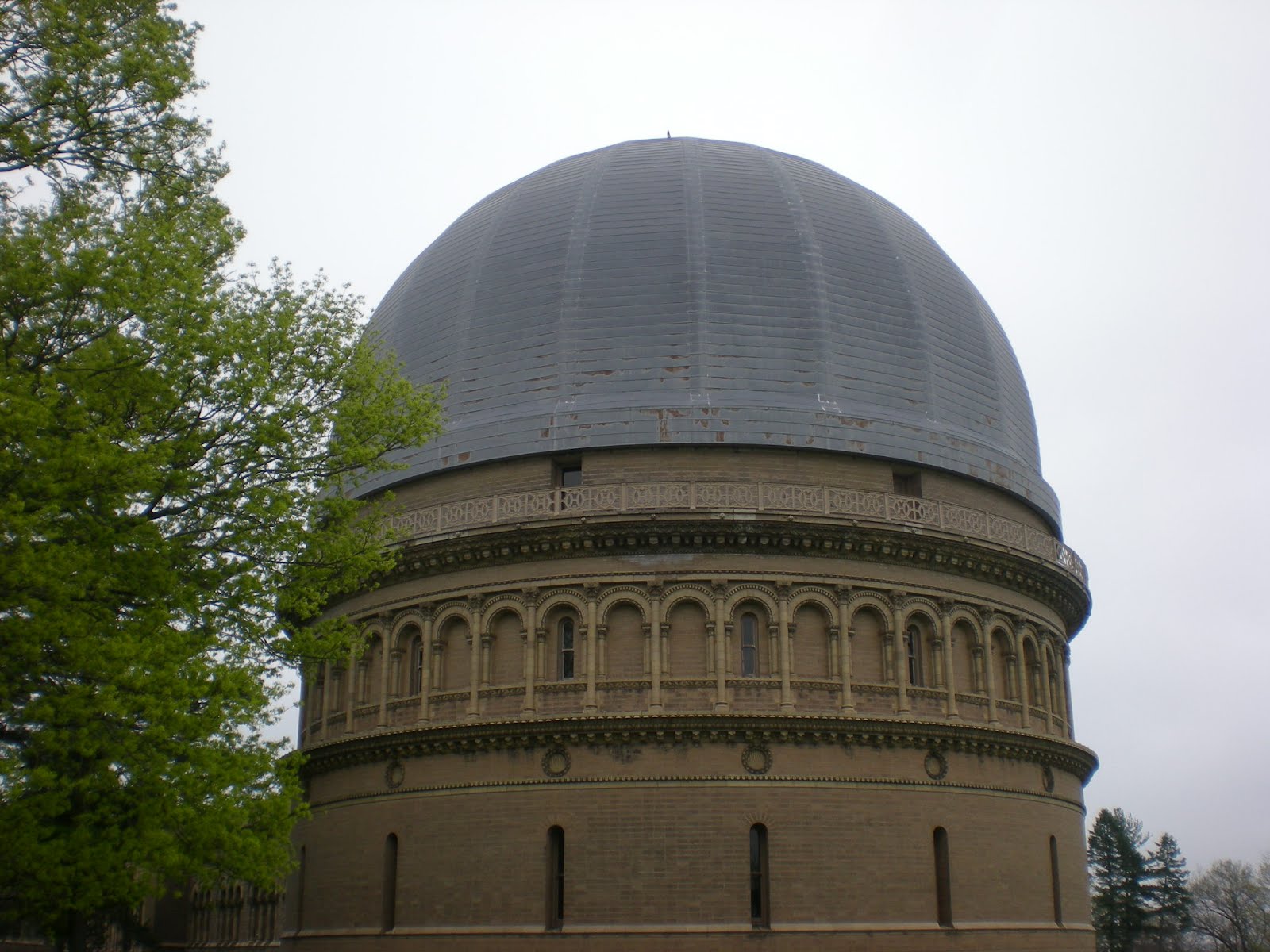
Later, I wandered around the grounds for a few minutes, and managed to take some shots of Yerkes' penile main dome in its park-like setting.


Under the big unheated dome -- Saturday was in the 50s, so it was cool in there -- is the 40-inch telescope, one of six at the observatory, and the only one seen on the Saturday tours. The guide told us a little more about the instrument, and moved it a little. He also raised the floor a few feet, and told us of the time Albert Einstein visited the observatory in 1921, passing around a photo that commemorated the visit.


The photo of Dr. Einstein and the Yerkes staff is at the bottom of this National Park Service page; the one looking Einsteinian is, in fact, the great physicist. I didn't think to ask the guide what Einstein was doing there, but from what I read later, the observatory was doing followups to Sir Arthur Eddington's observations of starlight bending around the Sun during the May 29, 1919, eclipse that confirmed general relativity, though the details of what Yerkes would do as a followup are beyond me.


Einstein is one thing, but he was only passing through. E.E. Barnard, an astronomer who worked at Yerkes, ought to be better known. I've known about him since I read about Barnard's Star in junior high (in one of the 8mm movies I made with some other junior high friends, we imagined a spaceship journeying to Barnard's Star, I think).


Besides Barnard's study of the red dwarf that now has his name, he discovered the fifth moon of Jupiter and a lot of comets, determined that certain dark regions of the Milky Way were actually vast clouds of dust and gas, was a pioneering astrophotographer and -- I didn't know this until this weekend -- was from Nashville and attended Vanderbilt, later receiving the institution's one and only honorary degree. His name remains as Barnand Hall, one of the dorms off Alumni Lawn.

Labels: , ,

Sunday, April 01, 2012

Andy Gump in Bronze

We were about to leave the town of Lake Geneva, Wisconsin, yesterday for a drive around the body of water known as Geneva Lake when I noticed a statute near one edge of the triangular Flatiron Park (and it just occurred to me why the park might be called that). Everyone else was tired from walking around the streets of Lake Geneva, so they waited in the car while I investigated. From the back and a hundred feet away, the thing looked odd, the figure too slender and marked by too many mild protuberances to be a conventional statue of a war hero or politico of old or the like.


The statue faces Geneva Lake (the body of water). It was cloudy yesterday, so the light wasn't that good, especially up toward his head. But I took the picture anyway.


I'd come across the only -- and I'm pretty sure about that -- public statue of the comic strip character Andy Gump. He looked vaguely familiar. I had to read the plaque to remind myself who Andy Gump was. I'm sure I've seen a few examples of the strip he was in, The Gumps, but on the whole the character had made a light impression on me. Until now: I'll remember the statue.


It would have been better if Andy had been placed a little lower, since it loses some of the impact if you can't see his odd, chinless face easily. Oh, well.


Apparently the creator of the strip, one Sidney Smith, lived in the town of Lake Geneva, and at one point the Chicago Tribune had a statute of Andy Gump made for Smith, such was the enormous popularity of the comic. Discontinued in 1959, now it's completely obscure. I doubt that even in the most perverse reaches of Hollywood is anyone dreaming of a modern version of The Gumps, any more than Barney Google and Snuffy Smith are poised for a come back, even though Barney now shares a name with the backbone of the digital age.


But I checked: Barney Google and Snuffy Smith is still being drawn. I guess I don't follow newspaper comics very closely, since I don't think I've seen it in 20+ years. According to King Features (the same comic plantation on which Popeye still toils), the strip is only on its third artist since its creation in 1919, and "this tremendously popular feature boasts clients in 21 countries and 11 languages." Greater longevity than Andy Gump, and of course Barney figured in an immortal pop hit once upon a time, too.

Labels: , ,

Thursday, January 05, 2012

Franks Diner, Kenosha, Wisconsin

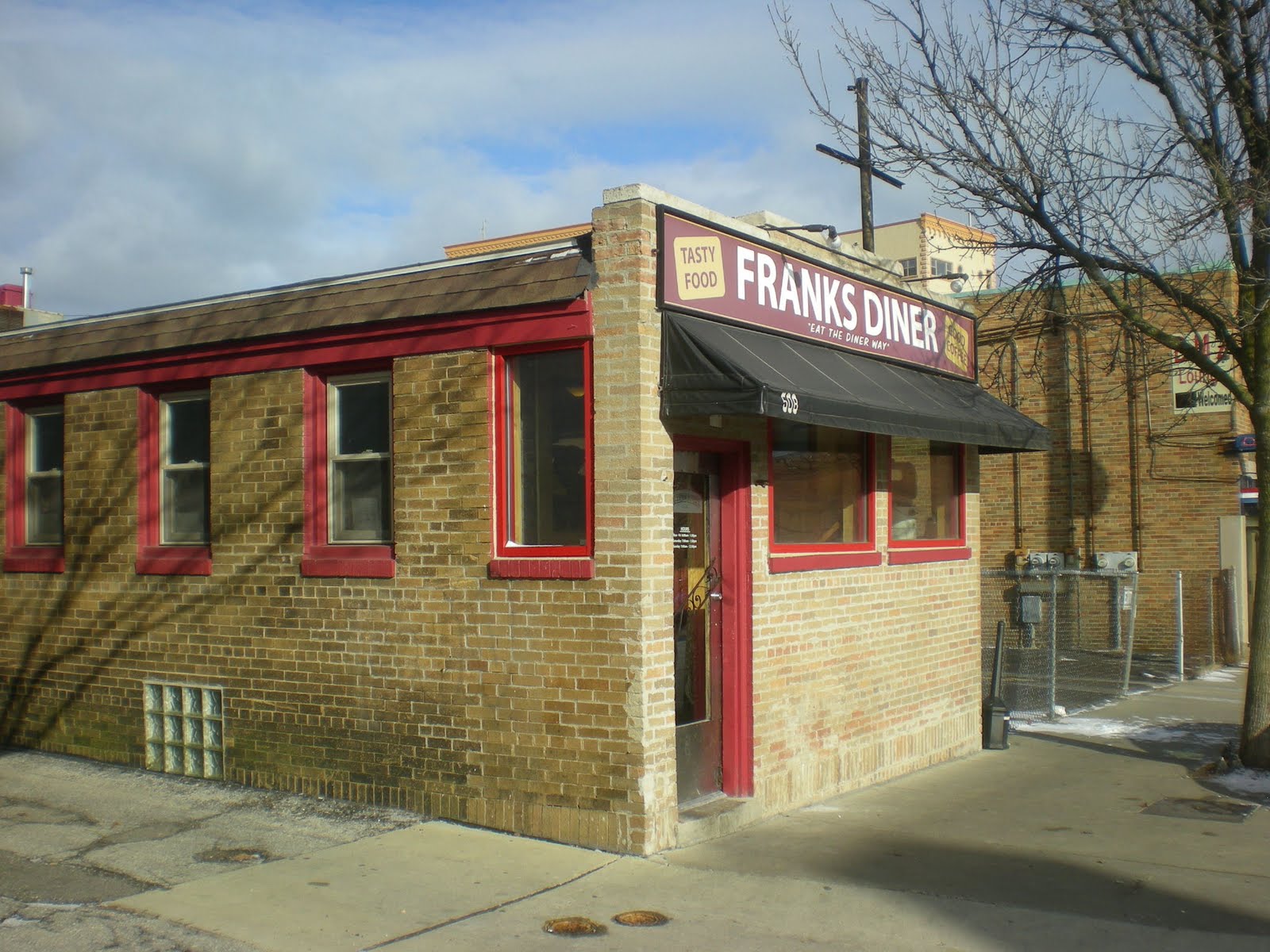
I've been to a diner or two in the Upper Midwest. But none quite like Franks Diner in Kenosha, Wisconsin. We were there recently, as a side trip to another southern Wisconsin destination. It's one of those places whose charms are not visible from the sidewalk.


Enter through the unremarkable front door and inside you find something much more remarkable: a genuine rail car-style diner dating from the 1920s surrounded by that brick exterior, which was added later (but probably not too much later). The main room, long and narrow -- narrow as a rail car -- features a stone-top counter with 18 stools and a narrow food-service area behind the counter, complete with a large griddle given over mostly to the preparation of Franks' specialty, the Garbage Plate, more about which later.


The place had that diner smell: eggs and meats and hash browns and coffee. It also had that diner sound: the murmur of conversation, workers calling to each other, silverware scraping plates, metal clinking metal, the hiss of the griddle.


It was packed. A row of people sat at the counter, while others were at booths in the small rooms added to the counter room. A line of people waited for their seats in a long row behind the people at the counter. When seating was free, the people at the front of the line squeezed between the people sitting at the counter and the people behind them in line to reach either empty counter seats, or a small door that went to the rooms with the booths.


Franks Diner has a history. The Jerry O'Mahony Diner Co., a corporation whose specialty is long lost, built the original rail car-style diner in 1926 in Bayonne, NJ. Taken to Kenosha by flatcar, "there was some real excitement in downtown Kenosha when six horses pulled Franks Diner to the spot where it stands today," notes the Franks Diner web site. "Anthony Franks, who first learned of the unique restaurant opportunity through a magazine article, paid $7,500 plus $325 in shipping charges to launch his business. He added a dining room in 1935 and a larger kitchen in the mid 1940s."


I have to add that $7,825 in 1926 dollars was quite a risk, totaling more than $95,500 in current dollars. Mr. Franks must have really wanted to make a go of it, and I'm glad to say that the Franks family owned the joint until 2001. The current owners have only had it for about a year, and apparently have not meddled with success. At one point, an enormous man -- large of height, large of stomach, bald and wearing a white apron with food stains -- emerged from the back kitchen, and by his conversation with someone else, I knew he was one of the co-owners. "Did you have a good year?" I asked him. "It's been great," he said.


Diner authenticity is one thing, but without Franks' great food, the restaurant would have vanished long ago. The star of the show is its Garbage Plate, a concoction of hash-brown potatoes, eggs, green peppers, onions, jalapeños (if you want them), and a choice of three or fewer meats (or including no meat). The thing is seriously large. The standard Garbage Plate has five eggs, while the half plate has three. Most of the people I saw leaving Franks were carrying to-go boxes probably full of garbage, so to speak. Yuriko and Lilly split a full Garbage Plate, and I was able to sample some. Wow. My own meal, a couple of large pancakes, was superb, but not as good as garbage.


Labels: ,

Wednesday, April 27, 2011

The Puelicher Butterfly Wing

More rain. The lawns are greening up nicely, though some parts of them are under puddles right now. Yet the urge to mow is strong among some householders, though not so much in my case. A neighbor's back yard -- visible from the park next to Ann's school -- features a couple of mower-tracks, obviously cut the other day in the process of discovering just how soggy the grass is.


While we were visiting the Milwaukee Public Museum, we toured a small but popular exhibit called the Puelicher Butterfly Wing. It's a warm, humid room full of free-flying butterflies. As I said, the place was popular.


It's hard to see any butterflies in that picture. But they were in the air, on the plants, on the walls, and sometimes on the visitors. None liked me enough to land on me. Lilly, on the other hand, attracted more than one, for reasons only known to the butterflies.


I asked a docent, an elderly gent in a t-shirt that said BUG SQUAD (or was it BUG PATROL?) whether most of the species in the room were tropical. Most are, he said, except for some Monarchs the museum happened to have handy. Grand as they are, Monarchs are positively dowdy compared to some of the iridescent-hued bugs flitting around that room.


Still, I wondered, what's the evolutionary value in being so colorful? It must work, but how? I guess I could look up current thinking on that point, but I'd rather it be a minor mystery.

Labels: , , ,

Tuesday, April 26, 2011

The Milwaukee Public Museum

Heavy rains last night and some later in the day, and even better, it was warm for a few hours today. Better than last Saturday in Milwaukee, when it wasn't pleasant enough for an outdoor romp. So we did an indoor romp at the Milwaukee Public Museum. We made the acquaintance of this creature while we were there.


It's the Herbior Mammoth, discovered in southern Wisconsin in 1994 and acquired by the museum in 2007. Imagine being in the vicinity of such a beast, more than two stories tall and sporting those wicked-looking tusks, while you are armed with a stone spear and maybe a stone knife or two, and you have no horses. Of course, you're with the rest of the hunters in your clan, but still. The mammoth will be angry when you start poking it with your sticks.


According to the museum, the mammoth died about 14,500 years ago -- and has evidence of being butchered. So people ended up eating the thing, whether they hunted it or scavenged it, which is less dramatic but also possible. I prefer to imagine paleo-Indians poking it with sharp sticks; that would have been quite an achievement. More importantly for paleoanthropologists, the bones are older than the Clovis site, and thus among the oldest evidence of human habitation in North America. Cool.


Elsewhere in the museum was the big-ticket exhibit, "Mummies of the World," which apparently displays dried dead people not only from Egypt and Peru, but also lesser-known mummification spots, such as "part of a group of 18th-century mummies discovered in a long-forgotten church crypt in Vác, Hungary," says the press release associated with the show. Imagine that discovery: "Say, Béla, what's in stone box over there?" "Dunno, let's find out."


Interesting, but I didn't want to shell out for it. Instead we wandered through the halls of the museum, looking at whatever caught our interest. Much of the place is given over to re-creations of one kind or another, such as Old Milwaukee, which features storefronts with large windows, inside which are various artifacts of old-time businesses. My own favorite item in that part of the museum was a poster at the late 19th-century drug store advertising Paine's Celebrated Green Mountain Balm of Gilead Cedar Plaster, which you can see here (with the wry note, "Advertisements often depicted the natural sources of proprietary medicines rather than the factories in which they were bottled.").


The Milwaukee Public Museum is also fond of traditional, full-sized dioramas: nature scenes, scenes featuring Indians, scenes depicting far-away cultures. One diorama has fish and other sea creatures hanging by strings from the ceiling, with a watery background, which is something I'd never seen before. I have to like a museum that's hanging onto its dioramas in our time, when digital imaging is state-of-the-art in simulation. But until we get holodecks, even computer-generated 3D imaging isn't quite going to replace the diorama.


Not all dioramas are in museums. Such as this odd contest I'd never heard of before: the Pioneer Press Marshmallow Peeps Diorama and Video Contest.

Labels: , ,

Monday, April 25, 2011

The Basilica of St. Josaphat

Here's a headline I saw over the weekend: "Chicago's Gas Prices Highest in Country." Hell's bells. "The U.S. average for a gallon of regular now stands at $3.88, but in Chicago, it'll cost you an average of $4.27," reports NBC Chicago. I assume the story means in the city itself, since out here in the suburbs it's about a dime less than that.


Just north of the Illinois-Wisconsin line at the junction of I-94 and Wisconsin 50, which sports a large knot of retail properties, gas could be had for $3.99.9/gallon last Friday. Four dollars, in other words. I know this because I bought some on our way to Milwaukee to take advantage of the last gasp of the frequent-flyer award my family's round-trip across the Pacific earned nearly two years ago. No charge to stay in the room, but some expense to get there.


Good Friday was cold and drizzly. We knew that ahead of time, so planned to spend most of our time indoors, including one place whose exterior has intrigued me for years, the Basilica of St. Josaphat. Every time I drive into Milwaukee on I-94, I see its dome from the highway, since it's pretty hard to miss, but I'd never taken a close look at it. Get off the highway, make your way into the heart of south-side Milwaukee, park on a nearby side street, and the dome is even harder to miss.


The structure is more than 100 years old, built for a massive Polish congregation and modeled after St. Peter's. "Father Wilhelm Grutza hired a German-born architect named Erhard Brielmaier to design what is, in essence, a smaller version of St. Peter's." says the Visitor Guide and Tour we picked up at the church. "The church has the same cross-shaped floor plan and same huge central dome that distinguish St. Peter's." Brielmaier and his family were the go-to architects if you wanted a Catholic church built in the Midwest in the late 19th- and early-20th century, it seems. One source credits them with designing over 800 churches.


St. Josaphat's is as resplendent as you'd expect, with large stained-glass windows, paintings, bronze bas-reliefs, gold leaf, a marble pulpit and a marble altar, some onyx columns, and a lot of activity up inside the dome -- various orders of angels, plus prophets, apostles and doctors of the Church. There's an inscription in Polish around the base of the dome: 1 Kings 9:3, according to the guide ("I have hallowed this house, which thou hast built, to put my name there for ever; and mine eyes and mine heart shall be there perpetually.")


Even better, there's a backstory to all that splendor. H. Russell Zimmermann, writing in Milwaukee Magazine, tells it: "Upon learning of the impending demolition of the Chicago Post Office and Customs House, [Grutza] negotiated a deal to buy materials. For $20,000 he got 200,000 tons, including stone, doors, hardware, railings and light fixtures. It took 500 railroad cars to ship... Brielmaier created a masterpiece, but close inspection will reveal a few reminders. Some ornamental brass hardware bears the U.S. Treasury seal, and carved capitals atop the portico’s columns contain American Eagles... Today, with its newly cleaned exterior, St. Josaphat’s looks better than it ever has."


So Brielmaier practiced green building, at least in re-using building materials, before that was even a glimmer of a concept. I didn't have the leisure to look around for those Treasury seals, which I didn't learn about till later anyway, because the Stations of the Cross was in progress when we arrived. We stayed for the end of that, and then looked around a bit afterward. I also missed the painting "Miracle at the Vistula," which depicts the defeat of the Bolsheviks by the Poles in August 1920. Not something you're likely to see in many churches.


Images of the basilica's interior are here. St. Josaphat, incidentally, was
this fellow ("Finally on 12 November, 1623, an axe-stroke and a bullet brought Josaphat his martyr's crown."). I'd never heard of him before, but apparently there's a church dedicated to him in Chicago as well.

Labels: , , ,

Thursday, September 16, 2010

Eat Cheese or Die

“Live Like You Mean It” ? That's the slogan of the state of Wisconsin? I'm with op-ed writer Gail Collins (April 4, 2009) in the NYT on this one: "In 1985, Gov. Anthony Earl of Wisconsin decided 'America’s Dairyland' was boring and sponsored a contest for a new state slogan, which drew an avalanche of suggestions. A screening committee declined to consider the popular favorite: 'Eat Cheese or Die.' I truly believe that nothing has gone right for Wisconsin on the slogan front ever since."


Eat Cheese or Die. Now that's a slogan worthy of the dairy imperium. Here's another one for the next Wisconsin tourist season: Eat Cheese, Pray Hard, Love the Packers.


The Wisconsin Cheese Mart is on Old World Third St. in Milwaukee, not far from the riverwalk. We found it because Ann had to go to the bathroom, and the riverwalk itself is deficient that way. The Cheese Mart's web site tells us that "Wisconsin's cheese making industry produces 2 billion pounds of cheese every year, 30 percent of the nation's total cheese production. More than 250 varieties, types, and styles of cheese are available from Wisconsin's skilled cheese makers... We carry over 150 types of cheese in our display cases."


That's a lot of cheese. But we didn't buy any, as fine as some of those 150 cheeses must be. At moment there's excess cheese in our refrigerator, good stuff too, and cheese isn't something you can hoard. But we were thirsty enough to buy three bottles of Sprecher soda: Root Beer, Cream Soda and Orange Dream, products of a local microbrewery. We'd chanced across the root beer before elsewhere in Wisconsin, but not the others. All were satisfying, especially the cream soda.


Near the Cheese Mart's front door was a large collection of foam cheese headgear. The standard wedge of cheese -- which is trademarked as a Cheesehead® hats -- but also foam cheese top hats, sombreros, cowboy hats, fire helmets and more. Foam cheese headgear, I'm glad to report, was a Wisconsin creation.


Ann was particularly taken with the "cheesehead cornhead" hat. But we didn't buy her one. Maybe Santa Claus will.

Labels: , ,

Wednesday, September 15, 2010

The Bronze Fonz

Back in the early 2000s, cable channel TV Land was seeding the nation with bronze statues of characters from the golden age of US television comedy -- Ralph Kramden, Sheriff Taylor and Opie, Mary Richards, Bob Hartley, et al. -- but has since dropped that particular marketing campaign. A statue of Arthur Fonzarelli was nearly orphaned when TV Land changed its mind about bronzes, but local boosters (especially VISIT Milwaukee, the local C&VB) took up the cause and raised enough dough to install the statue on the Milwaukee Riverwalk about two years ago.


I couldn't visit the riverwalk without seeing the Bronze Fonz.


It's the creation of sculptor Gerald Sawyer, but I didn't see any plaque saying so, or even explaining who this curious fellow with two upturned thumbs might be, though at the base there was a list of donors. Sure, most of the people now strolling by the statue know who Fonzie is, but that collective memory will vanish. Maybe the thing will be long gone by then anyway, relegated to a warehouse by the Milwaukee Historical Society, or even melted down to make ordnance for a war with Canada. But if it does stay by the riverfront across the decades, the people who see it will probably think of it as just another piece of public art.


That's because there's more art on the Milwaukee Riverwalk, such as this.


By John Ready, it's one of the few pieces I've ever seen that makes use of bowling balls. A bowling ball salad, you might call it.


Also using the sphere motif is this, which I think looks like something under an electron microscope.


I'd cite the name of the artist, but I've misplaced the Milwaukee Riverwalk art guide pamphlet that I picked up. Which, curiously, doesn't mention the Bronze Fonz. Maybe the publisher of the pamphlet took umbrage at Fonzie's turquoise pants, which didn't look very cool, but maybe the artist was trying for blue jeans.


I didn't tell my family we were going to see a statue of an old TV character. I wanted to see how they'd react, since I was pretty sure none of them knew him (and boy, did they miss out). Their reaction was almost no reaction: there's another sculpture. They didn't even ask why his thumbs were up. Sic transit gloria Fonzie.

Labels: , , , ,

Tuesday, September 14, 2010

The Milwaukee Riverwalk

When I have nothing better to do, I sometimes listen to radio stations randomly. You never know what outrageous thing you'll hear next. A while ago I heard a radio preacher actually specify when the end of the world will be: October 21, 2011. Not just down-to-the-day specific, but soon. Not something you hear every day. Who was that preacher? Did he learn nothing from the Great Disappointment? Or Matthew 24:36, though of course not everyone agrees on what that verse means?


Harold Camping, that's who, and he obviously holds no truck with the Mayans. Camping has examined Scripture quite closely, I'm sure, and has come up with a precise-as-Bishop-Ussher date for the rapture, May 21, 2011. After that it's a lot of wailing and gnashing of teeth for the remaining people of Earth until October 21: poof!


Do you suppose Mr. Camping would be willing to turn over all of his worldly possessions to me? I'd let him use them until May 21, but after that they're all mine. No? I didn't think so.


After visiting the Pabst Mansion on Saturday, we ate well at Phan's Garden, a Vietnamese restaurant on National Ave. not far south of the mansion. I can vouch for their mighty fine Vietnamese pork chops. Right next door to the restaurant is a Buddhist temple of some kind, occupying what seems to be a converted apartment building. We might not have noticed except that we sat near one of the windows at Phan's, and noticed a monk, fully decked out in robes, go into the building.


Sated with Phan's fare, we sought out the Milwaukee Riverwalk and did some walking near the Milwaukee River. It's a fairly new feature of the city. When I first visited Milwaukee in 1987, the river was just a wet place that passed through town. Much renovation of its banks has been done since then. To borrow from Wiki, which I have verified with my own eyes: "Milwaukee Riverwalk has grown to include art displays... Riverwalk Park, water taxi landings, and other venues such as cafés, and brewpubs."


It isn't as intimate as the San Antonio Riverwalk, since the San Antonio River is lilliputian and the Milwaukee River is fairly wide, but the Milwaukee Riverwalk definitely has its charms on a warm September weekend. It also sported a few groups of boisterous drunks upholding the traditions of Beer City.

Labels: , , ,

Monday, September 13, 2010

The Pabst Mansion

About a mile from home today, I saw Mormon missionaries pedaling along. On bicycles, riding one right after another, each wearing a tie, and looking like young lads -- yes, they had to have been door-to-door Mormons. Wow, I thought the LDS had given up on us Schaumburg Gentiles.


It was a good day to be on bicycles. Warm but not hot, mostly clear and dry. On Saturday morning we had a heavy downpour for a while, but not enough to discourage us from spending another day away from home. Not far: Milwaukee. Last weekend we were in Indiana, so I figured a jaunt to Wisconsin would balance things out.


One goal for the day was to tour this place, a palace that pre-Prohibition beer drinking built -- in full, the Captain Frederick Pabst Mansion.


It's a grand old house, full of back story: built by a colorful beer baron at the height of the Gilded Age, residence of the Catholic Archbishop of Milwaukee for decades after that, and subject of an intense effort in the 1970s to save it -- because it came within a whisker of being torn down for a parking garage. The woodwork is astonishingly fine, the artifacts mostly original, and the walls are adorned with enough fine art to qualify the place as a gallery besides being a house museum. A short history of the place is at the mansion's web site, as are some images that only do the place scant justice.

Off on the east side of the main building is an addition that Capt. Pabst himself supervised. These days the addition is the gift shop, but originally the structure was the Pabst Pavilion at the Columbian Exposition in Chicago. After that was over, the captain had the pavilion shipped to Milwaukee to add to his new home. Later, the prelates of Milwaukee added stained glass and used it as a chapel. It always pleases me to find a piece of the 1893 world's fair, since there are so few.


The mansion is missing only one thing, namely land. It doesn't need to be surrounded by vast tracts like Biltmore, just a few acres. As it is, two multifamily residences tower on either side and much of the property itself is taken up by a parking lot. Then again, I understand that the street, formerly Grand Ave. but now Wisconsin Ave., used to feature a number of mansions -- a millionaire's row back when that demographic didn't hide in gated communities or posh highrises -- so land was probably never that important. The Pabst Mansion is the only survivor of the era on the street, and Milwaukee is lucky to have it.
Labels: , ,

Sunday, July 18, 2010

Item From the Past: Cana Island, Door County

July 2001


Door County, the hangnail peninsula off the shape of Wisconsin), is very lush in July, and away from the coasts, I was surprised by the number of working farms -- especially along County EE, which cuts across the peninsula about halfway toward the top. For a few miles, you could have been driving on any rural road in central Wisconsin.


At a place called Cana Island -- which is really a peninsula off the peninsula, since a rocky bit of land connects it to the rest of Door County -- we stopped for a look around. Lilly was in the mood for a roam around the high hedges.


Cana Island sports a fine old 1880s lighthouse. We could go into the former light house keeper's house, but not the lighthouse, since it's still in operation.


Cherries, a local crop in season, were on every menu. We had them in the form of pie and a milk shake. One evening we attended a fish boil in a town on the Lake Michigan side, with the fish-boil master building a large wood fire in a fire ring outside to heat the black kettle, which is full of potatoes and onions and locally caught fish. To make the thing boil over, the fish-boil master adds a spot of accelerant to the fire. Whoosh!


Afterward, the fish and other ingredients are served up in mass quantities for some good eating.

Labels: , ,