Monday, October 01, 2012

Bergstrom-Mahler and Its Paperweights

Sept 9, 2012

Whenever I see glasswork that's a few centuries old -- and that's always in a museum -- I wonder, how could those items survive that long? Maybe they could under the care of a museum, but the likes of  enameled beakers, covered goblets and engraved tumblers from 17th- and 18th-century Germany (for example) were made to be used, even if they were expensive items in their time. Gravity has been continuous every moment since then, and so has the unpredictable motion of people, animals or waves of energy, such as when your city is bombed.

The Bergstrom-Mahler Museum in Neenah, Wisconsin, has some fine examples of centuries-old Germanic glassware, all clearly survivors of time and random motion. It also features interesting newer glass as well, plus temporarily exhibits. And then there's the paperweight collection, which includes more than 3,000 objects: whirls of color and shapes embedded in glass globes.

I've only ever seen its like once before, the Arthur Rubloff paperweight collection at the Art Institute of Chicago (1,500+ objects). I understand Rubloff gallery has been expanded recently after some years mostly in storage, but I remember when some of the paperweights were exhibited near the front of the museum.

Paperweight collecting sounds eccentric, and maybe it is, but there are some astonishingly beautiful paperweights in the world, if the Bergstrom-Mahler collection is any indication. Click on the
thumbnails
for a better view, but photos displayed on line really don't do the three-dimensional, well-lit objects much justice.


Labels: , , ,

Sunday, July 08, 2012

Items From the Past: DDR Relics

We've been having a South Texas summer lately. The last time the Fourth of July was so hot in metro Chicago, I've read, was 1911. The high for Independence Day was 101° F., and for some days afterwards it was almost as hot. But not today: only about 80°, which felt positively cool.

On July 9, 1983, my friend Steve and I crossed into East Germany at Checkpoint Charlie in Berlin, and spent most of the day there. For one thing, about four hours at the extraordinary Pergamon Museum, which remains one of my favorite museums anywhere. We had a large map of Berlin to guide us in those pre-Internet, pre-GPS days.

This is only part of the map, but it shows the Berlin Wall snaking through the heart of the city. It's the heavy red-dash line, with the shading on the east side of the wall, which must have represented the "guards will shoot you zone" that caught up with Alec Leamas, for instance.


Next is another set of relics of my time in East Germany: passport stamps. They don't make 'em like these any more, and the world is better for it. I have two DDR stamps, there on the same page of a passport long expired, one acquired on the train between Hamburg and Berlin, the other at Checkpoint Charlie.


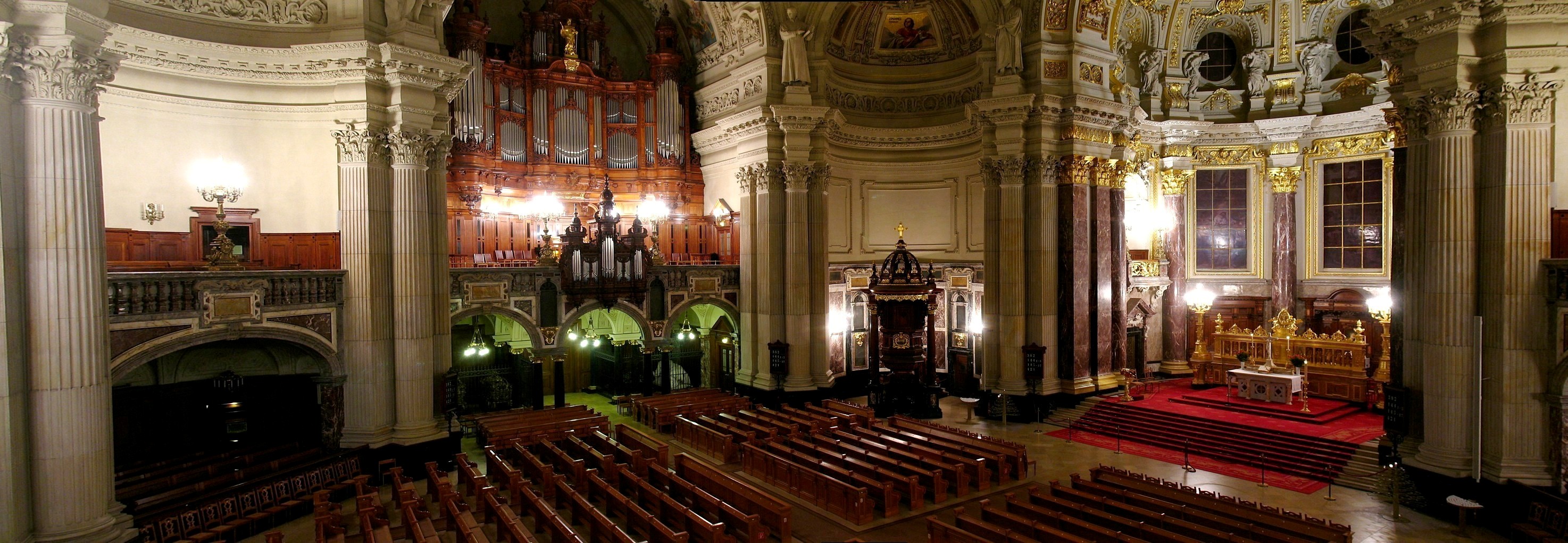
I didn't have a camera. Steve did, and later sent me a few prints. The pic below is the Berlin Cathedral (Berliner Dom) as it appeared in '83, with the East Berlin main TV tower in the background. The original dome took a hit in '44 and collapsed to the floor of the church. The dome had been rebuilt by the time we got there, and visitors could enter the building, but only peer inside, because the floor was still littered with rubble.


Since then, I see that the interior has been restored, as befitting a reunified Germany.

Labels: , , , ,

Monday, May 07, 2012

Remember the Akron

I forgot about the 75th anniversary of the Hindenburg disaster, which was yesterday, but today's close enough. So I poked around a little because it's easy to find film and audio and a lot of reading about the disaster on line, such as on this page about the history of WLS, where Herb Morrison worked when he made the famed recording describing the explosion and fire as he saw it. The lesson here? Besides not to load your airship with hydrogen, that is. If you want your disaster remembered, point cameras at it.

The point is driven home by the loss of the U.S. Navy airship Akron in 1933. More people died in that disaster than the Hindenburg. Though it was a helium ship, bad weather took it down off the coast of New Jersey (and what is it with New Jersey and airships?). Still, who's heard of that accident anymore? Of course, the Akron was major news at the time, but left no dramatic images. Even the song about it, I think, is lackluster, but things might have been different had Jimmie Rodgers or Woody Gutherie written a song about the Akron, though Rodgers was nearly dead himself by then.

Speaking of helium, years ago I read that the Germans couldn't make enough of it to raise a ship like Hindenburg, so they used hydrogen and tried with German thoroughness to control any possible sources of ignition. In hindsight, not thorough enough. According to this always interesting site devoted to National Historic Chemical Landmarks, the virtual U.S. monopoly on helium also had its advantages in wartime a few years later.

"Large-scale production of helium came too late to be of much value in World War I, but it did play a major role in World War II, when helium-filled U.S. Navy patrol blimps safely escorted thousands of ships carrying troops and supplies," the American Chemical Society says (and they ought to know). "The blimps used sensitive listening devices that when lowered into the water could detect submarines up to five miles away. At the time, the Allies had a virtual monopoly on helium, because the only known gas wells capable of producing helium in large quantities were in the United States and Canada."

Labels: , ,

Sunday, August 07, 2011

Item From the Past: Schwarzwald Saturday Morning

August 6, 1983, Freiburg.

After Frühstück Rich & I hit the trail and soon made our way into the Black Forest, which is dark indeed. Tall pines and firs lord over the paths, cutting off the light below, especially in the small hollows. We didn't see many other walkers out on the winding trails, something of a surprise on a Saturday morning. We did see a number of strange, shell-less snails with orange skin on the trail. If they hadn't been so orange, we might have stepped on some of them.


At one point, the trail wound up to the crest of a hill. It was a rare bit of open space. One of the slopes took the shape of half a bowl, and all of its large trees had been removed -- except for a stand of ancient pines at the base of the hill. Dotting the rest of the hillside were much younger, much smaller pines. It was a Greek theater with an audience of young pines watching their elders perform a very, very slow play. Beyond the pine-theater, the rest of the vista was terrific. We could see Freiburg nestled in its valley and the array of Schwarzwald hills behind the town, far in the distance.


We arrived back in town, hungry, in early afternoon. It was a Long Saturday, so the Stadtmitte was full of people. We each ate an enormous salad and bought food for tomorrow at "Schwarzwald City," a tiny, glittering shopping center. We ambled around after that, full of greens. Remarkable how much a salad can fill you up. Spent some time watching street musicians preform and rail against U.S. involvement in Nicaragua. They claimed -- in German and English -- that the money they were collecting in a hat was "in protest" of that involvement. Uh-huh.

Labels: ,

Sunday, December 12, 2010

Chicago Christkindlmarket, Kristkindlmarkt 2010

I made it downtown on Friday to the Christkindlmarket Chicago. So did a lot of other people.


If, for some odd reason, Google has referred you to this page for information about Christkindlmarket Chicago, go to this page on eHow instead. I wrote that too, and the more hits, the more I get paid for it.


Last year, I spelled it Kristkindlmarkt, which may or may not be more German, but it isn't how the event is styled in Chicago. In any case, that entry got hundreds of hits, even though I provided scant information about the festival itself, and more about a guy getting arrested during it.


Friday's crowding wasn't a fluke, though it probably helped that it was above freezing. It's a very popular event. People come to look at the ornaments, of which there are many, from Germany and a good many other places besides.


Beer and other refreshments were served, of course. At least one booth specialized in beer steins.


This web site claims there was a Golden Age of Beer Steins. I had no idea. Naturally, we've all missed it by a century.

Labels: , , ,

Wednesday, June 14, 2006

Olympiastadion

I don’t check very often to see who’s been reading my writings here, because I have a fairly good idea of who does. But the other day, I took a look, and noticed that in the last few weeks that someone from Chile spent about eight minutes looking at my pages, and someone from Indonesia visited as well, spending about four minutes. This makes me glad, even though I’m sure they came to my site via the “next blog” function on Blogger -- i.e., at random -- and that they’ll never come back.


Still, in case they do, I want to extend the hand of international friendship and hey-nonny-nonny to my readers in Chile and Indonesia, who may only think they know us here in the United States, since they’ve surely seen a lot of our movies. It might be more informative to read more of our blogs instead. But they’re probably busy following the World Cup these days, rather than random web logs.


Like with the Olympics, I’m more interested in the venues of the World Cup, and the circumstances surrounding the events, than the actual sport itself. I looked around at the FIFA web site recently, and discovered that the Olympiastadion in Berlin is not only being used for some of the matches, but that the finals will be played there on July 9. Also, the stadium was renovated recently with the World Cup in mind (from FIFA):


“Reconstruction had to be carried out with the greatest of care due to the listed status of the structure, originally designed by architect Werner March and built between 1934-36 for around 42 million Reichsmark.

“The new stadium incorporates VIP and Sky executive boxes, Business Seats, a Hertha BSC megastore, underground warm-up facility (including a 110m running track and long-jump pit) and an underground car park. The rebuilding project was primarily aimed at optimising functionality and spectator comfort. For example, practically all the 74,200 seats are covered, whereas previously only 27,000 seats were protected from the elements.”


Sure, the Germans can spend 242 million euros putting on a roof and adding VIP and Sky boxes, but it’ll always be the stadium of the Nazi Olympics, though of course the Olympic Committee had originally awarded the games to Weimar Germany, shaky as it was. Or, if you prefer, it was the Olympics in which Jesse Owens seemed to have been the only competitor, considering how often his participation is highlighted in ten-second spots mentioning those games. In any case, I hope the new boxes are nice, full of amenities far beyond the twisted dreams of the Führer.


In July 1983, drawn by the place’s historic associations, I took the U-bahn out to see the stadium and the Olympic pools nearby, famous from Leni Riefenstahl’s Festival of Beauty, which I’d seen in film class a few months earlier. Nothing was going on that day, so the place was almost empty but open anyway, so I wandered around. What I remember most were the large statues here and there on the grounds, a sort of stern German interpretation of the archaic Greek style, probably meant to evoke heroic Aryan youth. They had weathered the war and perhaps caused mild embarrassment to the Germans of the Federal Republic, but they weren’t overtly Nazi, so they stayed. The FIFA site doesn’t mention them, but I assume that since the stadium has “listed status” (it’s on a list!), they’re still around.

Labels: , , , ,

Wednesday, June 29, 2005

Matches & Cards

I come by my habit of collecting matchbooks and cards from restaurants honestly. My mother has, or had, a large collection of restaurant matches. That was simply part of the restaurant experience: get some matches at the end. She never smoked, so smoking had nothing to do with it.


These days you’re more likely to get a business card than a matchbook, but I still collect whatever’s available. Back in April, I was a little disappointed to discover that the Cuban restaurant we visited in Tampa (Carmen’s) had no matches or cards to give away.


This came to mind over the weekend when I assimilated the collection of cards and matches accumulated in my former office into my larger collection at home. At home, I have three former fruit-cake tins nearly full of matches, a business card-holder full of cards (104, I just counted), and probably that many loose cards.


They’re good memory aids, like snapshots. Better in some ways, because rather than looking at a fixed image, they evoke some other kind of memory: the taste of something you ate, a bit of odd décor, someone else at the table with you.


For instance, one beaten up box, emptied of its matches, says Restaurant Metro. 2400 Lübeck-Gr. Burgstrasse 59. Täglich kalte und warme. Speisen von 11 Uhr bis 23 Uhr. See Sunday’s small posting for my arrival in Lübeck—this is where I had lunch with my friend Rich later that day. All I remember is that the service was glacially slow.


Keeping in a German theme, another matchbook I have is from Gerst-House Restaurant. Famous German Style Foods. Draft Beer. Nashville, Tenn. Free Parking. Did that place ever have good pigs’ knuckles. The key was the sauce.


Picked more or less at random, there’s also a reminder of Arthur Bryant’s, a superb barbecue shack in Kansas City, Mo.; the dining room of the remote Kalaloch Lodge on the coast in Washington state; Mama Desta’s Red Sea, on Clark Street in Chicago, where I used to introduce out-of-town guests to the pleasures of Ethiopian food; Gautama, an Indian restaurant in Osaka; Arizona Charlie’s, a second-string casino in Vegas that had huge, terrific breakfasts for about $3 even after the trend for Strip casinos was to make their food service into profit centers, too.


Fine memory aids. Unless, of course, they evoke no memory.


Al’s Steak House. Entertainment Nightly. The Finest in Food & Cocktails. 1990 W. Jefferson St., Joliet, Ill. The matchbook’s a dull red with a fleur-de-lis as the only decoration. I don’t remember spending much time in Joliet, or at any steakhouses there. My best guess would be on one of few business trips I took while working at the Law Bulletin, 1987 to 1990. Probably with Ernie, my boss, who was fond of steakhouses.


There’s also Barney’s Market Club. For Great Steaks. Since 1919. 741 W. Randolph, Chicago, IL 372-6466. With a small drawing of a prosperous fat man, ca. 1940, complete with cigar and caption: Yes sir! Senator. Another steakhouse I don’t remember, and the matchbook shows its age—pre-1990 again, I’m sure—with its missing area code. Every place in metro Chicago was 312 until the late 1980s, and even then we got only two area codes.

Labels: , , ,

Sunday, June 26, 2005

Itemoid from the Past: Lübeck, BRD

28.6.83

Breakfast with Karen and Cindy, then boarded a bus for Lübeck. Nice ride up, lots of greenery, and as we approached, a view of the seven spires of Lübeck. Before we entered the city center (Zentrum) we stopped at a wide place in the road and disembarked. Three busloads of tourists, crowding around to take a look—from a distance, behind a large sign warning us to proceed no further -- at a mean-looking fence and a grim guard tower, looking just like one you’d see over a prison wall. We’d come to the border with the DDR. We were told that there are guard towers every 500 meters from the North Sea to Switzerland.

Labels: ,

Saturday, June 11, 2005

Item From the Past: Waldfriedhof

Notes from half a lifetime ago: 22 vs. 44. I’m glad I’ve had the habit of writing things down for many years now. It’s a pillar of history, personal or otherwise.


11 June 1983, Lüneburg, West Germany

Woke late (10), idled for a while, then walked to the far side of the river, to the Waldfriedhof, the Wooded Cemetery. Singularly the most beautiful cemetery I’ve ever visited.


It isn’t an old burial ground. Most of the stones I saw dated from the late 1960s to the present, including stones with names but no date of death, and patches of land for expansion. The Waldfriedhof is set in a pine forest with light underbrush, little of which seemed to be disturbed to create the cemetery -- the Lüneburgers merely built between the trees and among the bushes and grass. An upright stone marked each plot, and usually had a cluster of flowers growing at its base. A flower-garden-forest: bright yellow, red and blue to garnish the hard stones.

Labels: ,

Friday, June 10, 2005

Turning 40, Base 11

Earlier today, Lilly took to closing my home office door on Ann, and holding it shut for a while, telling Ann, “You’re going to jail!” Ann protested this treatment by hitting a fist on the carpeted floor and saying “Why, Why, Why?”


This is the first time I’ve ever heard her use that useful word. But I suspect she got it from a scene in SpongeBob SquarePants. One of the characters was thrown in jail, and may have reacted that way, but later grew to like it because she didn’t have to deal with SpongeBob any more. (I sympathize. Curiously, SpongeBob at one point actually said the jailed character had been “institutionalized.”)


We returned a SBSP disk the other day, and there aren’t any more new ones available from Netflix for now. But the hypercheerful yellow sponge is still with us, in the form of a drinking cup, a toothbrush, toothpaste and Band-Aids. Oh, for 1% of the merchandising revenue of that character. Probably even 0.1% would make my job search unnecessary.


I turned 44 this week. I don’t think I’ve meditated on my birthdays much, if ever, here. But that’s a nice repeating double-digit number. If we counted in base 11, I’d have turned 40.


I spent the day in scenic Schaumburg, Illinois, dining in the evening at a good Mexican restaurant we’d long wanted to try. Contrast with my 33rd birthday: spent it in Bangkok, in an un-air-conditioned guesthouse, eating at the little place downstairs (man, the food was good in Thailand). When I turned 22, I was in Lüneburg, West Germany -- been a while since one needed to put it that way. The best meal in that town was halb Henchen mit Pommes Frites at a greasy spoon my friends discovered.


As for 11, I’m fairly sure I was it home in San Antonio, though I did spend some time in the summer of 1972 in Ardmore, Oklahoma, with my Aunt Sue and Uncle Ken. The Democratic National Convention was on TV with I visited them, so that would have been the second week of July.


I had to Google “Democratic Convention 1972” to get the date, of course. I’d forgotten that both major party conventions were in Miami Beach that year, with the Republican one in August. Maybe it was chosen for ease of crowd control: a narrow island with a handful of streets.

Labels: , , ,