Monday, October 01, 2012

Item From the Past: Holy Family Shrine, Gretna, Neb.

Sept 16, 2012

In September 2004, I was on I-80 between Lincoln, Nebraska, and Omaha. I saw a billboard that said that the Holy Family Shrine wasn't far away. It was true. Once you get to the shrine, you realize that it's on a hill with a clear view of the highway in the near distance. According to the billboard and other references, Holy Family Shrine is in Grenta, Nebraska, but in fact it isn't in any town.

It's a charming structure, apparently in the style of Fay Jones, though designed by Jim Dennell of BCDM Architects. It's celebrating its 10th anniversary this year, so without realizing it, I'd come across the shrine when it was still fairly new.


Labels: , ,

Sunday, July 08, 2012

Items From the Past: DDR Relics

We've been having a South Texas summer lately. The last time the Fourth of July was so hot in metro Chicago, I've read, was 1911. The high for Independence Day was 101° F., and for some days afterwards it was almost as hot. But not today: only about 80°, which felt positively cool.

On July 9, 1983, my friend Steve and I crossed into East Germany at Checkpoint Charlie in Berlin, and spent most of the day there. For one thing, about four hours at the extraordinary Pergamon Museum, which remains one of my favorite museums anywhere. We had a large map of Berlin to guide us in those pre-Internet, pre-GPS days.

This is only part of the map, but it shows the Berlin Wall snaking through the heart of the city. It's the heavy red-dash line, with the shading on the east side of the wall, which must have represented the "guards will shoot you zone" that caught up with Alec Leamas, for instance.


Next is another set of relics of my time in East Germany: passport stamps. They don't make 'em like these any more, and the world is better for it. I have two DDR stamps, there on the same page of a passport long expired, one acquired on the train between Hamburg and Berlin, the other at Checkpoint Charlie.


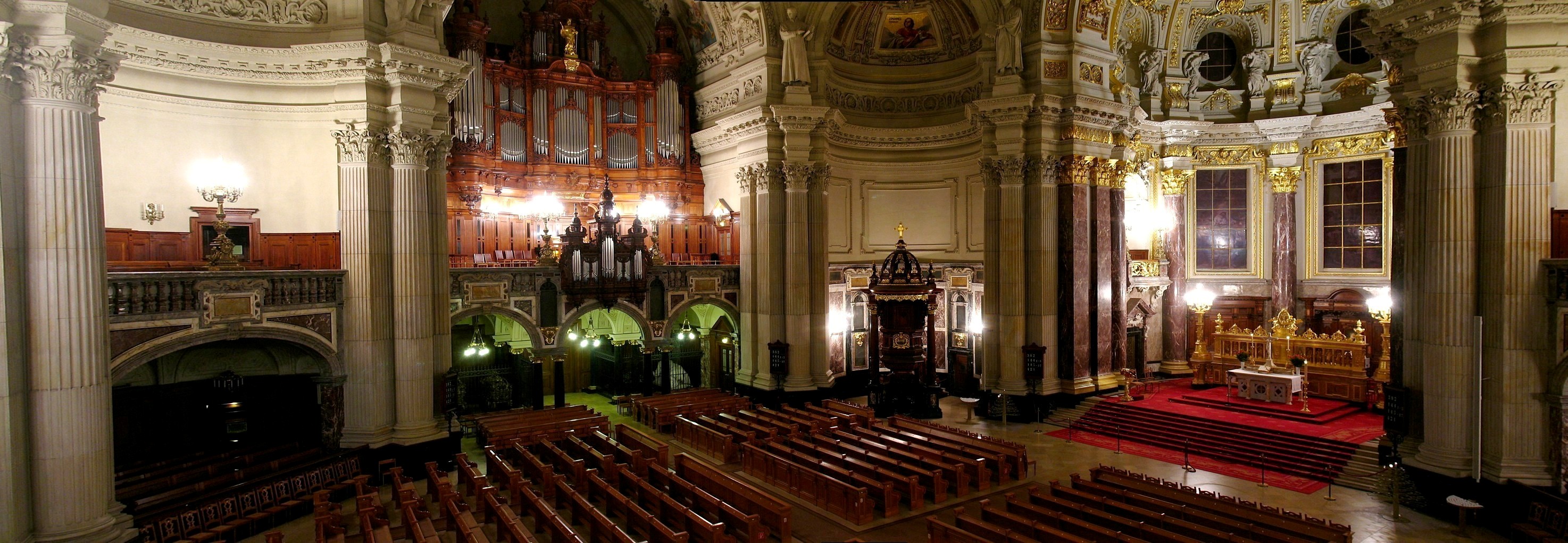
I didn't have a camera. Steve did, and later sent me a few prints. The pic below is the Berlin Cathedral (Berliner Dom) as it appeared in '83, with the East Berlin main TV tower in the background. The original dome took a hit in '44 and collapsed to the floor of the church. The dome had been rebuilt by the time we got there, and visitors could enter the building, but only peer inside, because the floor was still littered with rubble.


Since then, I see that the interior has been restored, as befitting a reunified Germany.

Labels: , , , ,

Wednesday, June 27, 2012

Blue Lotus

In Woodstock, Ill. earlier this month, not far from the town square, I noticed something I'd never noticed before, though I don't visit town that often.

Note the Buddha on the grounds of a building that has "First Congregational Church 1906" carved in stone next to the entrance, though it's a little hard to see the lettering in the picture. Turns out that the building is now the Blue Lotus Buddhist Temple — as of very recently, since the its dedication festivities as a temple were only last month, according to the temple web site. Except for the colorful (prayer?) flags, it still looks like a handsome early 20th-century brick church.


Just more evidence that North America is large, and contains multitudes.

Labels: ,

Sunday, December 18, 2011

Item From the Past: Urakami Cathedral

We happened to be in Nagasaki around Christmastime in 1993, and visited St. Mary's Cathedral, better known as Urakami Cathedral, after the district in the city in which it's located. We were there during the day and then in the evening on Christmas Eve, to attend church.


The place has a melancholy history. Begun in the late 19th century after the legalization of Christianity in Japan, the cathedral was finished in the early 20th century. On August 9, 1945, it was only about a third of a mile away from the atomic bomb blast, and so destroyed. The current structure dates from 1959, with a renovation in 1980 to make it more closely resemble its original French Romanesque style.


Not far away is the Nagasaki Peace Park, where you can encounter this 30-foot fellow, created by Sculptor Seibou Kitamura, a Nagasaki native.


I'm not versed on Buddhist iconography, but I'd guess that the sculptor took inspiration from it. In any case, the Nagasaki Tourism Guide says that "the raised right hand points to the heavens to signify the threat of atomic weapons while the left arm is raised horizontally to represent the wish for peace."

Labels: , ,

Sunday, November 20, 2011

Item From the Past: Ishiyama-dera

November 30, 1991

"Warm and sunny day, flawless weather to visit the exquisite Ishiyama-dera. I went with Ed and Lynn, two former fellow teachers, and Americans as it happens, to the temple, which is in Otsu, Shiga Prefecture. It's near the shores of unscenic Lake Biwa, the sludgepot that provides greater Osaka with its drinking water.


'No, that's not the best way to begin to describe Ishiyama-dera, which is set in the forested hills not far from the lake. You forget about Biwa while visiting the fine old wooden structures, which manage to convey their great age through their smell, somehow, maybe redolent of centuries of incense. This time of year, the temple also has the aesthetic advantage of seasonal reds and yellow. It augments the aura of esoteric objects honoring esoteric gods on remote shores."


Not much of a description, but I can fortify it with more information. "Ishiyama Dera was established in 749 by a Kegon priest named Ryôben at the request of Emperor Shômu (701-756; reigned 724-749) to enshrine an image of Nyoirin Kannon," says the Yamasa Institute's Japan Travel Guide. "At the time, the Emperor was praying for the discovery of gold to assist in his undertaking of the construction of the great Buddha of Tôdai-ji Temple in Nara.


"The Hondo, or Main Hall, designated a National Treasure, was built upon a great megalith, which contributes to the temple’s fame as one of the eight scenic views of Ômi, the Autumn Moon from Ishiyama-dera. The Hondo was built architecturally in a veranda construction style called 'Butai Zukuri'. The Tahoto Pagoda (treasure tower) was built by Minamoto Yoritomo in 1194 in the Kamakura period, and is the oldest of its type in Japan.


"Inside the Hondo is the Room of Genji, where Shikibu Murasaki created the plot of the
Genji Monogatari or the The Tale of Genji, a famous court story of the Heian period and believed by many to be the world's first novel. Murasaki is said to have begun writing The Tale of Genji, at Ishiyama on the night of the full moon in August 1004. The temple is mentioned in the Ukifune chapter of the story. A life-size figure of the author at work is displayed in this room."


I remember seeing the Lady Murasaki mannequin, looking pale and mannequin-like. Years ago I read the first few chapters of The Tale of Genji, a Charles E. Tuttle Co. publication (Tuttle Publishing these days) of a translation by British orientialist Arthur David Waley. My copy, a two-volume paperback boxed set, resides in one of the bookshelves near the desk, quietly reminding my that I'll never get around to reading everything I'd like to.

Labels: , , ,

Sunday, November 06, 2011

Item From the Past: St. John the Divine Detail

On November 5, 2000, I did a walkabout in Manhattan, including a visit to the Cathedral Church of St. John the Divine and some other points of interest. The cathedral is a magnificent house of worship, well worth the effort to get there from more commonly trod parts of Manhattan. (The cathedral also inspires crackpots. One web site I saw warns the world that "the cathedral tricks unsuspecting church goers into its occult house of worship," run by the masons. Ah, those masons.)


The three-ton bronze doors of the cathedral, which are works by Henry Wilson, and the Rose Window above the door, are justly famous. My photography of those famed features didn't turn out so well. But I did like this shot of some of the stonework around the doors, scanned in black and white. An assortment of saints, I assume.


If I've read my sources correctly, the work only dates from the 1990s, when British stonemasons came over to train Americans in the art for the purpose of continuing work on this famously unfinished cathedral. (Masonry being a lost art in the United States. Unless the masons secretly control everything.)

Labels: , , ,

Tuesday, September 06, 2011

Permanent Residents of Schaumburg

The holiday weekend included a visit to Septemberfest, the not-very-German festival that Schaumburg, Illinois, puts on each Labor Day weekend. It was lively and crowded. This year I noticed that the carny games were offering Angry Bird plush toys as prizes, along with Rastaman bananas, which I think I saw last year.


Not far away is a much quieter place, the graveyard of old St. Peter Lutheran Church near Schaumburg Road, which is much more German than Septemberfest is ever likely to be. I've posted about it before, but without pictures. This is old St. Peter.


And its cemetery, populated by diaspora Germans and others.


Many of the permanent residents of the cemetery were born in Germany, or had parents who were. I suspect that Friedrich Redeker here (1813-96) was one of the former.


A few of the names, such as Springinsguth, are now major street names in this part of metro Chicago.


According to the Schaumburg Township Historical Society, burials began at St. Peter in 1847, and its permanent residents now number over 1,000.

Labels: , ,

Sunday, August 28, 2011

The Church and the Basilica

Two weeks ago we attended 10:30 a.m. services at St. John's Episcopal Church, which happens to be on Lafayette Square in Washington. It's an elegant church inside and out, originally designed in the 1810s by Benjamin Latrobe, Surveyor of the Public Buildings of the United States and the architect who oversaw the restoration of the U.S. Capitol after it burned, among many other projects.


It's also a church steeped in presidential history, counting a number of sitting presidents since James Madison as members. It's been customary since the time of Madison for each president, whatever his denomination, to visit at least once during his term. According to the National Park Service's "A National Registry of Historic Places Travel Itinerary," that even includes William Henry Harrison. Maybe he was heard to be blowing his nose and coughing more than usual during a service in March 1841. There was a presidential visit as recently as this July.


Pew 54 is called the "President's Pew." When the service was over, I went to look for it. Not only is it so marked with a small brass plaque, the kneeling cushions at Pew 54 and a good many other pews in front of it -- there are no built-in kneelers -- have the presidential seal as part of their design, along with the name of an individual president. I suppose they're all represented, from Madison to Obama.


On our last full day in Washington, we rode the Metro to the Catholic University of America and crossed the campus to reach the Basilica of the National Shrine of the Immaculate Conception. It was either there or the National Cathedral, and the basilica won out because we could reach it without the extra bus ride that reaching the cathedral would have entailed. So the National Cathedral remains a sight to see, should I ever return to Washington.


The basilica is enormous. That isn't really the measure of a church, but it's striking all the same, even if you've read about it beforehand. At about 76,400 square feet, the basilica is the largest Catholic church in the United States. A cursory look at Wiki's "List of Largest Church Buildings in the World" puts it at 21st in the world and third in the United States, after the Cathedral of St. John the Divine in New York and the National Cathedral, both of which are Episcopalian. Other sources say it's the 10th largest church in the world. Another way to describe it is about half the size of the interior space of St. Peter's in Rome.


Done in a blend of Byzantine and Romanesque styles, and without structural steel, the Basilica of the National Shrine of the Immaculate Conception is also mind-bogglingly intricate, with dozens and dozens of chapels and side chapels and a few oratories on the main level and down in the crypt level too, many completed with funds from Catholic congregations around the world, such as Mary, Queen of Ireland; Our Lady of Guadalupe; Our Lady of Czestochowa; Our Lady of China; Our Lady of La Salettel; Our Lady of Siluva; Our Lady of La Vang; Our Lady of Bistrica; Our Lady of Lourdes; Our Mother of Africa, and more. Other chapels take their inspiration from the many and varied titles of Mary, such as Our Mother of Good Counsel, Mary Queen of Missions, Our Lady of Hope, Mother of Perpetual Help, Mary, Help of Christians, and more. All the various chapels are ornate, but so is pretty much every surface, nook and cranny of the basilica.


Vaulting overhead are large mosaics. Only one dome remains unfinished in this regard, and I understand plans are afoot to complete a design for it in some future decade. Among all the building's impressive mosaics, the most striking (fittingly) is the depiction of Jesus in north apse. According to the basilica, it measures 3,600 square feet and contains nearly 3 million tesserae. "Christ in Majesty has an apocalyptic nature," the basilica's web site says, "Jesus' strong youthful face and expression is consonant with the earliest images of Him in the Roman catacombs."


Even Roadside America has a take on this image, calling it "Mortal Combat [sic] Jesus." This is a good image of it -- better than on the basilica web site -- as well as a thoughtful blog posting. Jesus does have an unusually fearsome expression, at least to modern eyes, who are used to more placid views of the Savior. It reminded me of that bumper-sticker religious wisdom, "Jesus is coming, and boy is he pissed."


Labels: , , ,

Tuesday, June 21, 2011

Mary, Juan & Quisp

While passing through the cereal aisle at a discount grocery store today, I saw boxes of Quisp. How long has it been since I've seen Quisp? I couldn't say. Certainly not during any year than began with a 2. Why now? Why here? As an illustration, Quisp seemed exactly the same as 40+ years ago -- another Jay Ward cartoon legacy.


At more than $5 for a 9-oz. box, it wasn't priced to sell, despite being in a discount grocery. I might feel a twinge of nostalgia for the sugar-coated saucers, but not that much. Also, Quake was nowhere to be seen. I believe that character ultimately died in a mining accident.


This is a view of the outdoor part of the Shrine of Our Lady of Guadalupe in Des Plaines, late Saturday morning.


The figures on the mound are the Virgin Mary and St. Juan Diego, canonized only in 2002; 471 years from apparition to sainthood.


I'd never seen a cross quite like this.


I've found various sites describing it, such as this and this, but I'm still not quite certain of its significance in relation to the shrine, though at the base of the cross is a reference to the Venerable Concepción Cabrera de Armida, the Mexican mystic.


In a reliquary in a glass case cemented into the base of the cross is a bit of wood, and three metal signs mounted next to it say (in English, Spanish and Polish): "Original Relic of the Cross of the Apostolate. This cross will chase away the devil, spread warmth and life, cure souls and bodies, and make many miracles. The promise of Jesus to Concepción Cabrera de Armida."

Labels: ,

Monday, June 20, 2011

The Shrine of Our Lady of Guadalupe, Des Plaines

Woke early today to the rumble of thunder. A strange thunder, a little like the kind I heard vividly while in the Upper Peninsula once, like a bowling ball dropped on an aluminum sheet and then rolling. This morning's din wasn't quite as loud as the UP incident, but it got my attention. Until I went back to sleep.


On Saturday I had a few hours to myself and also happened to be near the Des Plaines River, so I decided to find the Des Plaines River Trail and do some walking, inspired by its description in an excellent guide I found in the library last week: Take a Hike Chicago, published by Moon, subtitled "Hikes Within Two Hours of the City." A first edition, published May 2011, and sporting a fine set of maps.


It's hard to consult maps while driving, however, and I missed the entrance to the parking lot near the trail, and eventually abandoned the idea (for now). Instead, I doubled back on Des Plaines River Road to take a look at the enormous All Saints Cemetery. I hadn't been to a new cemetery in a while, after all. But before I got there -- such are the twisty paths of travel serendipity -- I saw a sign for the Shrine of Our Lady of Guadalupe.


That I had to see. It was a lot closer than the other Shrine of Our Lady of Guadalupe, which is in La Crosse, Wisconsin, or the Basilica of Our Lady of Guadalupe near Mexico City, though of course that didn't occur to me until later. Turns out that the Des Plaines shrine isn't that old, dating only from the late 1980s. It was built on the grounds of Maryville Academy, a Catholic social service organization that focuses on children that began in the 1880s as St. Mary’s Training School for Boys, an orphanage on a 880-acre working farm.


"Although it's a focal point of the Catholic Church in the [Chicago] area for many Spanish speakers... the shrine is not greatly known to others," wrote Robert Herguth in 2010 in Chicago Catholic News. "The shrine includes a flower-adorned mound with statues of the Virgin Mary and the peasant Juan Diego, an enclosed image of the Virgin Mary and a cave where the faithful light prayer candles. There's a gift shop and a chapel, and services are held indoors as well as sometimes outside."


Indeed, on Saturday morning, there was a wedding in the chapel, so I didn't venture inside. Along with a steady trickle of other people, I spent some time taking in the outdoor part of the shrine, including the mound, the big cross, the relic at the base of the cross, and the cave. The cave exuded a powerful smell of wax. Hundreds of candles were alight -- it must be quite a glow by night -- and the cave's walls were covered with photos of children and others, sonograms, handwritten messages, devotional cards, prayer beads, items in plastic bags, and small toys, including a Minnie Mouse plush toy.

Labels: ,

Monday, April 25, 2011

The Basilica of St. Josaphat

Here's a headline I saw over the weekend: "Chicago's Gas Prices Highest in Country." Hell's bells. "The U.S. average for a gallon of regular now stands at $3.88, but in Chicago, it'll cost you an average of $4.27," reports NBC Chicago. I assume the story means in the city itself, since out here in the suburbs it's about a dime less than that.


Just north of the Illinois-Wisconsin line at the junction of I-94 and Wisconsin 50, which sports a large knot of retail properties, gas could be had for $3.99.9/gallon last Friday. Four dollars, in other words. I know this because I bought some on our way to Milwaukee to take advantage of the last gasp of the frequent-flyer award my family's round-trip across the Pacific earned nearly two years ago. No charge to stay in the room, but some expense to get there.


Good Friday was cold and drizzly. We knew that ahead of time, so planned to spend most of our time indoors, including one place whose exterior has intrigued me for years, the Basilica of St. Josaphat. Every time I drive into Milwaukee on I-94, I see its dome from the highway, since it's pretty hard to miss, but I'd never taken a close look at it. Get off the highway, make your way into the heart of south-side Milwaukee, park on a nearby side street, and the dome is even harder to miss.


The structure is more than 100 years old, built for a massive Polish congregation and modeled after St. Peter's. "Father Wilhelm Grutza hired a German-born architect named Erhard Brielmaier to design what is, in essence, a smaller version of St. Peter's." says the Visitor Guide and Tour we picked up at the church. "The church has the same cross-shaped floor plan and same huge central dome that distinguish St. Peter's." Brielmaier and his family were the go-to architects if you wanted a Catholic church built in the Midwest in the late 19th- and early-20th century, it seems. One source credits them with designing over 800 churches.


St. Josaphat's is as resplendent as you'd expect, with large stained-glass windows, paintings, bronze bas-reliefs, gold leaf, a marble pulpit and a marble altar, some onyx columns, and a lot of activity up inside the dome -- various orders of angels, plus prophets, apostles and doctors of the Church. There's an inscription in Polish around the base of the dome: 1 Kings 9:3, according to the guide ("I have hallowed this house, which thou hast built, to put my name there for ever; and mine eyes and mine heart shall be there perpetually.")


Even better, there's a backstory to all that splendor. H. Russell Zimmermann, writing in Milwaukee Magazine, tells it: "Upon learning of the impending demolition of the Chicago Post Office and Customs House, [Grutza] negotiated a deal to buy materials. For $20,000 he got 200,000 tons, including stone, doors, hardware, railings and light fixtures. It took 500 railroad cars to ship... Brielmaier created a masterpiece, but close inspection will reveal a few reminders. Some ornamental brass hardware bears the U.S. Treasury seal, and carved capitals atop the portico’s columns contain American Eagles... Today, with its newly cleaned exterior, St. Josaphat’s looks better than it ever has."


So Brielmaier practiced green building, at least in re-using building materials, before that was even a glimmer of a concept. I didn't have the leisure to look around for those Treasury seals, which I didn't learn about till later anyway, because the Stations of the Cross was in progress when we arrived. We stayed for the end of that, and then looked around a bit afterward. I also missed the painting "Miracle at the Vistula," which depicts the defeat of the Bolsheviks by the Poles in August 1920. Not something you're likely to see in many churches.


Images of the basilica's interior are here. St. Josaphat, incidentally, was
this fellow ("Finally on 12 November, 1623, an axe-stroke and a bullet brought Josaphat his martyr's crown."). I'd never heard of him before, but apparently there's a church dedicated to him in Chicago as well.

Labels: , , ,

Sunday, April 17, 2011

Items From the Past: Wong Tai Sin Temple and the Shing Mun Redoubt

On the afternoon of [April 10, 1994], we went to Wong Tai Sin Temple in Kowloon, a colorful, lively place. A weekend crowd was there and the air was smoky thick with burning joss. It is the first Taoist temple I've ever been to, though if I hadn't read about it beforehand, I'm not expert enough in Chinese religion to have known that.


The Main Altar of Wong Tai Sin Temple. According to Travel China Guide, "Many people who visit the temple come to have their fortunes told. Generally, worshippers entreat the fate of the same year. They light worship sticks, kneel before the main altar, make a wish, and shake a bamboo cylinder containing fortune sticks until one falls out."

Friday [April 15, 1994], found us on a short trip out to the New Territories. We spent part of the day walking a series of trails connected to the MacLehose Trail, "family walks" in the parlance of the Hong Kong park service. To get there, you take the subway to the end of the line at Tseun Wan, a major nexus of danchi and construction sites. From there, take a microbus to Shing Mun Country Park, a fine green spot around a reservoir dug in the '30s to supply the city. Hong Kong usually isn't associated with this kind of greenery. Almost no one else was there -- I don't associate a lack of crowds with the place either, but the park defied expectations. Maybe it's a different story on weekends.

We were under a double layer of shade: tall trees, and above that, a high thin layer of clouds. So the walking was cool. Later we did go on a section of the MacLehose Trail proper, Section 6, and hiked up a hill to the Shing Mun Redoubt, or what was left of it from the battle in '41. Still in evidence were long tunnels made of concrete, dug through the top of the hill. At their entrances are fanciful names -- London streets. Later generations have added graffiti to the ruins, and nature is slowly eating away at the concrete.


A fragment of the Shing Mun Redoubt along the MacLehose Trail, which snakes through the New Territories for about 60 miles. I'm not sure why I didn't take any photos of the overgrown concrete bunkers nearby.


Labels: , , , ,

Sunday, April 10, 2011

Item From the Past: The Sakura of Suminoe

Twenty springs ago, I visited the Osaka Gogoku Shrine in Suminoe Ward. I'd been told that the shrine's cherry blossoms (sakura) were well worth seeing. For one thing, they're cherry blossoms. A grove of cherry trees in bloom is arrestingly beautiful, something I already knew, having first visited Kyoto during cherry blossom season in 1990.


Just as importantly, no crowds. Everywhere else I saw sakura I had to deal with crowds, especially at the grounds of the Japan Mint, which happens to be in Osaka and happens to be planted with cherry trees.


No one else was at Osaka Gogoku Shrine that morning.


Note the headstones, featuring a shell, a warplane propeller and a cavalry horse, among other martial emblems. The web site of the city of Osaka says of the shrine: "Established in May 1940 and dedicated to Emperor Nintoku and all soldiers from Osaka who died in battle from the Meiji era onward. The surviving families of the fallen soldiers had wished for such a monument since 1900... Some volunteers formed a cherry tree donation committee, finally donating approximately one thousand cherry and paulownia trees, covering... the holy site and giving it a peaceful, serene atmosphere."


Because of their brevity, sakura have long been associated with mortality, and before 1945, the Japanese government promoted an association with the war dead in particular. But it's a fitting association, considering that most of the war dead would have had very short lives indeed.

Labels: , ,

Monday, November 08, 2010

Behold the Man Somewhere Else

Recently I drove on US 20 from the northwestern suburbs of Chicago to Rockford, Ill. I recommend it over I-90 for that particular trip, and not only because much of the road is the U.S. Grant Memorial Highway. On a clear day in early November, the rural route has its charms, including the remaining leaf colors, newly bare branches, farm fields now at rest for the season, tumbledown barns, signs large and small, towns only small, and unexpected sights.


At an intersection not far east of the town of Marengo, a large billboard announces that the Ecce Homo Shrine isn't far away, promising an unexpected sight to see. The billboard said something about baroque design, though I didn't make note of the exact phrasing. But the tone of the thing was, C'mon now, visit our shrine! Not far away!


How could I resist? A baroque shrine out in exurban Illinois: for all I knew, that could be the 1,001st thing you have to see before you die. Or maybe an unexpectedly quiet place for reflection and prayer. Either of those kinds of places would be worth stopping for.


So I turn off US 20 and then take another turn, and before long I see the shrine on the left side of the road, I drive up to the gate -- which is closed by a rope hanging between two posts. A sign on one post, like the sort you might buy in a hardware store, says KEEP OUT. On the other post another sign says PRIVATE PROPERTY.


I sat there for a few seconds, taking that in. I confirmed that this was, indeed, the shrine I'd been looking for. A sign not far away from the gate told me that. Then I noticed that two security cameras were pointing right at me, one on each of the posts also sporting the unwelcoming signs.


Fine. Maybe the Chicago-based Fraternite Notre Dame, which owns the shrine, has had trouble with vandals. Still, I hadn't felt that unwelcome at a religious site since I was brusquely ordered to leave the grounds of the Masjid Sultan in Singapore, though I'd visited no prohibited areas. Why the billboard, if all you see at the shrine are signs telling you to get lost? It was hard to think of the place as a House of God. More like a Gated Community of God, I think.

Labels: , ,

Sunday, October 24, 2010

Item From the Past: Temppeliaukio Kirkko & Bart Simpson

October 1994

I didn't take particularly good pictures of the Temppeliaukio Kirkko (Rock Church) in Helsinki. Better pictures are at this all-around fine site. But I'm posting mine anyway, because I have an image probably no one else has (not this one, the one at the bottom). Look carefully in the top pic and you'll see the cross.


Located in a part of Helsinki known as Töölö (and who doesn't love Finnish place-names?), the church is a late '60s creation by Finnish architects and brothers Timo and Tuomo Suomalainen. I made lousy notes about my visit, along the lines of "visited Rock Church today."


But that's what the Internet is for, looking up stuff after the fact. The Sacred Destinations writer, Holly Hayes, has this to say: "The underground Rock Church is built inside of a massive block of natural granite in the middle of an ordinary residential square. From ground level, the shape resembles the ancient tomb at Newgrange, Ireland. But the structure is barely visible from outside, with only the copper dome poking out of the rock... inside, the church is circular and enclosed by walls of bare rock. The ceiling is a giant disc made of copper wire. The interior is lit by natural light streaming through 180 vertical window panes that connect the dome and the wall."


I stood in front of the church's entrance, turned around, and took a picture of the buildings in front of me. Only because the Minimarket window, a rectangle of pink set in gray -- and which promised Cool Drinks and Fast Food, in English -- was using Bart Simpson as its pitchman. Add the Coke sign, graffiti and black dog, and you've got a late 20th-century urban tableau. Or maybe just an array of things that happened to be there.


It's good to visit churches. It's also good to take in the detail of the streets.

Labels: , , ,

Thursday, September 09, 2010

Our Lady of Mount Carmel Monastery, Munster

Roadside America, that "caramel-coated-nutbag-full of odd and hilarious travel destinations" (its own words) calls this building material -- the stuff behind the girls in this picture -- "sponge rock," specifically sponge rock from "a mine in Arkansas."


The scant information I can find on line about "sponge rock" associates the term with perlite, a silicous rock that when heated expands to many times its original volume. The material we saw didn't resemble the perlite I see on line. But whatever it is, there's a lot of it at Our Lady of Mount Carmel monastery, in Munster, Indiana, which we visited on Sunday a short while after Valparaiso University (the interlude being lunch).


The monastery's Discalced Carmelite friars built the Grotto of the Holy Mother and the Holy Sepulchre Chapel out of these rocks, and it's an odd effect at first. Cave-like inside, but also as if the cave were ordered from the Sears Catalog back when you could get structures delivered to you in pieces for DIY construction.


The friars themselves say at their web site: "After the Second World War, a group of Polish Discalced Carmelites, including former chaplains of the Polish Army, came to the United States. They fulfilled St. Raphael Kalinowski's dream of a Polish Carmel in America when they established a monastery in Hammond, Indiana. Two years later they moved to Munster, Indiana... They built a monastery and Shrine dedicated to Mary under the title of Our Lady of Mount Carmel, and in the monastery garden constructed a grotto in her under the title of Our Lady of Lourdes."


Roadside America, with its less serious attitude, takes it from there: "Small shrines and prayer spots populate the grounds. There's a memorial to the Polish Underground; a shrine (surrounded by barbed wire) to skinny Maximilian Kolbe, the martyr priest of Auschwitz; and another to St Therese of Lisieux, the 'Little Flower of Jesus,' who is sculpted as she tells her tearful dad that she's off to join the Carmelites.


"It's dark inside the Holy Mother Grotto, and warm -- hundreds of candles are burning. Decoration is sparse [no it isn't], with occasional marble sculptures, stained glass windows, and accents of fluorite, dogtooth calcite, dolomite and rose quartz to enliven the gloom. Overall, this place seems more like a twisty sponge rock catacombs than a religious shrine... We expected the same when we walked down a path to the Holy Sepulchre Chapel, but it has some surprises. Inside is the Flagellation Chapel, with a marble Jesus tied to an alabaster pillar.... In an adjoining alcove lies dead Jesus on his bier. Beneath his carved pillow and blankets is an impressive altar crafted from giant minerals -- a huge backlit ball of crystals evokes the image of a glowing sacred heart."


I didn't know the story of Maximilian Kolbe. The plaque next to his memorial on the grounds of the monastery says, Blessed Maximillian Kolbe O.F.M. Conv. • Priest • Publisher • Prisoner • Martyr of Brotherly Love • Gave His Life For a Fellow Prisoner in the Auschwitz Concentration Camp on August 14, 1941.


More detail came be found at the Jewish Virtual Library, including the fact that he has been canonized since the plaque was created (one of John Paul II's many new saints; the second one of his pontificate, as it happens). It was hard to get a good picture of the memorial, but if you look carefully you might see that his statue is partly surrounded by barbed wire threaded through wooden posts that evoke the camp.

Labels: , ,

Wednesday, September 08, 2010

Chapel of the Resurrection, Valparaiso University

On Sunday, we visited Valparaiso and Munster, which didn't involve logistically difficult, or even impossible, transits between metro Chicago, Chile and Germany in a single day. Those are also towns in Indiana. Even better for our purpose, they're towns in northwestern Indiana -- so close they're part of the Chicago CMSA, according to the U.S. Census Bureau. Valparaiso is in Porter County, Ind., while Munster is in Lake County, Ind.


Which isn't too say that these places seem close, because driving through gooey traffic on forever under-construction highways is usually necessary to get to that end of the metro area, opposite from ours. Sunday meant that traffic was fairly light, however, and so it took us about an hour and a half to arrive at the Chapel of the Resurrection of Valparaiso University.


That's only the chancel; the rest of the chapel, which is a lot of building, trails off to the left in my pic. This blog has a lot better, and a lot more, images of this handsome modernist chapel, inside and outside.


Ann was especially taken with the place, exploring it at some length, and insisting that I take her picture in front of the chancel's stained glass. It was hard to go wrong with a setup like that.


"The chapel was dedicated in 1959, three years after groundbreaking ceremonies..." says the university's web site. "Architects for the building were Charles Stade and Associates of Park Ridge, Ill., although other designers were involved in special elements such as the stained glass windows and the baptistery.


"Inspiration for the design of the building was provided in part by the Church of the Nativity in Bethlehem... The chancel of the Chapel of the Resurrection is 98 feet high and is circular in shape with a roof shaped like a nine-point star. The nave is 58 feet high and 193 feet long. There is seating for more than 2,000 people, although capacity varies depending upon the configuration of the movable pews."


I'm always glad to see an example of a modernist structure, and there are some, built with some regard historical context and the people who will be using it. Almost everything about the Chapel of the Resurrection says "Eisenhower era" and yet the design idiom is fully that of a Western church. It's vaulting and full of natural light, and neither lavishly ornate nor austere. The architect made it all work.


There's all kinds of interesting detail around the building. Including the cornerstone -- or rather, the temporal cornerstone, Jesus being the "chief cornerstone."


Not only do you read the year of dedication anno Domini, you're provided the Reformation Year too. Valparaiso U. is a Lutheran school, after all.

Labels: , ,

Sunday, August 29, 2010

Cathedral Park & the Bishop Jones Center

It's been a run of clear, very warm days during declining summer this year, but cool nights. Meaning that Lilly and Ann weren't dressed for it on Saturday evening when we went to Spring Valley Nature Center to look through an amateur astronomer's fine telescope. So there was a fair amount of complaining about being cold while we walked to the viewing area. But it was worth it in the end, at least for me, since we saw the Ring Nebula (M57), which I'd never seen before outside of photos.


The colorful ring in photos isn't what you see through a small telescope. Instead, the lens reveals a wispy smoke ring among the solid background stars.


During the afternoon of the last day of 1977, some four or five friends and I gathered at a house on Patterson Ave. in Alamo Heights, where one of our group lived, to begin celebrating the new year. It might have been the end of December, but the day was pleasant, and so we took a short walk down Patterson to where it meets Torcido Ave. Ellen, the girl who lived on Patterson, told us this was the way to Cathedral Park.


The property is fenced in, so the gate must have been open that day. We repaired to a large patch of land at the foot of a large hill, in view of some buildings up on the hill that were partly obscured by trees. We sat under a copse of trees at the base of the hill, next to a small, rocky stream, and talked about whatever we talked about. I remember that it was warm enough to dip our bare feet in the water (a cold front in the early hours of 1978 brought more seasonably cold weather).


When it's flowing, that stream must be one created by the Edwards Aquifer that feeds Olmos Creek, which, together with the Blue Hole on the campus of the University of the Incarnate Word, form the headwaters of the San Antonio River. I didn't know any of that 32-plus years ago. Or exactly what was up on the hill, though I did look up and wonder about it out loud. Ellen said the park belonged to the Episcopal Church, but I don't remember any mention of the Bishop Jones Center. Turns out, that's what was atop the hill.


On August 18, 2010, I spent time looking around the Bishop Jones Center and its 19-acre grounds, unexpectedly answering the question about the place that I asked years ago, but had long forgotten asking.


The web site of the Episcopal Diocese of West Texas has a paragraph's worth of information about the Bishop Jones Center: "In 1962, the bishop of the diocese and his staff moved... to the spacious new Cathedral Park in Alamo Heights. Already on the property, when it was given by the Kamko Foundation, was the lovely and quaint 'pink house.' Cathedral Park rapidly became a location of worship, rest and refreshment for the people of the diocese and community neighbors. Today, the Bishop Jones Center -- which comprises Cathedral House, Chapel House, and Cathedral Park -- is home to the diocesan bishop and his staff and continues to be a gathering place for the diocese."


During my recent visit, I drove my mother to the center late in the morning and while she did what she had to do as a volunteer for the Episcopal Church, I took a look at the chapel and meeting center, done in a charming Spanish Colonial Revival style inside and out, and set in a lush landscape all around the hill that sports enormous old trees, plantings at short intervals and thick grass. Stone-surfaced trails wind through the grounds and also lead to a columbarium built into the hillside. The columbarium must be fairly new, since I counted only about 20 permanent residents, with space for many more.


Though I took a few pictures, the photo collection of this fellow, who obviously works (or worked) at the Bishop Jones Center, provides a much more complete look at this gorgeous property.


Some stairs lead down the hill in one direction, to Patterson Ave. In another direction, the hill slopes down without the benefit of stairs, or many trees or much grass either. I went down the hill at that point, reaching a small group of trees surrounding a dry, rocky stream bed. I couldn't remember whether this was the spot we visited all those years ago, but I figured it could have been. Then I turned around and looked up the hill -- and that jogged my memory. Whoosh. For an instant three decades and then some vanished. This was the same place, absolutely.

Labels: , , , ,

Sunday, February 14, 2010

Item From the Past: St. Louis 1990

Twenty years ago, I broke my life in half; into before I moved to Japan and after I did so. In February 1990, I was still on the ragged edge of the break. February 2 was my last day at work in Chicago, and shortly afterward I headed for Dallas with a load of possessions, to store them at my brother and sister-in-law's house.


On the 13th, I headed back toward Chicago to pick up the rest of my possessions, making it as far as a cheap, independent motel in Rolla, Missouri. I must have paid no attention to TV weather forecasts that night, since the next day I didn't try to beat the winter storm that was headed for central Illinois.


Instead, I decided to spend a few hours in St. Louis. I'd never been to the Gateway Arch, so I wanted to do that. The view from the base of the thing, curving up as it does impossibly into the sky, struck me as more impressive than the view through small windows at the top, or at least it did on that gray winter day. But I was amused by oddity of the enclosed tram pods that take you upward inside the Arch and to the top. Mork came to Earth in a pod something like that.


Afterward I visited the Basilica of St. Louis, King of France (the Old Cathedral), which is practically underneath the Arch -- or rather, the Arch was built a stone's throw away from the church. It's a fine Greek Revival church building, dating from the 1830s, and well worth seeing inside and outside. As I was leaving, one of the staff (I think) said, "If you liked this, you should see the New Cathedral." New in that it had been completed in 1914. He gave me directions.


The New Cathedral is actually the Cathedral Basilica of St. Louis (just the Cathedral of St. Louis in 1990). I didn't know anything about it, but I took the tip and I'm glad I did. It's one of the most astonishingly beautiful churches I've ever seen. I'm a sucker for mosaics.


A few years later I wrote a squib about the New Cathedral for a newsletter, which I'm quoting here in its entirety: "It isn't necessary to cross oceans to savor the majesty of large-scale mosaic art, vaultingly expressed in a cathedral. You only need to visit the Cathedral of Saint Louis, about 10 minutes west of that city's well-known Arch. Composed of millions of tesserae -- tiles of stone or glass -- the mosaics of the cathedral dome and walls offer visitors a pageantry of Christian saints, symbols and stories rendered in hundreds of subtle hues. The architecture is deeply reminiscent of the great Byzantine cathedrals of Italy and points East."


After seeing the New Cathedral, I drove northward toward to Chicago and hit an ice storm. But I'm not sorry I tarried in St. Louis that day.

Labels: , ,

Monday, September 21, 2009

Old St. Patrick's, Chicago

Cool today after yesterday's rains, but last Friday just before noon it was very warm, as it has been all month. I found myself on Des Plaines Street, on the near West Side, an easy walk west from Union Station. I had a lunch to go to, but I also had the advantage of a few spare minutes.


So I visited Old St. Patrick's Church. It's been a few years since I've been able to admire its interesting Celtic Revival interior, especially the stained glass, so I ducked inside and for a few minutes was the only one there. The church dates from the 1850s, survived the Fire somehow, and was redecorated in this unusual style in the 1910s.


"Inspired by the Celtic art exhibit at the Columbian Exposition of 1893 and the Book of Kells in Ireland, Thomas A. O’Shaughnessy designed, constructed, and personally installed the 15 beautiful stained-glass windows of Old St. Patrick’s between 1912 and 1922," says the church's web site. "The 12 side windows were inspired by the Celtic designs of Ireland's Book of Kells. The final triptych windows, done in an art nouveau style and installed in the eastern facade of the church, are the 'Faith, Hope & Charity' windows, also known as the Terrence MacSwiney Memorial Triptych."


The lighting inside was no good for photography, but I did stand across the street and capture another unusual feature of this church, the towers, in a slightly crooked image. One is supposed to represent the western church, the other the eastern church. The "western" tower is actually to the south of the "eastern" tower, geographically speaking, but never mind. They make an interesting pair.

Labels: , ,