Sunday, May 20, 2012

Item From the Past: Austin '88


On May 20, 1988, I flew to Austin for a long weekend. My old friend Tom was graduating from UT. Later, instead of detailing the weekend in diary form, I did a schematic.


I'm not going to transcribe the entire thing, but it shows my arrival on a United flight into Austin -- I'm surprised I didn't fly Southwest -- and then my movements afterward: to Tom's apartment, Kirby Lane for dinner, back to Tom's, and then that night's sleep, which was disturbed by cats. The next morning, we bought groceries, helped Tom clean up, and then went with a number of people to Carmelo's for the "Graduation Banquet," as I called it.

After that, we hung out awhile, eventually attending Tom's graduation. Bill Moyers was the commencement speaker. For dinner that night, we went to a place called Trudy's, a Mexican restaurant ("Saturday Night's All Right for Eating," I called the meal). That night's sleep was "smooth" -- the cats were quiet, I guess. The next day we had breakfast at a place called the Omletry [sic] and spent some time at Pease Park in Austin. I went to the airport after that.

The Joneses together for the occasion (from left): Richard, Lisa, Tom, Zan.


Tom, Nancy and I, during an interlude.


Labels: , , ,

Thursday, May 03, 2012

Springtime Misc.

Recently I interviewed a fellow at Pure Industrial Real Estate Trust, a company whose portfolio is made up of industrial buildings in Canada (I'm using the commercial real estate definition of "industrial," mainly warehouses and distribution centers). The company's acronym is PIRET. I didn't think anything of it until he told me that its symbol on the Toronto Stock Exchange is AAR.UN.  You know, ARR like a PIRET says, he told me. I got a kick out of that.

I pull up Google News every day and see more stories about the election, mostly horse-race coverage. Do I want to read this? No. The election is six months from now. I know who's running. I might take a passing interest when the Republicans fill their VP position, but other than that, this mess can wait till October.

Lilly and I saw some cool cloud-to-cloud lightning this evening, off to the east, where it must have been raining. She hadn't been aware that lightning could do such a thing. I told her that it could; a meteorological teaching moment. Ball lightning didn't come up, though.

Ann did her state report recently: writing, making a cube with pictures and drawings on it, and doing an oral report with props. She picked Texas as her subject. I was able to supply her with a number of props: postcards of various Texas spots, a plastic bluebonnet, a bag of Fritos, a 21 X 34-inch Texas flag that I hang in my office. She said a classmate held it up while she did her report.

But there was more. She wanted some Texas songs. She'd read that "Texas Our Texas" was the state song, so she wanted that on tape to play the class. I didn't tell her how seldom I'd heard it growing up, or the fact that a lot of people — a lot of Texans — think "The Eyes of Texas" is the state song. She wanted two others, and asked me for suggestions, which is a recipe for me suggesting something unusual.

Which I did. I suggested "Galveston," which I hadn't heard in some years. Not really about Texas, though part of the theme, and she took to it, maybe because she'd read about the city in one of her books. It's an example of song that's melodically peppy yet lyrically poignant. Not nearly as many people know the follow-up song, "Dear John, From Galveston," in which the narrator is so upset after receiving the title letter that he takes out an entire nest of Germans or Red Chinese or Viet Cong single-handedly in a berserk fit. Not to worry, he only lost a couple of fingers and some hearing in one ear, and lived out his days quietly as a family man in Houston — he married another girl — working as an appliance, and later car, salesman.

The other song I suggested was "Across the Alley From the Alamo," which doesn't have all that much Texas in it either, except for the essential ingredient of the Alamo, added for euphonious purposes. We played all three songs on YouTube, taping them on one of the tape-using microcassette-recorders I quit using a few years ago in favor of a digital recorder, and she played them for her class. Lo-fi, but passable. If that doesn't count as fair use for educational purposes, I don't know what would. It isn't likely that any of the other kids had ever heard those songs, and maybe the teacher was unfamiliar with them too.

Labels: , , , , ,

Tuesday, March 06, 2012

Remember the Alamo


"The gallantry of the few Texans who defended the Alamo was really wondered at by the Mexican army. Even the generals were astonished at their vigorous resistance, and how dearly victory was bought..."

-- Francisco Antonio Ruiz, alcade of San Antonio in 1836 and supporter of the Texans; ordered by Santa Anna to see to the disposal of the bodies of the defenders of the Alamo.

Labels: , ,

Thursday, February 09, 2012

Late '60s Postcard Relics

Ahead of our family's move to San Antonio in the summer of 1968, my grandmother took me to her home in Alamo Heights, mostly (I realize now) so I wouldn't be in the way of moving preparations. During that visit, I went with Grandma to the world's fair -- HemisFair '68, it was called. She got this card for me, and we sent it to my mother and brothers back in North Texas. "We had a good time at the Fair," my grandmother wrote. I signed it with my name.


I don't specifically remember going to the fair with Grandma, but I suspect that any memories of that visit have bundled with a later visit with my mother and brothers, after they'd moved to town. I don't remember the September 15 monorail accident at all, but I must have heard about it.


The card isn't dated, but it is postmarked July 12, 1968. The cancellation mark on the stamp mentions HemisFair. The front depicts the Institute of Texan Cultures, a worthwhile museum that's still in operation.


In summer of 1969, so famed for Apollo 11 and Woodstock's crowd control issues and the murderous doings of the Manson family, we headed out on the comparatively new Interstate system for a drive around the South: Texas to Oklahoma to Arkansas to Tennessee to (briefly) Georgia to Alabama to Mississippi to Louisiana and back to Texas. Chattanooga was as far east as we got, and we stayed here.


On that trip, we'd previously stayed only in one- or two-story properties, so a five-story motor lodge was positively enormous. When you're eight. Again, my memories of the place are sparse, though there was the thrill of staying on the fourth floor, and I'm pretty sure a vending machine at the Chattanooga Howard Johnson's cheated me.


Cursory investigation reveals that there's only one Howard Johnson's in metro Chattanooga these days, in Cleveland, Tenn., which isn't the property on the card. If the structure is still there, it's flagged by another brand, and probably renovated beyond recognition. HoJo is a Wyndham Hotel Group brand now, incidentally, and I can't remember the last time I saw one. I never did associate Howard Johnson's with ice cream or food; for whatever reason, we didn't eat at them much when on the road. Mainly, they were the motels with orange roofs where we occasionally stayed.


According to Wiki at least, the brand is a b-school example of how not to deal with an adverse economy, especially if you're in the customer service business. The spikes in the price of gasoline beginning in 1973 cut into U.S. car travel, and so the company "attempted to streamline company operations and cut costs, such as serving cheaper food and having fewer employees. It proved disastrous as guests were finding this new era of Howard Johnson's restaurants and motor lodges unsatisfactory, compared to the services they had come to know for years." Oops.

Labels: , , , , , ,

Sunday, January 15, 2012

Item From the Past: The Salt Lick

Driftwood, Texas, in the Hill Country west of Austin, has a number of charms, but the one I remember best is The Salt Lick. It does one thing and does it well: barbecue. In January 1993, Yuriko and I stopped by on the recommendation of an Austinite friend, and feasted on beef, sausage and pork ribs -- you can get all that on one plate, and we did.


The Salt Lick Pavilion, a venue for large events, is located near the restaurant itself. "An 8,000 Sq. Ft. Open Air Pavilion on the Banks of Onion Creek, a Scenic Setting Available for Private Parties, Weddings, Receptions, Company Picnics & Seminars," as the sign puts it.


I'm glad to know that Salt Lick is still around, and in fact has another location in Round Rock, Texas, northeast of Austin, and an outpost at Austin-Bergstrom International Airport. One of these days, I'm going to visit again. I'm sure the other locations are fine, but I'll hold out for the original, sitting at the long tables of the Salt Lick in Driftwood.

Labels: ,

Wednesday, September 07, 2011

Bastrop State Park

I was unhappy to learn over Labor Day weekend that much of Bastrop State Park has burned to the ground. The park is in Bastrop County, Texas, not far southeast of Austin. It isn't a large park, a little shy of 6,000 acres, but it is distinctive for its loblolly pines -- a patch of piney-green East Texas dropped into Central Texas.


I've been there more recently, but my fondest memories of Bastrop are of two camping trips to the park with high school friends in the spring and summer of 1979. If I pause for a moment, I can picture the campsite, the fire we tended late into the night, the sloping ground nearby blanketed by pine needles and rich in pine cones -- which we spent time throwing at each other. I can hear the voices of my friends, but not quite what we said during our many and varied conversations (we had no electronic entertainment, and were better for it). I can almost smell the pines, but I'd need to visit a stand of loblollies for the memory to return with any olfactory gusto.


Over the weekend, wildfires encouraged by the windy leftover of Hurricane Lee ravaged the drought-dried Bastrop SP and, unfortunately, hundreds of homes in the vicinity. I understand that loblolly pines grow back quickly, but still. It's a damned shame.

Labels: , , , , ,

Sunday, July 10, 2011

Item From the Past: Anticipation of New Orleans

Career consultants and their ilk say never to post pictures of your drunken self on the Internet, but I'm going to ignore that advice. Besides, after 30 years I'm not sure just how much I'd had to drink on the night of July 12, 1981, at my home in San Antonio in the company of some of my high school friends, two years after finishing school.


Probably not that much, all things considered. I look pretty giddy, though.


We had reason to be giddy. Four of us -- three in the picture, and the fellow taking it -- were planning to visit New Orleans later that week. And so we did, leaving on the 16th. Now that was a time.

Labels: , ,

Thursday, May 19, 2011

Small Kolaches & Big Airports

I didn't have the pleasure during this visit to Texas of going to the central Texas town of West, home of Czech Stop, a bakery well worth stopping at if you're south of Dallas but north of Waco on I-35. The kolaches are superb. I've never actually been there myself -- and how I forgot to stop there in '09, I don't know -- but my brother Jay and sister-in-law Deb picked up a box of the bakery's creations and brought them to San Antonio last week. I enjoyed a couple of fruit kolaches and a sausage roll before we ran out.


A Czech bakery in Texas isn't the oddity it might sound like to non-Texans. Czechs have been coming to Texas in some numbers since not long after Stephen F. Austin came, though most came in the years before World War I. The ever-informative Handbook of Texas Online has an article about Czechs in Texas.


I flew to Texas this time via Denver. That sounds like an out-of-the-way route, and it is somewhat, but that's what you get when booking Southwest; Chicago-Denver-San Antonio was the best price at roughly the time when I wanted to fly. Besides, I also wanted to look around Denver International Airport, which I still think of as the "new" airport in Denver, even though it's been open for 15 years. Not that I ever flew into Stapleton. When I came to Denver in 1980, I was on a bus.


I barely got a glimpse of the distinctive white roof of the airport on the return trip, when I had a window seat. It's supposed to evoke the snow-capped Rockies, and maybe it does, but I thought of teepees. A small town of teepees way off on the Colorado high plains somewhere.


On the transit to Texas, I had a chance to look around Terminal C, since my connecting flight was a little late. It's a spacious place, and you feel when looking out the windows that you aren't really near anything else. Which is true. The airport is far off to the northeast of Denver proper, occupying 53 square miles or so, enough acreage to make the facility expandable to accommodate space planes, if it ever comes to that.


During my transit back to Chicago, I barely had time to catch my connecting flight. Naturally, it was at the other end of Terminal C, so I was huffing along, not quite running, to get to the gate. Which brought to mind O.J. Simpson, once upon a time,
running through an airport with panache. That was the pre-murdering-his-ex-wife O.J., of course, but looking at the commercial again after so many years, I have to ask: just why was he running so fast, not to catch an airplane, but to get to his rental car?

Labels: , , ,

Wednesday, May 18, 2011

Happy Cow, Hunter, Texas

After my nephew's graduation last Friday, three cars' worth of friends and relatives went with him to Happy Cow in "Downtown Hunter, Texas," which is a few miles north of New Braunfels. Actually, Happy Cow, which is a Hill Country watering hole, seems to be much of downtown Hunter.


Hunter used to be much larger than it is now -- population 200, as opposed to 30 -- and in 1890, it included "two saloons, a barbershop, a blacksmith, a wagonmaker, a meat market, and a gin and gristmill," according to the Handbook of Texas Online. It still has the two saloons, if you count Happy Cow and Riley's Tavern, which is just down the road. I also spotted a concrete products facility not far away.


Dees and his band play at Happy Cow sometimes. The place is a steel building with a concrete floor, a bar, a few tables and games, a stage, some neon beer ads, and a larger-than-life portrait of Nolan Ryan. We came for lunch, which was bar food. The cheeseburger was mighty tasty, and a Shiner beer was just the thing to go with it. Those unfamiliar with Shiner beer, a Texas institution, should look here. These days, it's actually available in most of the states, but I wouldn't think of ordering one anywhere but in Texas, preferably at a Hill Country watering hole.


Even better, one that has belt sander racing sometimes.


We weren't there for the races, but this is the age of YouTube, so it's easy to get a sense of them. Even if it looks like whoever was holding the camera had had a good many Shiners before the races.

Labels: ,

Monday, May 16, 2011

Another Friday the 13th Graduation

Last Friday I attended a graduation ceremony at Strahan Coliseum of Texas State University in San Marcos, Texas. As the mass of graduates started to leave after it was over, they looked something like this down on the coliseum floor.


My nephew Dees, TSU Class of '11, is in there somewhere. But he's a lot easier to see in the pic I took outside of the coliseum a few minutes later.


As I pointed out to Dees, and will say here again, I'm happy that he graduated not only on a Friday the 13th, but 28 years to the day after I graduated from VU, which was on a Friday the 13th. The last time I went to a graduation was in St. Louis, when my nephew Sam graduated from Wash U., Class of '05. (My prediction then about Richard Gephardt is so far still true.)


The TSU event was pretty much what you'd expect, minus a long-winded commencement speech, though the president of the university did say a few words. There was no special guest, maybe because Kinky Friedman was unavailable.


A number of graduates had decorated the tops of their mortarboards, mostly with glittery designs, but a few with feathers or other 3D decorations, possibly inspired by Princess Beatrice's headgear at the recent royal wedding. I'd never seen the likes of decorated mortarboards before. Also, at the beginning of the event, the audience was asked not to use air horns celebrate. That was a new one on me as well.

Labels: , ,

Sunday, March 06, 2011

The Day to Remember the Alamo

Commandancy of the Alamo—
Bejar, Fby. 24th 1836—

To the People of Texas &
all Americans in the world—

Fellow citizens & compatriots—
I am besieged, by a thousand
or more of the Mexicans under
Santa Anna—I have sustained
a continual Bombardment &
cannonade for 24 hours & have
not lost a man—The enemy
has demanded a surrender at
discretion, otherwise, the garrison
are to be put to the sword, if
the fort is taken—I have answered
the demand with a cannon
shot, & our flag still waves
proudly from the walls—I
shall never surrender or retreat
Then, I call on you in the
name of Liberty, of patriotism &
every thing dear to the American
character, to come to our aid,
with all dispatch—The enemy is
receiving reinforcements daily &
will no doubt increase to three or
four thousand in four or five days.
If this call is neglected, I am deter
mined to sustain myself as long as
possible & die like a soldier
who never forgets what is due to
his own honor & that of his
country—Victory or Death

William Barret Travis
Lt. Col. comdt

Labels:

Wednesday, September 22, 2010

Texas City, 1947

It might be a good read: "In 1947, Texas City was experiencing boom times, bristling with chemical and oil plants built to feed Europe's seemingly endless appetite for raw materials to rebuild its ruined cities. When an explosion ripped through the docks, the effect was cataclysmic. Thousands of people were wounded or killed, the fire department was decimated, planes were knocked out of the sky, and massive ocean-bound freighters disintegrated. The blast drove people to their knees in Galveston, ten miles away; broke windows in Houston, 40 miles away; and registered on a seismograph in Denver."


The book is City on Fire by Bill Minitaglio (2003), and that's a slightly edited version of part of the blurb, which needed a little editing. I hope that doesn't portend careless editing of the rest of the book, because I'm looking forward to reading another story of a generally forgotten yet enormous disaster, in this case an ammonium nitrate explosion in April 1947 that caused other explosions.


It wasn't something that came up in Texas History class in the seventh grade that I remember -- even though the teacher surely would have remembered the event herself -- nor in Texas History Movies, a collection of comic strips formerly used to teach Texas history that we had kicking around the house when I was growing up. (It's likely that the strips were published before 1947.) I forget where I first heard about the Texas City explosion, but it's always been a shadowy reference. Time to read a little more about it.

Labels: , , ,

Thursday, September 02, 2010

Texas '10 Oddments

Back to posting on September 7 or so. An enjoyable Labor Day weekend to all.


On our last full day in Texas, we ate barbecue with my brother Jim, who suggested we go to Texas Pride, a joint east and a little south of San Antonio on Loop 1604. As the name says, that road loops all the way around the city, making an even larger circle than Loop 410, which is part of the Interstate system (though no one ever calls it I-410). Much of Loop 1604 is a rural, two-lane highway, and so it is near Texas Pride.


The place is going for that former gas station/road house look, I guess. Had some good 'cue there and a Frostie Root Beer. Can't remember the last time I had one of those.


On the way back, I asked Jim if I could drive (we were in his car), and he agreed to that, so I drove a little south on Loop 1604, and then turned west on US 87 back toward the city. The point of this maneuver? So I could pass through China Grove, Texas, the subject of a fairly nonsensical but still memorable 1973 song. Going home that way wasn't out of the way, so I figured, why not? I'd never been there before, song or no song. In China Grove I saw a scattering of businesses, including gas stations, an industrial bakery and a convenience store. I didn't stop. Maybe the interesting parts of the town are off the main road.


I had more interest in the San Antonio River and its headwaters on this trip than at anytime before, perhaps because of my visit to the now-dry spring at Cathedral Park that was flowing in the late 1970s. This web page is remarkably detailed on the subject of the headwaters. I wish I'd seen it before I visited (that happens often). Next time I'm in town, I'm going to visit the Headwaters Sanctuary and the Blue Hole on the campus of the University of the Incarnate Word.


There were a lot of objects around my mother's house, photos but also smaller items, that I wanted to scan and post sometime or other. Trouble was, I had no scanner. Not even a computer. That was one aspect of the trip that I liked best, since I need to leave my electronics behind now and then. Not quite all of my electronics, since I had my digital camera, and so I took a few pictures of unusual objects around the house. Such as this one.


That's a commemorative plaster plaque from the American Legion National Convention in San Antonio in 1928, which my grandfather attended. So did Gen. Pershing and Col. Lindbergh, who are the floating heads above the Alamo chapel. My mother says she has a faint memory of her dad in a Legionnaires parade (she would have been three years old). He didn't buy the plaque at the time of the convention. I don't think that would have been in character for him. But many years later, my mother found it at a garage sale or the like, and got it as a retroactive souvenir.


I've read that H-E-B, or more formally the H.E. Butt Grocery Co., now has nearly two-thirds market share in San Antonio, and I believe it. There were many to be seen during our drives through the city. Once upon a time, back in the retail mists primeval BW (Before Walmart), H-E-B was one of three major grocery operators in the city. The other two were Piggly Wiggly and Handy Andy. Piggly Wiggly left the market all together, I believe, while Handy Andy is a shadow of its former self with only a handful of stores. Maybe. I haven't seen any for years, and the most recent articles I found on the subject are some years old, never a good sign about whether a business is ongoing.


A Handy Andy was within walking distance of the house I grew up in. This was an important consideration in the days before getting a drivers license, so I went there often enough. It seemed so large then -- it would be small now -- and by the mid-70s had a deli. That was an exotic innovation. Besides an impossibly large selection of meat and cheese -- which would be small now -- the deli also carried exotic goods such as Tiger's Milk nutrition bars and canned bear meat. We rarely bought anything like that, but it was somehow good to know that you could.


There was also a mini-mall attached to the Handy Andy, all under the same roof, which was there as recently as 1994, when I had some film developed at the mall's camera shop. The entire area now an H-E-B, with no trace of the mini-mall; the grocery store swallowed it up. The site of the small barber shop where I got my hair cut every six months or so is now part of the store bakery, way at the back. My regular barber back then was a good ol' boy from somewhere in East Texas. He fit the stereotype, too (someone has to). In the early '80s I remember seeing a report on the barber shop TV about AIDS, before it even had that name, I think. The reporter explained that the mysterious disease seemed to afflict Haitians, homosexuals, hemophiliacs, and heroin users; and my barber said that any disease like that was all right with him.


On the streets of Alamo Heights, a small city completely surrounded by San Antonio, I saw a number of black signs with white lettering that simply said: NO SOCIALISM. I'd heard about these signs, and others, which appeared last year during the long hot-n-bothered period before the passage of health insurance reform. I wondered whether the signs represent a principled stand against public ownership of the means of production (and service industries, in our time) or resistance to an entitlement program that will not benefit the sign-placers personally.


Since both Lilly and I were traveling by car together, we each sought San Antonio radio stations on the dial not necessarily to the other's liking. But here's the twist: I remember some of the same stations from years ago. Especially KONO, which now is an oldies station. In other words, it plays almost exactly the playlist it might have in 1979. KTFM, on the other hand, now plays contemporary music. In the 1970s it was an album-oriented rock station until suddenly one day in January 1979 it went 100 percent disco. I left town before the station, I imagine, sheepishly pulled the plug on that format sometime in 1980.


But in any case I wondered: which of these two stations hasn't really changed? One plays the same stuff as it did 30+ years ago; the other plays new stuff, which it did 30+ years ago.


Some lawyer or architect or accountant needs to lease this building, which is on the Austin Highway at its junction with Broadway in Alamo Heights. It was once a Mobile gas station, in case the Red Pegasus wasn't a giveaway.


The station closed in 1985, and I've read that Mobile allowed the new owners of the building to keep the trademark on the building as a "permanent loan." Good to see than not all landmarks disappear when you leave town for a few decades.

Labels: , , , , ,

Wednesday, September 01, 2010

Kerbey Lane Cafe, South Austin

Ah, for the life of a food blogger. It would be easy to photograph your meals and post them. The hard part would be ensuring accuracy in your descriptions, provided you were conscientious in that way. Taking notes with every meal, interviewing the chef (don't call him a cook), following up on what all those ingredients were -- it could all add up to a long list for the conscientious food blogger. Then there's the risk of burning out on eating just-so expressions of a chef's passionate love of the art of food. I wonder whether the young woman doing Lick My Spoon ever gets a strong urge for a Pop-Tart.


Along with my friends Tom and Catherine, I participated in the eating of this carrot cake, served by Kerbey Lane Cafe-South Austin on the evening of August 16, 2010. (Lilly and Ann had ice cream at the same time.)


I can't list the ingredients, though I'm fairly sure carrots were included. Note the grated carrots as garnishes. Texas isn't particularly known for its carrot production, so local sourcing might not have been an option (my guess is California carrots, trucked in via I-10). I also didn't interview the pastry chef, so I can't honestly gush about his love for the art of carrot-cake creation, building on the traditions of carrot cakes served at the 1855 Exposition Universelle de Paris but adding that ever-so modern twist of using x ingredient, which also pays homage to the terroir of California's Central Valley. Maybe the literal terroir, since there was probably dirt on the carrots when they were delivered.


Never mind, it was delicious carrot cake. At least I got a picture of Ivor, our personable waiter.


Not really, that was a painting on one of the walls of Kerbey Lane South, near the restrooms. One of a series for sale, I think, but I took no notes. The restaurant itself is one of a series of five in Austin. "The first Kerbey Lane Cafe opened on May 5, 1980, with the simple goal of having a cozy place to eat that offered healthy local food at a low price," says the Kerbey Lane web site. "At the time, this was a virtually competitive free restaurant concept."


The first location happens to be on a small Austin street called Kerbey Lane. I don't remember eating there during my Austin summer in 1981, but by the time I visited town regularly during the mid- and late '80s, I started going there with my Austinite friends. In fact, it was almost always the first place we would go once I got to town.


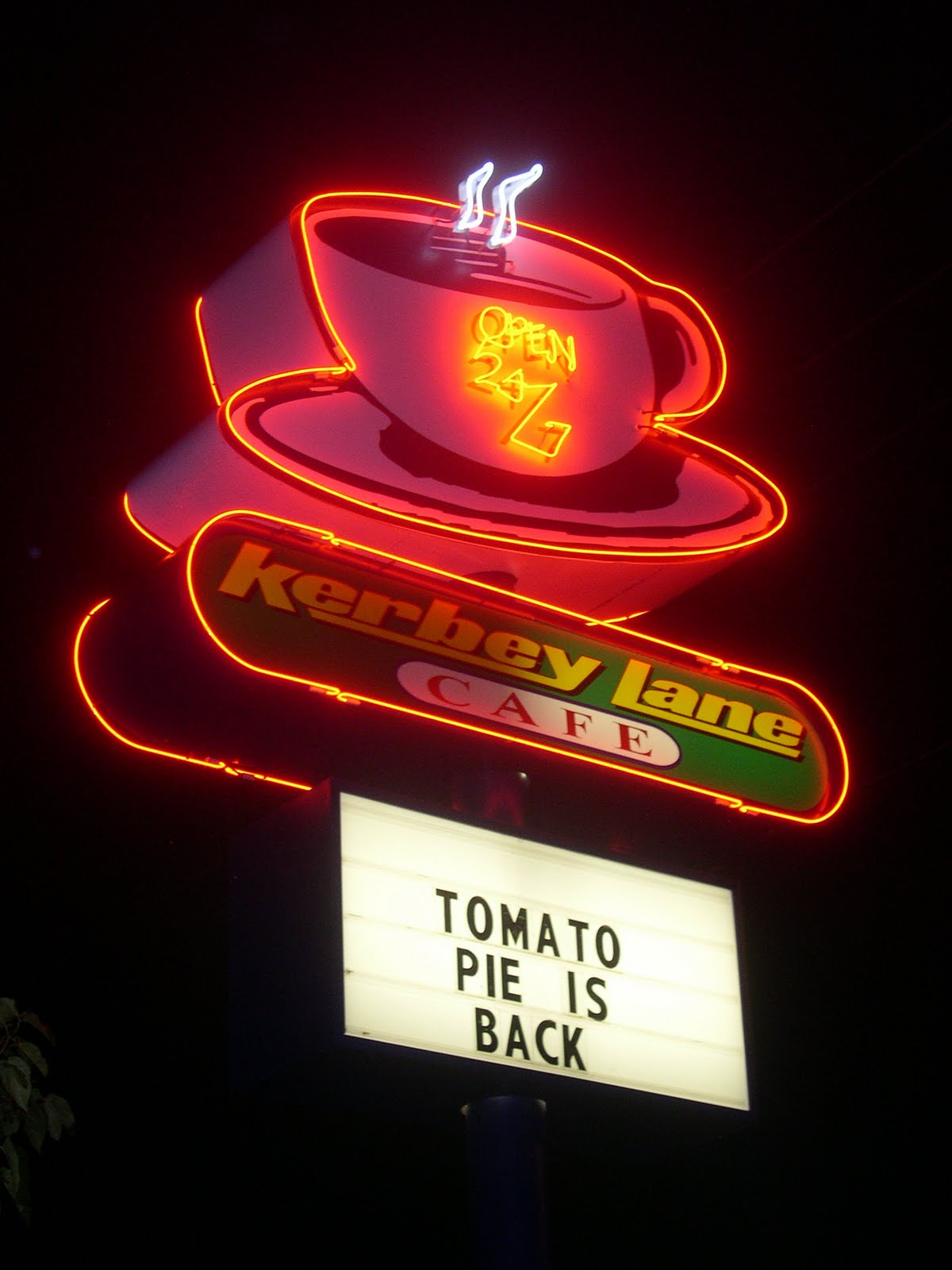
Last year and this year I went with those same friends to the South Austin location on South Lamar, opened in 1986 and marked by some spiffy neon (I didn't try the tomato pie).


Kerbey Lane South's comfort food is just as comfortable as at the original location. Besides carrot cake, which came last, I enjoyed breakfast for dinner -- biscuits & gravy with sausage. Here's my stab at food blog writing: mmmmm.

Labels: , ,

Tuesday, August 31, 2010

Hill Country Ramble

On August 16, somewhere not far from Blanco, Texas, I was driving in a car commercial -- empty rural road, good scenery, wandering attention -- when suddenly woooooo! A loud siren from directly behind has a way of focusing your wandering attention. It didn't take long for my brain to process the following, must faster in fact that the time it takes to write or read it: A cop! He's pulling me over! Am I speeding? No, I'm not. What for then?


I slowed down, then noticed that it was a fire truck. A specialized brush fire truck. Relief. I didn't catch too many details as it sped on past, but my impression was of an enormous red water tank on wheels with BRUSH painted in yellow on the side. I couldn't see any columns of smoke anywhere in the distance, but I'm sure the truck had someplace to go right away in the dry Hill Country terrain of August, terrain that sometimes seems to fold over on itself and is thick with trees, scrubs and grasses. Somewhere out there was room for a raging fire. I never did see where.


Earlier in the day, after lunch at Sonic in New Braunfels, my goal had been to get to Austin for dinner, but by a meandering route. First we headed up River Road, which connects Loop 337 outside New Braunfels with Canyon Lake. Numerous guidebooks and sites call the road "scenic," and by rights it should be, because it follows the verdant Guadalupe River, crossing it four times along the way. "The Guadalupe River provides excellent water recreation for visitors," says hill-country-visitor.com. "The Guadalupe, between Canyon Dam and New Braunfels, is famous for its exciting rapids and sparkling clear waters and [is] very popular with tubers."


It adds: "Several river outfitters provide raft, tube and canoe rentals, plus guided float trips." Dozens, rather than several, would be more like it. I was glad we weren't there on a weekend, since that would have probably meant a traffic jam on scenic River Road. The road had its winding charms, but the view on the river itself from one of those tubes would probably have been a lot more scenic, or at least a lot less cluttered with signs touting this and that. But it was a good drive anyway, especially after the number of outfitters thinned out toward Canyon Dam. Also: "Toob" is the way most of the outfitters spell it. WE HAVE TOOBS, KAYAKS AND RAFTS.


Canyon Dam, which holds back Canyon Lake, appears suddenly at the end of River Road. I'd never seen it before, and at first I thought it was a landfill hill. Then I realized it was the dam, an earthen structure -- over a mile long and more than 200 feet high. Most of the dams that I've seen have been from the top: driving across Hoover Dam, for instance, when that was still possible. It's something else to see a dam from the bottom. Think about it long enough and you begin to appreciate the fact that it's holding back however many billions of gallons of water just on the other side, a wall of water stopped short of where you are.


From there, Farm to Market 306 winds around Canyon Lake without too many views of the lake itself, and the connecting Potters Creek Road goes to Fischer, Texas. We picked up Ranch to Market 32 in that town. The difference between Ranch- and Farm- is nomenclature alone, since the roads are the same kind of winding, well-maintained two-lane thoroughfares through the Hill Country hills. RM 32 goes toward Blanco -- that's the road on which the brush fire truck buzzed our tailpipe -- terminating at US 281 just south of that town.


"Blanco, Texas, was settled 1853 by a pioneer stockmen who had to fortify homes against hostile Indians," notes hill-country-visitor.com. "The centerpiece of town square is the Old Blanco County Courthouse, a fine example of Second Empire style architecture. Blanco is now a popular tourist and resort area in the Hill Country. The town square is joined to Blanco State Park by a two-block city park, with a nature trail featuring a xeriscape garden."


I would have gotten out the car to see those things. But my daughters would have remembered the heat (100° F. or so) and not the xeriscape garden or anything else. So we pushed on. Driving through the countryside was mesmerizing anyway. Our route hairpinned back via RM 165 and then FM 2335 to Wimberley, Texas. It too has its attractions, as detailed in this well-edited visitors web site. (Many visitors sites are so much slag. This one has some meaty items: read this article about a dangerous natural marvel near Wimberley.)


We stopped at the Wimberley Village Library, a fine small facility with a welcoming staff. I was off the grid for the week, but Lilly wanted access to Facebook. We also wanted access to central air conditioning. So we sat around a while, reading web sites, books and magazines. It took a while to pry ourselves out of there, but I had an appointment with friends and food to keep in Austin.

Labels:

Monday, August 30, 2010

Under the Karst

I drive through the Hill Country whenever I can, which hasn't been nearly enough over the years. The other Dees Stribling loose in the world, my musician nephew, knows the meandering farm and ranch roads, the towns and especially the Hill Country's many music venues much better than I do -- which I only imagine as dance halls, beer halls, holes-in-the-wall, road houses, juke joints and dives in wide places in the road. Lucky fellow.


With two children in tow, holes-in-the-wall weren't part of the plan this time around. But I had a much larger hole in mind as we headed out from San Antonio on the morning of August 16. I took Lilly and Ann to Natural Bridge Caverns, out in Comal County but barely beyond metro San Antonio. It's off I-35 near the towns of Selma and Schertz, and it probably shows my age that I automatically think of these towns as notorious speed traps, since they were when I learned to drive.


It's wetter down in Natural Bridge than I remember, though considering its position in the Edwards Aquifer system, dampness underfoot and steady dripping from the ceiling shouldn't be a surprise. It's been nearly 30 years since I last visited the cavern, which was only discovered 50 years ago. How fast do living limestone cave formations grow? Maybe the flowstones, stalactites, stalagmites and such have grown a few millimeters since I last saw them.


I haven't mastered the art of taking digital snapshots in darkish places yet. Or rather, taking good snapshots in such spots. That might mean consulting the instruction manual. But the cave's own web site has much better images than I could ever take, freely available under media photos.


The public parts of the cave are more than 200 feet deep, meaning that you walk down and then up that far. Such an expenditure of energy meant that lunch was inevitably next, and we found what we needed in New Braunfels at a Sonic. There are more than 3,500 of them nationwide, and the corporate headquarters is in Oklahoma City. But I persist in associating them with Texas, for the same reason Selma and Schertz remain fixed in my mind as speed traps. Some of the notions that get stuck in your head at 16 have amazing staying power.

Labels: ,

Sunday, August 29, 2010

Cathedral Park & the Bishop Jones Center

It's been a run of clear, very warm days during declining summer this year, but cool nights. Meaning that Lilly and Ann weren't dressed for it on Saturday evening when we went to Spring Valley Nature Center to look through an amateur astronomer's fine telescope. So there was a fair amount of complaining about being cold while we walked to the viewing area. But it was worth it in the end, at least for me, since we saw the Ring Nebula (M57), which I'd never seen before outside of photos.


The colorful ring in photos isn't what you see through a small telescope. Instead, the lens reveals a wispy smoke ring among the solid background stars.


During the afternoon of the last day of 1977, some four or five friends and I gathered at a house on Patterson Ave. in Alamo Heights, where one of our group lived, to begin celebrating the new year. It might have been the end of December, but the day was pleasant, and so we took a short walk down Patterson to where it meets Torcido Ave. Ellen, the girl who lived on Patterson, told us this was the way to Cathedral Park.


The property is fenced in, so the gate must have been open that day. We repaired to a large patch of land at the foot of a large hill, in view of some buildings up on the hill that were partly obscured by trees. We sat under a copse of trees at the base of the hill, next to a small, rocky stream, and talked about whatever we talked about. I remember that it was warm enough to dip our bare feet in the water (a cold front in the early hours of 1978 brought more seasonably cold weather).


When it's flowing, that stream must be one created by the Edwards Aquifer that feeds Olmos Creek, which, together with the Blue Hole on the campus of the University of the Incarnate Word, form the headwaters of the San Antonio River. I didn't know any of that 32-plus years ago. Or exactly what was up on the hill, though I did look up and wonder about it out loud. Ellen said the park belonged to the Episcopal Church, but I don't remember any mention of the Bishop Jones Center. Turns out, that's what was atop the hill.


On August 18, 2010, I spent time looking around the Bishop Jones Center and its 19-acre grounds, unexpectedly answering the question about the place that I asked years ago, but had long forgotten asking.


The web site of the Episcopal Diocese of West Texas has a paragraph's worth of information about the Bishop Jones Center: "In 1962, the bishop of the diocese and his staff moved... to the spacious new Cathedral Park in Alamo Heights. Already on the property, when it was given by the Kamko Foundation, was the lovely and quaint 'pink house.' Cathedral Park rapidly became a location of worship, rest and refreshment for the people of the diocese and community neighbors. Today, the Bishop Jones Center -- which comprises Cathedral House, Chapel House, and Cathedral Park -- is home to the diocesan bishop and his staff and continues to be a gathering place for the diocese."


During my recent visit, I drove my mother to the center late in the morning and while she did what she had to do as a volunteer for the Episcopal Church, I took a look at the chapel and meeting center, done in a charming Spanish Colonial Revival style inside and out, and set in a lush landscape all around the hill that sports enormous old trees, plantings at short intervals and thick grass. Stone-surfaced trails wind through the grounds and also lead to a columbarium built into the hillside. The columbarium must be fairly new, since I counted only about 20 permanent residents, with space for many more.


Though I took a few pictures, the photo collection of this fellow, who obviously works (or worked) at the Bishop Jones Center, provides a much more complete look at this gorgeous property.


Some stairs lead down the hill in one direction, to Patterson Ave. In another direction, the hill slopes down without the benefit of stairs, or many trees or much grass either. I went down the hill at that point, reaching a small group of trees surrounding a dry, rocky stream bed. I couldn't remember whether this was the spot we visited all those years ago, but I figured it could have been. Then I turned around and looked up the hill -- and that jogged my memory. Whoosh. For an instant three decades and then some vanished. This was the same place, absolutely.

Labels: , , , ,

Tuesday, August 24, 2010

More Iconic San Antonio: A 750-Foot Icon, to be Exact

In the fall of 1968, I went with my family to the world's fair in San Antonio, known as HemisFair '68. I doubt that we would have traveled to see it, but we didn't have to go far to get there, since we'd moved to town in July of the same year. I remember a few things about attending HemisFair, such as my brother Jim getting lost in the crowd once; and my brother Jay buying an African-style wooden mask and some small iron-tipped arrows to go with it; and the exciting fact that the West German Pavilion was giving away one-pfennig coins as souvenirs.


Then there was the Tower. Officially, the Tower of the Americas, but few San Antonians during my time growing up there in the '70s called it anything but the Tower. It is as distinctive to the skyline of the city as the Arch is to St. Louis or the Space Needle to Seattle, and visible from countless vantage points far away, some even outside the city. More than 40 years later, it endures. Stand right under it and you see this.


If a city or town has a public observation tower, I'll find it and go to the top, provided it isn't outrageously expensive (that means you, Top of the Rock in Manhattan: $21 for adults, bah. Tower of the Americas: a tolerable $10.95). This tendency of mine might go back to 1968, when I went with my grandmother and brothers the top of the Tower during the world's fair: a thrilling ride for the seven-year-old that I once was.


I hope it was thrilling enough for the seven-year-old and the 12-year-old who went with me to the Tower after we visited the Alamo last week, getting there by way of the Riverwalk. They seemed to enjoy the rising view from the outside-facing elevator as it sped upward, and the miles and miles you can see on a clear day from both the inside and outside sections of the observation deck. To them, it might have been just a large, unknown city below, stretching out in all directions, but still impressive.


I recognized a lot of San Antonio's buildings from that perch, such the former downtown Joske's of Texas department store, home of the first retail escalators in Texas, and an early user of air conditioning. The structure would have been a complete city block in size but for the refusal of St. Joseph's, a Catholic church, to be demolished to make way for Joske's expansion. The church remains, surrounded on three sides by the former department store. "Former" because Dillard's, the successor flag to Joske's, closed up shop downtown a few years ago. (God forbid there be any local or regional variation of department store names, like Joske's or Marshall Field.)


Looking down from the observation deck on a summer afternoon, you see this, if you're facing east.


Not far from the shadow of the Tower is US 281/I-37, and beyond that -- the Tower shadow is nearly pointing at it, and note the rail line -- is the 1902-vintage Southern Pacific Railroad Station (Sunset Station), now a special-events facility. Early one morning in March 1990, I caught an Amtrak train there that took me to San Francisco, where I caught a flight to Japan.


I barely remember my 1968 visit to the Tower (except it was a thrill), but in 1978, I clearly remember taking a date up to the observation deck. On January 13, as it happened, because that was also the day that Hubert Humphrey died, and remarkably it was warm enough to spend time on the outside part of the deck. In the mid-80s I came again, with a out-of-state girlfriend who previously doubted that San Antonio was a city of any size; and in early 1993, I brought Yuriko. So besides seeing the three dimensions in front of me, I also sensed the arc of time as I made the ambit around the Tower's observation deck with my kids.

Labels: , ,

Monday, August 23, 2010

Iconic San Antonio

We arrived in San Antonio on Friday the 13th and left Friday the 20th, traveling by way of that very Texas institution, Southwest Airlines. When we returned to suburban Chicago, her mother asked Lilly, "How was Texas?"

"Hot."

So it was, but in fact only five to 10 degrees (Fahrenheit) hotter than the Chicago area during the same span of days. Still, that made for a more oppressive heat, near or at 100° F. every day, which took some getting used to, even for me. Such is August in South Texas. Casual visitors, especially lifelong Yankees and Canadians, take note: see San Antonio in October or November or in March or April. Or during winter, for that matter, but take a coat. Hawaii, it's not. For the record, the climate is considered humid subtropical.


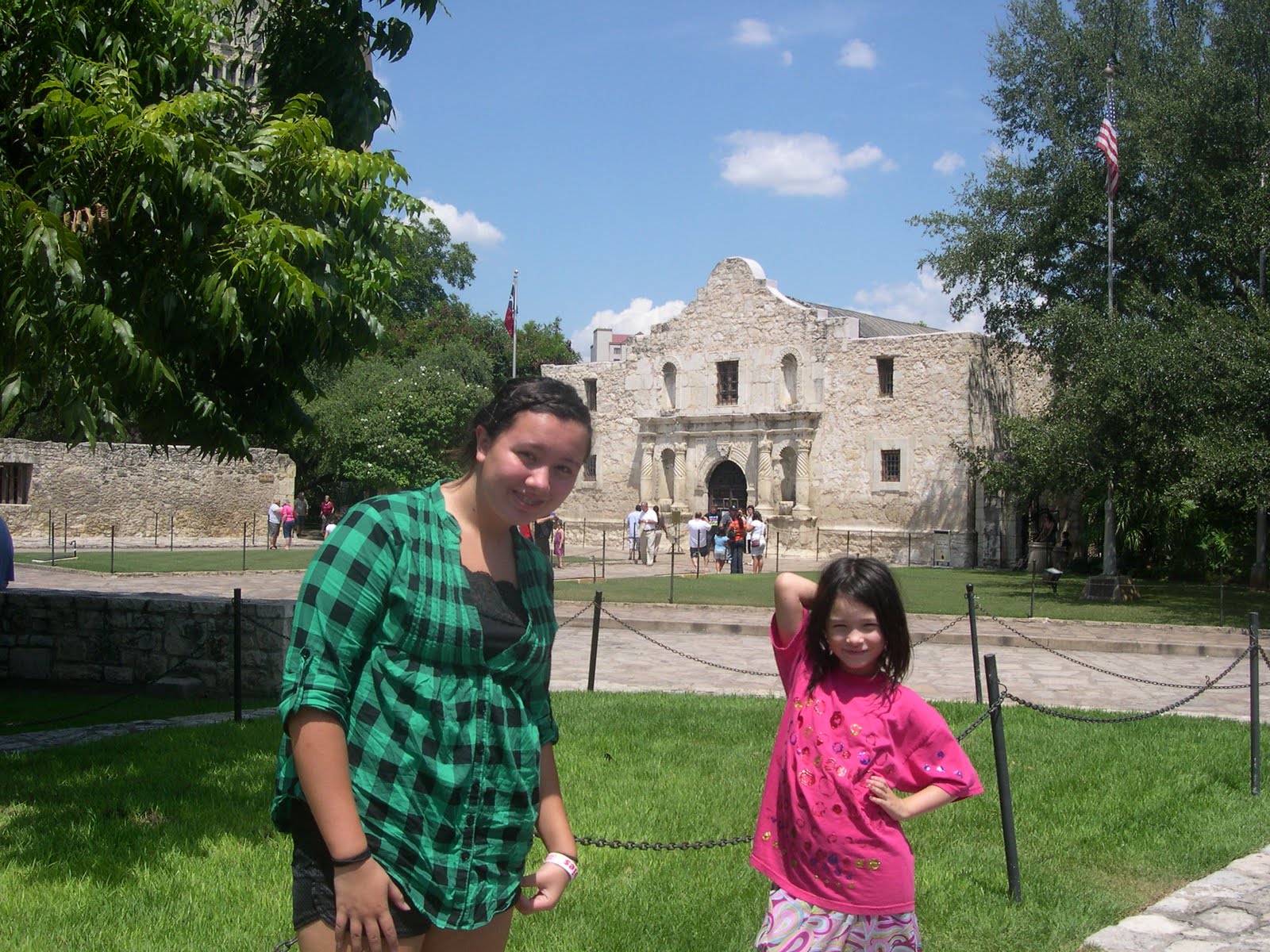
Hot or not, I spent a few afternoon hours last Wednesday introducing my daughters to some San Antonio icons. The Alamo, for example, which also counts as a Texas icon and, though out of fashion for now, an American icon. Maybe they'll read about the place later or see pictures of it, or even hear about its non-existent basement, but being there remains a different order of experience, so I took them.


A hot 'n' sweaty experience it was, until we entered the chapel of the Alamo, which has been air conditioned in our time (and has a roof, too, which it didn't have in 1836). Inside the quiet, somber space, we milled around with other people, looking at the various display cases, pieces of art and plaques, some of which are in small sacristy rooms off the main room. William Barrett Travis's ring and David Crockett's buckskin vest are among the items to be seen there.


According to the Moon Handbook of Texas, the Daughters of the Republic of Texas, who operate the shrine, "have removed from the north interior wall the large, tacky painting that featured Davy Crockett swinging his flintlock at a mob of Mexican soldiers -- the figure's face was unmistakably John Wayne's." Moon's usually pretty accurate, but I can't remember ever seeing such a painting, which sounds like the artwork for the 1960 movie Dmitri Tiomkin soundtrack. Then again, I've only visited the Alamo sporadically over the years, the last time being in 1993, I think. More poignant than any such painting are the names of the defenders on signs near the rear of the chapel, and the chipping of the walls that might date from the battle.


We passed a few good minutes in the chapel, and then a few less pleasant minutes in the gift shop, since Ann hasn't quite outgrown her little-kid pestering when it comes to retail spots. Outside the gift shop we returned to the hot 'n' sweaty experience, and it was all I could do to keep Lilly and Ann seated (in the shade -- still hot) to listen to a short talk about the siege of the Alamo by a costumed interpreter whose opinions on the subject I didn't entirely share, but who wasn't outrageously revisionist (along the lines of how dare those people not live up to modern standards).


We hurried through the Long Barracks at Lilly's insistence, even though that structure is also air conditioned and contains some fine exhibits. As it should, since the Long Barracks saw some of the fiercest fighting on the last day of the siege. Still, I managed to take a few more pictures of the grounds of the Alamo. Such as one of the enormous live oak (about 100 years old, it seems) shading the entrance to the Long Barracks, and a sizable cactus of indeterminate age near the chapel.


Who knows, maybe my daughters will actually remember the Alamo.

Labels: , , ,

Sunday, August 22, 2010

The Great 2010 Egg Recall Hits Home

On Saturday, the day after we got back from Texas, I decided to participate in something larger than myself, namely the recall of many hundreds of millions of eggs, or a billion, or whatever the final total might be. While Ann, Lilly and I were away, Yuriko had acquired a package of 36 Hillandale Farms-brand eggs, but had eaten none.


"If your carton has a combination of numbers that matches the affected plant number AND Julian date, your eggs are affected in the recall," notes the Egg Safety Center web site (which is part of the American Egg Board, the marketing organ of the U.S. egg industry). Our carton had a plant number of 1860 and a Julian date between 099 and 230. Match! We had recalled eggs.


The egg industry uses "Julian Dates"? Somehow I understood that the Egg Safety Center meant day of the year, which in our eggs' case would be April 9 to August 18. NASA, at least, asserts that "Julian date is sometimes used as a synonym for day of year, but this is not correct usage."


I'd never heard of it used that way, either. Long ago I read of how astronomers use the term, which NASA also describes: "Julian dates (abbreviated JD) are a continuous count of days and fractions since noon Universal Time on January 1, 4713 BCE (on the Julian calendar). Julian dates are widely used as time variables within astronomical software and should not be confused with day of year."


Tell that to the egg men. Anyway, I added an extra errand to my Saturday: swing by the warehouse store, return the eggs. Probably we could have eaten the eggs, since heat kills salmonella, and we're able to apply heat to our eggs. Moreover, the eggs might not harbor the bacteria in the first place.


Still, as I mentioned above, I wanted to be part of the recall just for the sake of being part of the recall, so there I was in line at Costco around noon on Saturday. Two lines of people waited to return items, and most of them carried eggs. When my turn came, the clerk merely scanned my membership card and refunded $3.03, quick as a wink -- and then deposited the eggs in a grocery cart that was almost full of eggs already.


It was nice to be home and back at quotidian duties like participating in a billion-egg recall. But we had a good visit in San Antonio. The point of the late-summer trip was for my daughters and I to visit my mother and brothers, which we did. But we had a week to spend, and managed to shoe in some other activities. It's the thing to do in one of the country's least known, but most interesting large cities, even if it is your old home town.

Labels: , ,