Wednesday, July 11, 2012

July 10, 2012

Yesterday I got up at about 5 a.m. and set to work on a short article that needed to be done, and then worked on a larger article that also needed to be done. At about 7, I went back to bed, not thinking I'd be able to go back to sleep. But I must have, since I got up at 8 surprisingly refreshed. Good thing, too, because I needed to be considering what I had to do the rest of the day.

I finished both the short and the long articles by 10:30, with time for a quick shower thrown in. Then I drove to Glenview, a northern suburb, where I needed to take photos of a lunch gathering of a real estate organization. The event was at a kind of place I rarely see: an upmarket golf club, complete with all the posh trappings.

I took pictures of four groups of people, talking to them about their business, then drove back in time to pick Lilly up from her summer school class. When I got home, I took Ann to no-extra-charge, supervised swimming at a nearby park district pool, and then went home to write most of my daily column about the economy, as well as my next weekly contribution for another publication, along with a phone interview thrown in. I almost finished both bits of writing by about 4, when I picked up Ann and left her at home with Lilly, since I had another event to go to, this one in the southwest suburbs. Traffic was awful.

Never mind the details, the main thing was the event included a 30-minute walking tour of UPS' Chicago Area Consolidated Hub, a 1.5 million-square-foot package sorting and distribution facility. I'd never seen the likes of that. I was going to stay for the dinner, but I had something else scheduled in the evening: a concert to attend, scheduled before I knew I going to be doing these other things on the same day.

So I drove back home -- traffic was much lighter by this time -- picked up Yuriko and drove to the northern suburbs. We got to Ravinia only a few minutes after the concert started, and stood for the whole thing. We didn't mind a bit, because we got to see Natalie Merchant.

We got home by 11:30, and I polished off the work I hadn't quite finished in the afternoon, despite exhaustion. I filed the bastards just after midnight and went to sleep without much trouble.

A remarkable day. But I'm glad I don't have too many like it.


Labels: , , ,

Monday, July 02, 2012

Musical Weekend

On Friday, I drove to Berwyn, Ill., to see my nephew's band, Sons of Fathers, at FitzGerald's, a venerable venue in the near western suburbs. They were playing as part of FitzGerald's American Music Festival, one of the first acts to take to the stage, doing two sets. My nephew Dees is their drummer, and all together the lads -- I can't help thinking of them that way, though of course they're all grown men in their 20s -- have a lot of talent and energy, and put on an enjoyable show.


On Sunday, Yuriko and I went to Ravinia on the North Shore, another venerable Chicago-area venue, to see Jake Shimabukuro, four-string Hawaiian ukulele virtuoso. He too is young (that is, in his early 30s), with talent and energy. It's astonishing what he made that ukulele do -- an instrument, as he joked at one point, that invites low expectations.

Labels: ,

Monday, June 25, 2012

Irish Pipes

One pretty good way to start your weekend is with some bagpipes.


These happen to be the Shannon Rovers of Chicago, playing in downtown Chicago at a real estate event I attended toward the end of last week. They played -- I don't remember, but they were bagpipe-y tunes, skillfully done.

As the name suggests, the Shannon Rovers are an Irish pipe band. A history of the organization is here, stating that the early goals of the club were, "for the promotion of Irish music and to help members who are in distress; to run dances and social affairs; to finance these objectives." Unstated is the opportunity to drink, but I won't dwell on old Irish stereotypes.

Labels: , , ,

Wednesday, June 13, 2012

Al Stewart, 2012

Al Stewart was in fine form early this month at the Woodstock Opera House. The remarkable thing is that his guitar virtuosity and fine voice sound almost the same now as they did on records he made around 35 years ago, or during live performances of the period currently disseminated by YouTube. We should all age so well.


The audience has aged with Al. In fact, I felt a bit younger than the average. Al Stewart had his biggest records in this country in the late '70s, when I was a teenager, but many in the audience must have first listened to him in their 20s or even 30s. Lilly, of course, was drastically out of the audience demographic, and claimed that people were starring at her (she's the age at which she feels that way a lot, but it was probably true in this setting).

The talented Stewart sideman David Nachmanoff and a bassist opened the show with three Nachmanoff songs, and then Al came out for a set in which they both, or all three, played Al's songs. After an intermission, they repeated the pattern. As usual, Al bantered between most of the songs, sometimes to explain a song's back story, sometimes to talk about some early experience in music, which I'm certain he knows the audience likes to hear. Once he talked about meeting the young Rolling Stones as a very young man himself -- 17, I believe he said, which would put the event ca. 1962.

The playlist relied heavily on his '70s albums, especially Year of the Cat. No doubt he feels obliged to play "Year of the Cat" and "On the Border" from that record, which he did, but this time around he also played "Midas Shadow" and "Flying Sorcery," the latter about aviatrix Amy Johnson. Surprisingly, he reached all the way back to his first album to play the title track of Bed-Sitter Images, a song I don't think I'd heard before. Also on the playlist from an early album (Orange) was "The News From Spain," which he characterized as his worst-selling single, "because it's so depressing." I'll go along with that.

When I saw Al Stewart live for the first time at the Park West in Chicago in early 1989, someone in the audience requested something from Orange, and he mocked the suggestion. But then again, he had an album to promote during that tour — Last Days of the Century — and so focused on newer items that aren't so new any more. These days he obviously doesn't mind reaching back more than 40 years for a tune.

The newest thing he played at the Woodstock Opera House was "Sheila Won't Be Coming Home," something he co-wrote with Nachmanoff. Also on the playlist were the relatively new "(A Child's View Of) The Eisenhower Years," which is good fun, and "Night Train to Munich," which I assume was inspired by the movie of that name, though I've never seen it.

All in all, a good show. I wouldn't have expected anything else. Still, I wouldn't have minded hearing some songs of his I've never heard live before, such as the moody "Palace of Versailles" or the only pop song I know about the fall of Constantinople in 1453.

Labels: ,

Tuesday, May 08, 2012

Passing by the Beasties

Everyone has a Beastie Boys story, don't they? No? It's never good when anyone only 47 dies of cancer, but I have to say that the band left a very light impression on me. Except for the time I rode in the same El car as a number of Beastie Boys fans. It was a fairly crowded car, but they stood out. How do I know they were Beastie Boys fans? They weren't shy about it.

No property damage or fights occurred during their ride, but they sounded like they were up for either. After a few minutes of noise, the lads got off to see the band at the Aragon Ballroom, which is on the North Side of Chicago, within sight of the El. I did some looking around, and that must have been during the Beasties' infamous 1987 tour.

Stephen Thomas Erlewine writes in Allmusic: "In fact, Licensed to Ill became the biggest-selling rap album of the '80s, which generated much criticism from certain hip-hop fans who believed that the Beasties were merely cultural pirates. On the other side of the coin, the group was being attacked from the right, who claimed the Beasties' lyrics were violent and sexist and that their concerts -- which featured female audience members dancing in go-go cages and a giant inflatable penis, similar to what the Stones used in their mid-70s concerts -- caused even more outrage. Throughout their 1987 tour, they were plagued with arrests and lawsuits, and were accused of inciting crime."

Remarkably, I'm able to pin it down: They played the Aragon on Friday, March 13, 1987, according to this fellow, who claims to have documented the many concerts he's been to. I'll go along with that. I don't have any record of what I did that night, but I was out doing something, and it's what I think of on those rare occasions when I hear about the band, such as this week.

Labels: , ,

Thursday, March 22, 2012

The Next '20s Just Isn't Going to be the Same

Spring break time and it actually still feels like spring, though they say cool (not cold) air is on the way. Back to posting around April 1. In the meantime we will not be going hither and yon, or even part way to yon. But there may be a few new sights to report on come April. Sights are sights, even if they're close to home.


I must be in an early 20th century frame of mind, since lately I've been reading The New Deal (2011) by Michael Hiltzik, an engaging work. Besides discussing the broader scope of the various economic and social policies under that rubric, the book also details the efforts of cabinet members and advisors, some of them mostly forgotten now, who shaped and executed those policies. There are also some wonderful asides, such as a discussion of how a photograph of plutocrat J.P. Morgan Jr. and Ringling Bros. midget Lya Graf at U.S. Senate hearings on Wall Street came to be (June 1, 1933).


Also, I've been watching some Max Raabe videos not posted when we saw him a few years ago. In the one below, he explains why the version of "Singing in the Rain" they're about to do isn't quite like the version from the movie. We heard him discuss this in English in his droll way, and then heard their exceptional rendition of the song. The clip has the added bonus of featuring the fetching Cecilia Crisafulli.


Please continue to pray for Deb, my sister-in-law, in her slow recovery, and for her husband Jay, whose life is quite difficult now.

Labels: , , ,

Sunday, March 18, 2012

(Literal) Item From the Past: The Galena Mug

As predicted, the warm temps lasted through the weekend, which meant cleaning out parts of the garage on Saturday, which I didn't much want to do, and taking a long walk on Sunday, which I did.


The same weekend in 1989, it was cold. I remember that because I drove to Galena, Illinois, on (Friday) March 17 that year, and at one point on US 20 not far from that town, my car hit some ice and gave us a momentary scare. It was cold the entire weekend, but Galena didn't disappoint. It's a lovely town in the extreme northwestern part of the state, rich in historical associations, including a former residence of U.S. Grant.


I went to Galena because of Jim Post. In early 1989, instead of paying attention to the Super Bowl, that Sunday I went to see him do his one-man show, Galena Rose: How Whiskey Won the West. Amazingly, there's a late '88 article from the Reader about the show online.


"Though Post's soaring tenor pipes produce some of the strongest, sweetest sounds this side of heaven, the show is anything but syrupy nostalgia," wrote Hank De Zutter. "For it features flesh-and-blood characters -- Indians betrayed, a runaway slave recaptured and freed, an Irish fugitive caught with his pants down, a pioneer woman uncertain about starting over in a town without lace curtains, and Mississippi River poleboat men, fueled by little more than dreams and drafts of whiskey -- the whiskey, Post claims with ample historical evidence, that 'won the west.' "


I'm not sure, but I probably read the article when it was originally published, and it might have influenced my decision to see Post's show. In any case, Post inspired me to go to Galena itself. All these years later, the only physical reminder I have of the trip is this souvenir.


I'm glad I still have it. A lot of things have been lost or kicked around in the years since then. In this pic, it's holding hot tea, which is what I use it for more than anything else.

Labels: ,

Monday, March 05, 2012

RIP, Steve Bridges

I read today that Steve Bridges died. I hadn't thought about him in years, probably because I haven't watched The Tonight Show regularly in many years (since an entertainer named Carson appeared on it a lot). I would never have heard of Bridges, in fact, except that I happened to be at the right place at the right time to see him live. The man had talent.


"Impressionist Steve Bridges, who used prosthetics and wigs to turn into presidents and laughs to make a living, was found dead at his home, his manager said Monday," an AP article by Sue Manning reported late this afternoon. "He was 48. Bridges returned from China on Feb. 23 and complained to friends of 'super jet lag,' manager Randy Nolen said. Bridges' maid found the comic dead about 9:30 a.m. Saturday in his Los Angeles home, Nolen said."


In early 2004, I visited the Boca Raton Resort & Club, which was hosting a national convention of a prominent real estate trade association. We conventioneers were promised a headliner as entertainment one evening, but not told who it would be. As I later wrote, "everyone was waiting for the unspecified 'entertainment' mentioned in the program. Rumor was that Jerry Seinfield was going to show up -- plausible, since the apartment landlords of the nation could come up with whatever his astronomical fee would be.


"He was mentioned because people had sighted Larry David, Seinfield’s long-time writer, at the Boca Raton Resort & Club. In fact, my associate Anthony saw David as we walked through the lobby earlier that day. I wouldn't have recognized him, but Anthony was sure it was him.


"The entertainment turned out to be presidential impersonator Steve Bridges, and it was a spot-on impersonation of Bush the Younger, one of the best I've ever seen of any politician, and outrageously funny."


I was glad to read that Bridges had a larger career than just doing George W. Bush, since there's only so much mileage a comic's going to get out of any one politician (though he milked it well). "Sometimes, Bridges would do shows without makeup that were titled 'Steve As Steve' and showcased his 200 voices — from Bill O'Reilly to Rush Limbaugh to Tom Brokaw and all the presidents from Kennedy to Obama," the AP article noted. Bridges might have died young, but at least he had more professional luck than Vaughn Meader.

Labels: , ,

Tuesday, October 25, 2011

Those Few, Those Happy Few

I suspect that today was the last warm day of 2011. Warm, windy, cloudy. I eked out a short while to sit on the deck and read.


I picked up Ann from her school this afternoon to take her to the dentist (no cavities, glad to report) and noticed that a white board in the school office said: Today is Denim Day. I don't think they meant this. Maybe it was this, but that's off a few weeks. I didn't ask the staff. Later, I asked Ann about it. She had no idea.


Never mind. It's St. Crispin's Day. I've posted about it before, but here's another rousing performance of the St. Crispin's Day speech, this one by a young Richard Burton.

Labels: ,

Thursday, October 06, 2011

Norma Jeane and the Robot King

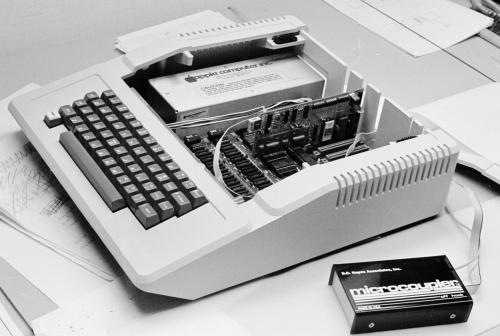
In the summer of 1978, I took some summer school classes and one day happened to be at the school library after class when two fellows I knew, Lester and Trey, brought in an odd-looking piece of equipment and took it to one of the library's audio-visual rooms, where they fooled around with the thing, connecting it to a television. It was an Apple II.


Whose machine it was or where they got the money for it, I don't know. I joined them for a while, but soon decided it wasn't my kind of hobby. A lot of other people felt differently and, eventually, I also came around to an admiration for Apple products. RIP, Mr. Jobs.


After poking around the Lurie Garden downtown on Sunday, we walked northward on Michigan Ave. until we reached the giant statue of Marilyn Monroe near the Tribune Tower. It's the work of J. Seward Johnson, the same fellow who did the play on "American Gothic" a couple of years ago. That statue, I liked. Johnson added a fillip to the icon, the suitcase with the travel stickers. By contrast, the 26-foot "Forever Marilyn" statue had no extra touches to make it interesting. It's a straightforward reproduction of the publicity images for The Seven Year Itch, and shows exactly zero imagination on the artist's part.


Marilyn Monroe needs to be left to rest in peace anyway. Marilyn Monroe and Elvis Presley and Buddy Holly and James Dean; enough already. Next summer's going to be the 50th anniversary of her death, and I'm sure we'll hear all about it for days.


How about a giant statue of Jane Russell and a pistol, if the subject is to be a mid-20th-century sex symbol? But if the statute must be Marilyn Monroe, what about a giant figure based on this photo? A fetching brunette holding a propeller. Call it "Norma Jeane and the Propeller." Now that would be different. People might be shocked to see her brown hair.


At the southeast corner of Michigan Ave. and Wacker Dr., we saw the "Robot King" doing some busking.


He did his robot dance. A nearby sign said that he's from Miami, but other than that, I haven't found out anything else about him. This little-watched video gives some idea of his act. I thought he was more interesting than the overblown pop icon not far away on Michigan Ave.

Labels: , , ,

Sunday, January 23, 2011

Not Much of an Item From the Past: The Other Elvis

While thinking about inaugurations last week, I remembered that on the day Ronald Reagan became president, Elvis Costello and the Attractions, with Squeeze as the opening act, happened to play at Vanderbilt. I saw them, but I'll never be a music critic because all I wrote about it -- and I was keeping a diary regularly at the time -- was "Neal, Layne and I went to Langford to see Elvis Costello and Squeeze. Good show."


Langford was Langford Auditorium, and I also remember that the acoustics were lousy. They always were at Langford. So maybe the show wasn't quite as good as it could have been.


Macklam Feldman Management manages Mr. Costello these days, and interestingly enough publishes a detailed chronology of his career that mentions the VU date. Apparently he took advantage of being in Nashville.


"A Nashville date at Vanderbilt University provides an opportunity for a trial session with Billy Sherrill at legendary Columbia Studio B -- venue for 'Stand By Your Man,' 'Behind Closed Doors' and 'Blonde on Blonde,' " notes the site.


"Pedal-steel player, Pete Drake, augments the Attractions for the session, which yields two cuts, Hank Cochran’s, 'He’s Got You' -- a hit for Patsy Cline and Loretta Lynn as 'She’s Got You' -- and the Bobby 'Blue' Bland R&B ballad, 'I’ll Take Care Of You.' ”

Labels: , ,

Sunday, July 25, 2010

Item From the Past: PHC '85

My brother Jay and sister-in-law Deb introduced me to A Prairie Home Companion sometime in the early '80s during a visit to their home, and I've been an irregular listener ever since, enough to know most of the schtick. Some parts of show are admirable, a few parts annoying.


In the summer of 1985, the show came to the Tennessee Performing Arts Center in Nashville and I went. I didn't write anything about it at the time that I can put my hands on now, but I enjoyed the show and do remember a few things. But not who any of the guests were, or what the monologue was about, as it happens.


Mainly I remember that Garrison Keillor warmed up the audience up before the broadcast actually started, and that involved inviting Lamar Alexander up on stage to play a little piano. Alexander was governor of Tennessee at the time and a skillful pianist besides. Keillor made some small talk with the governor, including something like, "You're from East Tenneesse, aren't you, Mr. Governor? [Alexander grew up near Knoxville.] You guys were on our side during the war."

Labels: ,

Monday, June 14, 2010

Valentino Georgievski, Puppet Master

On Saturday evening, I spotted a lone firefly in my front yard, flashing his vest-pocket Mazda. He's early, unless the recent heavy rains and lush growth bring masses of them out sooner rather than later. We'll see.


Last week the Art Institute of Chicago lions wore hockey headgear.


As the world well knows, or at least as North America knows, the Stanley Cup belongs to the Blackhawks for now, and besides the Art Institute dressing up the Michigan Avenue lions, last week there were plenty of other visible reminders downtown of the victory. A lot of Blackhawk jerseys and t-shirts on pedestrians, mainly, plus signs in windows and city-hung banners from lampposts.


I didn't make it over to the Chicago Picasso, but I heard that was decorated too. No surprise, really. It got the White Sox treatment back when they won the World Series.


Hockey gear on the bronze mascots of a fine arts palace is one thing, but note the guy in the red shirt and black-and-white cap, facing the crowds along Michigan Avenue. That's puppet master Valentino Georgievski getting ready for his act. How do I know that? I didn't until I stopped to watch him busk.


Summertime Chicago needs more buskers. There's been a history of pigheaded municipal harassment of buskers by the city, and by other U.S. cities, that I can't fathom, and I don't know the current restrictions on the activity. But at least Georgievski, who had a plastic license attached to his belt, seemed to be entertaining without restriction.


His puppets lip-synch and play puppet instruments to pop standards, jazz and blues numbers, which play in the background. The puppets -- Georgievski has four in all -- look the part, and more importantly, have the moves. A small crowd watched. It was much fun. Though this video is blurry, it gives a good impression of his puppetry (one of the songs I saw him do was "Sultans of Swing").


(Link for Facebook readers.)


During a break, I asked him how long he was going to be in Chicago. His home is New Orleans, he said in a thick Central European accent, where it's too hot now for much street theater. He'll be in Chicago through the Taste of Chicago, which packs in the crowds not far from the Art Institute until the Fourth of July, and then it's on to Ocean City, Maryland, for the rest of the summer.


Some time ago, I got some $2 bills at my bank when I noticed that the teller had some. I've given a few away so far as tips or parts of tips. As I left, I wished Georgievski well and put one of my remaining $2 bills in his tip basket.

Labels: ,

Sunday, March 14, 2010

Manchurian Buckwheat Pi

Every time Pi Day rolls around, I forget to mention it until March 14 has already come and gone. Not this year. Time to post a few links about the world's favorite irrational number (though there must be e partisans; but it's too hard to conceptualize for mass appeal).


YouTube doesn't disappoint when you run "pi" through it, once you get past trailers for the movie of that name. That may be a fine movie for all I know, but it isn't "Pi Pi Mathematical Pi Song."


All I can say about this is, surely you're joking, Mr. Feynman.


By way of the blindingly erudite Mr. Kurp, a Polish poem about pi, reconfigured into English.


I was looking through one of my envelopes of personal debris recently for things to scan, and came across a ticket stub that fits mid-March.


Item from the past all right, but the trick of memory is that I don't remember seeing Buckwheat Zydeco at all, and the only bit of writing that I can find about doing so is an entry in my 1988 At-A-Glance desk calendar (of course I still have it). The entry uselessly says "Buckwheat Zydeco," but is on the correct date, at least.


So that show's down the memory hole, though I probably saw something like this. Another note in the calendar a few days later tells me that I saw The Manchurian Candidate for the first and only time 22 years ago, when it was revived at the Fine Arts Theatre. That I remember, maybe because Wo Fat was in it.

Labels: , ,

Sunday, January 31, 2010

Item From the Past: Weavermania!

Weavermania! was a fun show. Eight years later I can't remember exactly what they sang, but I'm fairly sure it included the likes of "Midnight Special," "If I Had a Hammer," "Twelve Gates to the City," "Battle Hymn of the Republic," "Nobody Knows You When You're Down and Out," and "This Land is Your Land."


The show was what I paid to see. Namely, a re-creation of the Weavers, since I spent much of that group's career not being born yet, and thus unable to mosey on down to the Village Vanguard to catch a show. Even by the time of the Weavers' final reunion at Carnegie Hall in 1980, I didn't know enough to find my way to New York to try to see it, though it would have certainly been sold out anyway.


I've found only a scattering of references to Weavermania! on line (most hits for the word refer to actual weaving), but enough to find out that Tom Dundee, who re-created the part of Fred Hellerman, died in motorcycle accident in 2006. Other members of the tribute band included Mark Dvorak channeling Pete Seeger; Barbara Barrow in the part of Ronnie Gilbert; and Michael Smith sounding very much like Lee Hays. This is pretty much what they looked like in concert.


That was the first and unfortunately only time I've been to the "new" Old Town School of Folk Music. Not so new any more, since the school has been on North Lincoln Ave. in Lincoln Square since 1998. When I first moved to Chicago, the school had its venue on Armitage, and I saw a few shows there, but I can't remember who just now.


Yuriko bought their CD for me after the show. Since it's a collection of live recordings, there are some spoken introductions to some of the songs, as they did during during the show we saw. My favorite is the description of old song "Eddystone Light," which I don't believe they sang at the Old Town.


"The next song tells a story," one of them (not sure which one) says. "A folk song that tells a pretty serious story about a man who was a sociopath -- a hermetic sociopath, actually. With the exception of one night, when he had an adulterous affair with a mythical sea creature. From the passion came three offspring. Of the three children, one was cannibalized, the other ended up in zoo his entire life, and the third boy lived in a lighthouse. One day, his mother returned after years of abandonment. The song ends with a curse. [pause] This is a children's song."


(Lyrics here; plays music upon opening.)

Labels: ,

Thursday, October 08, 2009

Chamber Blues '09

Since so many musicians supposedly defy and blur and transcend genre labels, preconceptions and pigeonholes -- there's a whole arsenal of clichés available to critics about genre-busting -- you'd think that there wouldn't be musical genres at all. Yet the descriptions have their uses. As Corky Siegel writes on his Chamber Blues web site: "My greatest inspiration in my life has been the blues. What an amazing opportunity in 1966 at Pepper's Show Lounge on the South Side of Chicago as a young musician blues lover to be part of the house band that hosted Muddy Waters, Howlin Wolf, Willie Dixon, Hound Dog Taylor, Little Walter, James Cotton, Junior Wells, Buddy Guy and all the great blues masters you can think of...


"And then this Japanese fellow shows up in 1966 and wants my band -- Siegel-Schwall -- to jam with his band. His band was the Chicago Symphony Orchestra and he was Seiji Ozawa. He explained that blues was the very spark that classical music needed. Traditionally classical music forms borrowed from the folk forms of the day. And what more important folk form is there then the blues?"


Besides Corky Siegel and Howard Levy on harmonica and piano, the rest of Chamber Blues at the Prairie Center for the Arts last Saturday were the West End String Quartet and percussionist Frank Donaldson. With his toothy smile and talent with anything he touched, hit, shook, rubbed or scraped -- bongos, tabla, tambourine, triangle, cymbals and other items I can't put a name to -- Donaldson was a hit with the audience. Early on, he donned a metal vest and played that for a few minutes, sounding unlike anything I'd ever heard.


Sometimes the quartet had their own moments in the spotlight, either all together (as you'd expect), or during duets or solos. The young violinists Chihsuan Yang and Aurelien Fort-Pederzoll did their ensemble parts expertly, but at one point broke into what I can only describe as a friendly fiddle contest. The fetching Yang also had the opportunity to play the erhu, the Chinese two-stringed fiddle, for one piece. Rounding out things were violist Doyle Armburst and cellist Jill Kaeding.


All together, or sometimes separately, Chamber Blues played for about two hours. For the encore, Corky Siegel came out by himself and said that he asked everyone else to leave, because they couldn't sit around and not play. He then started in at the piano, and sang a song about how he couldn't be a vegetarian (or a potato man, as the song had it). One by one, the other members of Chamber Blues came back on stage, with Corky pretending not to notice until they surrounded the piano. At that point, at least four of them -- I couldn't quite see how many -- played with him on piano, each contributing a hand. I don't know how that can sound good, but it did. A rousing finish for a joyous concert.

Labels: ,

Wednesday, October 07, 2009

The Mysteries of the Harmonica

The harmonica is a mystery to me. Blow into it, get vaguely musical noise. Move air up and down the slots in the harmonica, get a cascade of noise. At least that’s what happens when I noodle on one, including cheapo models and a couple of expensive, polished metal harmonicas complete with their own cases that I’ve had the chance to handle over the years. The quality of the instrument doesn’t matter. The noise I make is a distance cousin of music, and they’re not on speaking terms.


So how does Corky Siegel do it? The mystery deepens. From off stage, all I could see were his hands cupped together, moving rapidly, with a microphone wire emerging from them. Or, during the moments when he left the stage and played for a few minutes in one of the aisles, just his hands cupped over the instrument, moving rapidly, blowing fine without benefit of an amp. Somehow, he produced wa-was and wails and lonesome blue notes.


Even if I’d been standing next to him, his exact technique would be elusively hard to see, since besides his hands, much of the rest of Corky Siegel is in motion when he plays. Body motion during harmonica jams, and a stomping foot during his piano numbers. He's got an impressive amount of energy for a man in his mid-60s at least, but I guess that’s a natural extension of his enthusiasm for performance.


Corky wasn’t the only harmonica player on the bill. Howard Levy, a tall fellow of roughly my age dressed all in black, played in duet with Corky, or sometimes with the other musicians or solo, when Corky was off resting. Energetic he may be, but no spring chicken.


The handoffs to Mark Levy were seamless, and as far as I could hear, he has every bit as much talent as Corky Siegel. He opened the second set under a spotlight doing an arrestingly beautiful harmonica version of “Amazing Grace,” did a couple of adapted Romanian Folk Dances (Bartók), and at one point accompanied himself by playing the piano with his left hand and the harmonica with his right.

Labels: ,

Tuesday, October 06, 2009

Corky Siegel, Ecstatic Bluesman

Years ago I saw Keith Jerrett perform an open-air concert at the Piazza del Campidoglio in Rome. It was standing room only in the most literal sense – no seating, only standing – and I had a fairly good, but not up-close view of the man as he persuaded the piano to do his remarkable bidding. But even at some distance, I could tell it was an angry performance. Maybe the audience was too noisy, or unappreciative, for Jerrett. Supposedly he’s touchy that way.


In any case, at one point Jerrett stopped playing, stood up, glowered at the audience, and left. That was the end of the concert. We stood around for a while, wondering if he would come back, but no.


Corky Seigel’s artistic temperament could not have been any different. He’s an amazing blues harmonica virtuoso, of course, and a hell of a piano man, and all those talents were on display during the concert. But from beginning to end, the unassuming-looking Corky seemed purely happy to be in this modest auditorium, playing to this modest crowd. I don’t think the music he offered up, an unusual, distinctive amalgam of blues and classical, would have worked nearly as well if his attitude had been, “I’m an artist, dammit, listen here.” Instead it was a wide-eyed, “Wow, listen to this! You won’t believe it!”


Who knows how many places he’s played in 40-plus years, venues famous and obscure? He probably doesn’t know, and he wasn’t entirely sure where he was on Saturday, though we didn’t hold that against him. Toward the end of the second set, he gushed, “You’re the best audience I’ve ever had.” Everyone laughed, taking it as a joke about the kind of things musicians say to all their audiences.


“No really, this place is great,” he added. He leaned over a moment to Jill Kaeding, the cellist, and she said something to him. He didn’t hear her, so she repeated in a stage whisper everyone could hear, “Schaumburg.”


“Right, Schaumburg! What a great place!” he enthused. The audience roared with laughter. Corky didn’t need to know exactly where he was, he would be the same ecstatic bluesman anywhere and everywhere, for any audience who would listen.

Labels: ,

Monday, October 05, 2009

An Evening at the Prairie Center for the Arts

The web site Chicago Traveler has this to say about the closest live theater to where I live: "The Prairie Center for the Arts is located northwest of Chicago, in the suburb of Schaumburg. The Center, which first opened in 1986, features performances in music, dance, theatre, film, and storytelling... With just 442 seats, the theatre at the Prairie Center is intimate, comfortable, and offers every patron an exceptional view -- no seat is farther than 15 rows from the front of the stage. Also, there is ample free parking at the Center."


Almost accurate. Free parking, yes indeed. And the venue itself is what small theaters are called -- "intimate." For Yuriko and I on Saturday night, sitting in the sixth row, the view was excellent. So too were the acoustics, something Chicago Traveler doesn't bother with.


"Comfortable," on the other hand, isn't a word I'd use to describe the seating. The seats are hard and narrow, with little leg room. If you're tall and fat, then, it's a lot like sitting in an airplane. Only about two decades have passed since the theater was built, yet the patrons have already outgrown the seats.


But if the show's any good, that's just a quibble. You forget about the seating arrangements and get lost in the musical arrangements. So it was Saturday. We don't go out for music very much, but when we do it's good to hit the nail on the head.

Labels: ,

Wednesday, July 01, 2009

Vermilionville, Acadiana

Vermilionville, an open-air museum in Lafayette, Louisiana -- "a Cajun/Creole Heritage & Folklife Park" -- is a first-rate example of that kind of museum. It has a pretty setting on the Bayou Vermilion, for one thing. Its lush landscape, described in great detail by the pamphlet you receive when you pay your admission, is another (now I know that Spanish moss is a member of the pineapple family). The place also has 19 buildings of pre-20th-century vintage, and of various original uses, but all from the part of the state called Acadiana, the concept of which seems to be a 20th-century invention.


To digress, Acadiana has its own flag, which I'd never seen nor heard of before. Not to be confused with the older flag of Acadia.


But the museum had more than interesting buildings in a good setting. The morning I visited, June 16, I ran into a couple of interpreters who not only knew their stuff, but could play their stuff. Stationed in the La Maison des Cultures, a Creole house dating from the 1840s, was a Creole fiddle player whose name I can't remember and which I couldn't spell even if I could remember, so French was it. Perhaps in his early 30s, the fellow was tall but not quite lanky, dark of hair and eyes but not quite so dark of skin, and dressed in what I took to be mid-19th century workingman's attire. We talked for a while about the peopling of Acadiana. I think he was glad I had some notion that Cajun and Creole were not the same, but rather ingredients in the ethnic (shall I say it?) gumbo that is Louisiana.


I was the only visitor at La Maison des Cultures, so we talked a while, and then he fiddled a while. "This," he'd say, "is how they play it in such-in-such a place." Then he played a few bars, or if inspired, more than a few. "Now this," he'd continue, "is more like such-and-such music, but you know, they listened to this-and-that music, too, so it's all mixed together." (Like gumbo.) More playing followed. I couldn't remotely keep up with him, so fluid was his demonstration of various styles and substyles. A remarkable talent.


In the 1890s schoolhouse, L'Académie de Vermilionville, I learned that the state of Louisiana suppressed the speaking of French in the schools for much of the 20th century, since that fact was written in large letters on the chalkboard (in English). I also met "Bob" (I can't remember his name either), an Acadian with an accordion. Tall like the fiddle player, but older and Caucasian, he too was in period clothes, and was just as talented. "I heard this when I was a boy," he'd said, and then launch into a blur of hand and finger movements that made the accordion sing. "Now this one, you might have heard in such-and-such a place." More music would emerge.


I wouldn't have heard it in such-and-such, since my experience in Acadiana is sadly limited. But I left Vermilionville early that afternoon, and left Lafayette itself the next day, wanting more. I'd say that's the mark of a good destination.

Labels: , ,