Thursday, July 26, 2012

Gem of the Lakes © 1990

There’s a plaque at the foot of the larger-than-life bronze sculpture in the Winter Garden at 311 S. Wacker in downtown Chicago, which is also part of a fountain. The plaque says: GEM OF THE LAKES © 1990 Raymond Kaskey.

Kaskey is best known as the “principal artist” -- the detail man, in other words -- of the World War II Memorial in Washington DC, designing the bronze eagles, the wreathes, the many bas-reliefs, the haunting bronze star field on the Wall of Valor, even the flagpoles. As such, I’d say he did a fine job. It was the overall design by architect Fredrich St. Florian that didn’t greatly impress me.

I thought that © was odd, right there permanently on the bronze plaque. But then I read about another statue by Kaskey in Portland, Ore., called “Portlandia” (1985). Joseph Streckert writes in Not For Tourists, “Downtown Portland's Fifth Avenue transit mall has a lot of what you would expect -- buses, trains, and commuters, for instance. Look up, though, and you might notice a giant woman holding a trident.

“Sitting on the ledge of Michael Grave's postmodern Portland Building is 'Portlandia,' a symbol of Portland that never took root...  Most of this can be attributed to artist Raymond Kaskey's retention of 'Portlandia's' copyright. Kaskey never allowed his work to be put on key chains, t-shirts, shot glasses, or calendars. Portlandia was to be in the (not very good) Madonna film Body of Evidence, but Kaskey sued Paramount and had footage of his statue removed from the final cut.”

So the © is in character. If Kaskey feels that strongly about it, I won’t publish any pictures of his statue here, fair use though it may be, and it will just another (incredibly minor) step on the way to future obscurity for him and his work, despite the high visibility of the WWII Memorial. It’s a moot point anyway, since the light wasn’t right for good pictures, especially of the face. But of course other people have published images: Google Images reveals some, including the statue wearing a Blackhawks jersey, which must have been after that team won the Stanley Cup.

Emporis, at least, describes the work this way: “It depicts a large Neptunian figure drying himself over a seashell fountain.” I’ll go along with that. A buff dude with a long beard. And still very green after 20+ years, so building management must keep him nice and clean.

Labels: , ,

Tuesday, June 19, 2012

Point Venus, Chicago

To reach the Adler Planetarium, our Point Venus for the June 5 transit, I took a train downtown, arriving just before 5 pm. Yuriko, the girls and Lilly's friends were already there, and I was going to meet them. I walked part of the way, but broke down and hailed a cab on Michigan Ave. for the rest of the trip.

At first the cabbie was one for small talk, in Middle Eastern-flavored English, and I mentioned the transit to him. I'm not sure what he made of it. I also said there was an important election going on in Wisconsin, and I'm sure what he made of that, either. But he must have been eager to please his fare, since he found a news station on the radio to listen to while we were stuck in traffic, which was a lot. It was rush hour, after all.

On one station a couple of goofballs were talking about the transit, something along the lines of this can't possibly be interesting because it isn't a CGI three-ring circus. But they did confirm that the transit was under way. So I took out my pair of eclipse glasses and looked at the Sun through the cab window. I could tell the cabbie was trying to see what his odd passenger was up to, but I didn't explain.

I also didn't see anything on the disk of the Sun which, through the glasses, looks like a pale traffic light. But then again the cab soon moved and I lost my view. Traffic on Solidarity Drive, which leads right up to the Adler, was achingly slow, so I paid my fare and walked the rest of the way to find a better vantage point. But first I noticed this statue in front of the planetarium.


It's none other than Copernicus. At that moment, in fact, it was a statue of Copernicus watching the Transit of Venus, something the man Copernicus never got to do.

Labels: , ,

Thursday, April 05, 2012

Austin Gardens Park, Oak Park

Austin Gardens Park in west suburban Oak Park is a pleasant green interlude. This was one of the entrances to the park's wildflower area late last month, when it shouldn't have been so green.


The park also includes, per square foot, the most memorial plaques I've seen in any non-cemetery green space: plaques near trees, on benches, on stones here and there. Mostly, as you'd expect, they're remembrances to individuals who have preceded the rest of us into the great beyond. Such as:

Dedicated on May 17, 2009
In Memory of a Wonderful
Friend and Fellow Artist
TERRY HARRISON
By the
West Suburban Artists Guild

In Loving Memory of
Susan L. Walsh, RN
She Loved the Outdoors

Celebrating
1st Sgt. JAMES
THEODORE
Korea 1952 – 1954
1928 – 2001


There are many others. One large item standing in the park, a work of sculpture, did not have an informational plaque nearby that I could see.


Interesting piece, but it would be nice to know who the artist is. I see that I'm not the only person to notice the essential anonymousness of the sculpture. Someone at the Oak Park Park District knows, probably. But no one's paying me to find out, so I'll let it lie. Besides, it's not a terrible thing to run across mysterious public art now and then.


This piece of sculpture, just outside the park's fence, is not so mysterious. It's Oak Park's favorite local man made good in architecture after he ran off with a client's wife, Frank Lloyd Wright. It's in the head-stuck-on-rock style of memorial.


A plaque says that it's the work of Egon Weiner, who also did "Pillar of Fire," the piece on the spot that the Chicago Fire started (I'm going to have to go see that one of these days). I've absorbed too much bad science fiction in my life, so I can't help thinking that FLW's going to shoot some kind of rays out of those sinister eye sockets, maybe mind-control beams that will change people's taste in design to match the Master's own.

Labels: , ,

Tuesday, April 03, 2012

Fermilab's Analemmatic Sundial

There's a sundial on the grounds of the Lederman Science Center at Fermilab. Not a (literal) garden-variety sundial, but an analemmatic sundial, which in this case is a horseshoe-shaped structure large enough to stand on. When the sun is out, you stand in the right place on the structure and your shadow will point to one of a semicircle of stones in the ground, telling you (roughly) the non-daylight savings time hour.


The following is my shadow, pointing to the 3 pm stone -- the third stone to the right of a stone marked "12." I was there with Ann on the afternoon of March 24, 2012. According to the clock in my cell phone, the only timepiece I carry around, the time was 4 pm, but of course that was a daylight savings time reading. I was glad to see that the shadow of my head exactly touched the stone.


Ann is pictured here standing on one of the squares on top of the structure: same one that I did, MARCH. There are 12 squares. Each has the name of one of the months carved on it. Stand on the correct month and you'll get the correct hour, provided the sun in shinning and you account for the change in the clocks.


Waymarking tells me that the sundial is at N 41° 50.363 W 088° 16.013. The formal name of Fermilab is the Fermi National Accelerator Laboratory, which is easy to visit if you happen to be in Batavia, Illinois. We didn't arrive in time to go inside the Lederman Science Center, but we did manage to see the sundial and a few other things, more about which tomorrow.

Labels: , ,

Sunday, April 01, 2012

Andy Gump in Bronze

We were about to leave the town of Lake Geneva, Wisconsin, yesterday for a drive around the body of water known as Geneva Lake when I noticed a statute near one edge of the triangular Flatiron Park (and it just occurred to me why the park might be called that). Everyone else was tired from walking around the streets of Lake Geneva, so they waited in the car while I investigated. From the back and a hundred feet away, the thing looked odd, the figure too slender and marked by too many mild protuberances to be a conventional statue of a war hero or politico of old or the like.


The statue faces Geneva Lake (the body of water). It was cloudy yesterday, so the light wasn't that good, especially up toward his head. But I took the picture anyway.


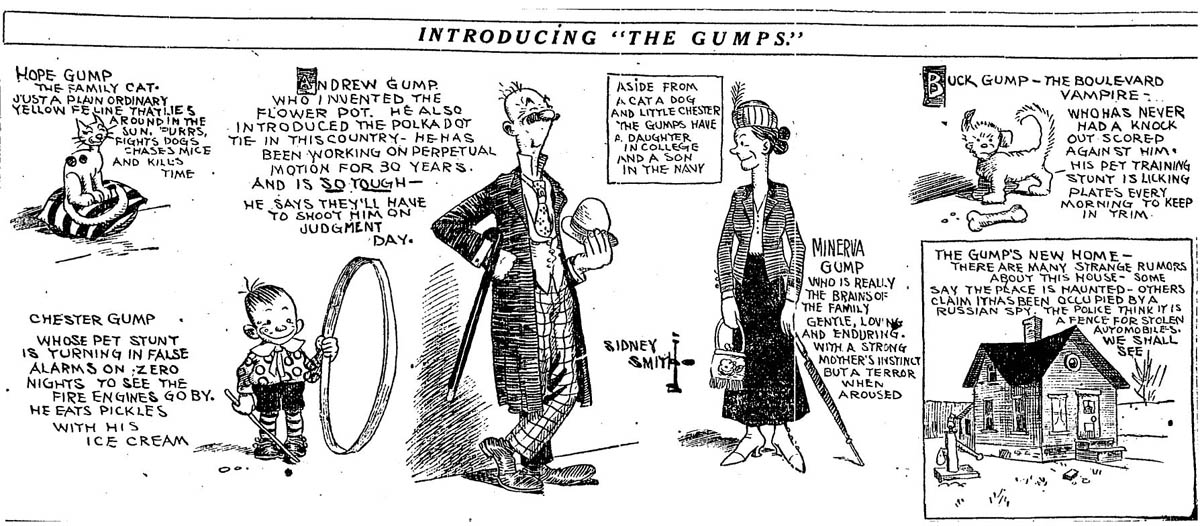
I'd come across the only -- and I'm pretty sure about that -- public statue of the comic strip character Andy Gump. He looked vaguely familiar. I had to read the plaque to remind myself who Andy Gump was. I'm sure I've seen a few examples of the strip he was in, The Gumps, but on the whole the character had made a light impression on me. Until now: I'll remember the statue.


It would have been better if Andy had been placed a little lower, since it loses some of the impact if you can't see his odd, chinless face easily. Oh, well.


Apparently the creator of the strip, one Sidney Smith, lived in the town of Lake Geneva, and at one point the Chicago Tribune had a statute of Andy Gump made for Smith, such was the enormous popularity of the comic. Discontinued in 1959, now it's completely obscure. I doubt that even in the most perverse reaches of Hollywood is anyone dreaming of a modern version of The Gumps, any more than Barney Google and Snuffy Smith are poised for a come back, even though Barney now shares a name with the backbone of the digital age.


But I checked: Barney Google and Snuffy Smith is still being drawn. I guess I don't follow newspaper comics very closely, since I don't think I've seen it in 20+ years. According to King Features (the same comic plantation on which Popeye still toils), the strip is only on its third artist since its creation in 1919, and "this tremendously popular feature boasts clients in 21 countries and 11 languages." Greater longevity than Andy Gump, and of course Barney figured in an immortal pop hit once upon a time, too.

Labels: , ,

Thursday, March 08, 2012

Bowling for Soup

Got a new client, so these have been busy days. I'm also going out for events now a bit more than I used to, which mostly counts as a good thing. Because sometimes I stumble across items like the following.


I went to a small expo last week and saw several structures like the one above. They were in the atrium just outside the meeting space. My notes fail me on what this particular item was supposed to represent, but as the picture shows, it's built out of canned goods, mostly ravioli and pork 'n' beans. It was built to raise money for the Northern Illinois Food Bank. You "voted" for the nonfresh food structure you liked best by putting at least a dollar in the collection box near it.


Not quite all the structures were built of cans. The one above, for instance, was called "Bowling for Soup." The lane is made of spaghetti boxes and the pins are bottled water, with only a few cans of soup holding up the boxes of Saltines. I liked this one best, so it got my dollar.

Labels: ,

Tuesday, February 21, 2012

"Spirit of the Prairie" by David Alan Clark

Schaumburg Square here in the northwest suburbs is mostly retail -- a grocery store, some small in-line shops, a freestanding ice cream parlor and a restaurant. It also includes the Schaumburg Township Library and a pond with a fountain that sprays in the warm months. Near the pond (and the ice cream shop) is "Spirit of the Prairie," a bronze pair by David Alan Clark installed in 2002.


Saturday's warmish weather encouraged me to take a close look at it.


The Wyoming-based Clark's web site says that he specializes in "public monuments, portraits, wildlife and historic themes." I'm glad to see that he's done a statue of John Wesley Powell, located at the Sweetwater County Museum in Green River, Wyo. The Schaumburg Square statue counts as an historic theme. Schaumburg used to be a farming town, after all.


Now it's the Retail Capital of the Universe. That's my nickname for it, anyway. In the background above is the square's clock tower, fuzzily documenting the fact that the picture was taken at about 3:10 p.m.

Labels: ,

Sunday, December 18, 2011

Item From the Past: Urakami Cathedral

We happened to be in Nagasaki around Christmastime in 1993, and visited St. Mary's Cathedral, better known as Urakami Cathedral, after the district in the city in which it's located. We were there during the day and then in the evening on Christmas Eve, to attend church.


The place has a melancholy history. Begun in the late 19th century after the legalization of Christianity in Japan, the cathedral was finished in the early 20th century. On August 9, 1945, it was only about a third of a mile away from the atomic bomb blast, and so destroyed. The current structure dates from 1959, with a renovation in 1980 to make it more closely resemble its original French Romanesque style.


Not far away is the Nagasaki Peace Park, where you can encounter this 30-foot fellow, created by Sculptor Seibou Kitamura, a Nagasaki native.


I'm not versed on Buddhist iconography, but I'd guess that the sculptor took inspiration from it. In any case, the Nagasaki Tourism Guide says that "the raised right hand points to the heavens to signify the threat of atomic weapons while the left arm is raised horizontally to represent the wish for peace."

Labels: , ,

Sunday, November 06, 2011

Item From the Past: St. John the Divine Detail

On November 5, 2000, I did a walkabout in Manhattan, including a visit to the Cathedral Church of St. John the Divine and some other points of interest. The cathedral is a magnificent house of worship, well worth the effort to get there from more commonly trod parts of Manhattan. (The cathedral also inspires crackpots. One web site I saw warns the world that "the cathedral tricks unsuspecting church goers into its occult house of worship," run by the masons. Ah, those masons.)


The three-ton bronze doors of the cathedral, which are works by Henry Wilson, and the Rose Window above the door, are justly famous. My photography of those famed features didn't turn out so well. But I did like this shot of some of the stonework around the doors, scanned in black and white. An assortment of saints, I assume.


If I've read my sources correctly, the work only dates from the 1990s, when British stonemasons came over to train Americans in the art for the purpose of continuing work on this famously unfinished cathedral. (Masonry being a lost art in the United States. Unless the masons secretly control everything.)

Labels: , , ,

Thursday, October 06, 2011

Norma Jeane and the Robot King

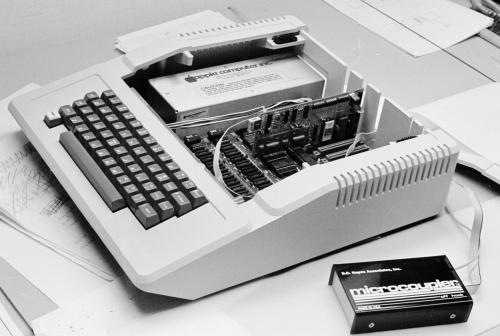
In the summer of 1978, I took some summer school classes and one day happened to be at the school library after class when two fellows I knew, Lester and Trey, brought in an odd-looking piece of equipment and took it to one of the library's audio-visual rooms, where they fooled around with the thing, connecting it to a television. It was an Apple II.


Whose machine it was or where they got the money for it, I don't know. I joined them for a while, but soon decided it wasn't my kind of hobby. A lot of other people felt differently and, eventually, I also came around to an admiration for Apple products. RIP, Mr. Jobs.


After poking around the Lurie Garden downtown on Sunday, we walked northward on Michigan Ave. until we reached the giant statue of Marilyn Monroe near the Tribune Tower. It's the work of J. Seward Johnson, the same fellow who did the play on "American Gothic" a couple of years ago. That statue, I liked. Johnson added a fillip to the icon, the suitcase with the travel stickers. By contrast, the 26-foot "Forever Marilyn" statue had no extra touches to make it interesting. It's a straightforward reproduction of the publicity images for The Seven Year Itch, and shows exactly zero imagination on the artist's part.


Marilyn Monroe needs to be left to rest in peace anyway. Marilyn Monroe and Elvis Presley and Buddy Holly and James Dean; enough already. Next summer's going to be the 50th anniversary of her death, and I'm sure we'll hear all about it for days.


How about a giant statue of Jane Russell and a pistol, if the subject is to be a mid-20th-century sex symbol? But if the statute must be Marilyn Monroe, what about a giant figure based on this photo? A fetching brunette holding a propeller. Call it "Norma Jeane and the Propeller." Now that would be different. People might be shocked to see her brown hair.


At the southeast corner of Michigan Ave. and Wacker Dr., we saw the "Robot King" doing some busking.


He did his robot dance. A nearby sign said that he's from Miami, but other than that, I haven't found out anything else about him. This little-watched video gives some idea of his act. I thought he was more interesting than the overblown pop icon not far away on Michigan Ave.

Labels: , , ,

Tuesday, August 30, 2011

The National Sculpture Garden

I forgot to mention that the West Building of the National Gallery of Art now occupies the site formerly occupied by the Sixth Street Station (Pennsylvania Station) of the Baltimore and Potomac Railroad, built in the 1870s and demolished in 1908. On July 2, 1881, President Garfield went to that station to leave town, since anyone with any sense leaves Washington during summer, but instead was shot by Charles J. Guiteau there.


While the station stood, a plaque marked the spot. As I knew from reading Assassination Vacation (Sarah Vowel, 2005), nothing marks the spot now. But near the U.S. Capitol, Garfield has a statue. I didn't see it this time around.


Across 7th St. from the West Building is the National Sculpture Garden, bounded by 7th St., Madison Dr., 9th St. and Constitution Ave. It's a part of the National Gallery of Art, and relatively new, opening only in 1999. At its heart is a large fountain. Not an ornate one -- you might expect a little sculpture at such a place -- but still a great place to sit and soak your feet. Dozens of people were doing that on the warm late afternoon we visited. We all did too.


The garden has 17 works installed in the landscaped area around the fountain. Below is probably the best known of them, "Typewriter Eraser: Scale X" by Claes Oldenburg and Coosje van Bruggen (1999), with an orange traffic cone for scale. I don't think I've seen a regular-sized one in years. A typewriter eraser, that is. I suppose that's part of the charm.


These are two views of the stainless steel and concrete "Graft," by Roxy Paine (2008-09).


Next is "Moondog," by Tony Smith, who died in 1980. The painted aluminum work was created posthumously in 1990, based on versions done in 1964 and 1970.


Finally, "Thinker on a Rock" by Barry Flanagan (1997).


The rest of the works can be seen at the National Gallery's web site, except that it needs to be updated, since "Graft" seems to have taken the place of a work called "Cluster of Four Cubes," which is still listed.

Labels: ,

Monday, August 22, 2011

Here a Memorial, There a Memorial

The best map of Washington DC that I found during our trip -- unfortunately late in the game, on the second-to-last day -- was a federal government folding map called "Seeing the Nation's Capital." It's a National Park Service publication (GPO: 2011 365-615/80616) with distinctive black borders, a detailed map of central Washington on one side and some historic notes on the other. I enjoy just looking at it. Besides streets, railroad lines and bodies of water, the map features government buildings of all kinds, including the Smithsonian museums, greenspace and parks, easy-to-read street names, Metro stops in their precise locations, and of course memorials.


Washington is lousy with memorials. It's also one of the few places in this country where memorials get their due. Or at least the major ones do in the peak summer tourist season, though I recall a fair amount of tourist interest even during previous visits in November.


The ride to the top of the Washington Monument is so popular in the summertime that early in the morning the Park Service runs out of the free tickets it allots for each day. We stood at the base of the monument in the gathering dusk last week -- a literal and figurative golden time to do so -- and admired the 555-plus-foot obelisk, the tallest stone structure on Earth, but couldn't get in. A lot of other people were doing the same.


"Can I touch it?" Lilly asked when we arrived at the base of the monument. "Of course you can," I said.


Lilly thought of and executed that gag shot. I'm reminded of a photo I saw recently of three or four people posing for photos to look like they're holding up the Leaning Tower of Pisa, except that the photographer caught them at a completely different angle, so it looked like they were simply holding out their arms at random.


After dark, the Lincoln Memorial glows with soft light from the interior spilling out past the columns. Daniel Chester French's giant Lincoln looks down from his chair, as he always does. People look up at him. More people course up and down the steps. Even more people sit on the steps or wander around the front of the memorial. Under the main level of the memorial is a lower-level museum. A lot of people were there as well. I suppose the crowds thin out during the wee-est of the wee hours, but how many other memorials anywhere attract visitors well past the dinner hour?


Here's the crowd at the foot of Lincoln. It's a blurry image, but the best one I took. So let's call it my Hipstamatic shot of the Lincoln Memorial crowd, even though I don't have that app -- that way the picture's technical shortcomings are really just part of its retro charm.


Around the banks of the Tidal Basin, the most visible structure is the Jefferson Memorial. I walked up to it in the summer of 2011 trying to remember whether I had, in fact, visited before. You'd think I'd remember something like that, but no. It wasn't as crowded as any of the memorials on the National Mall, but still hosted a healthy contingent of sightseers, seen here admiring the central bronze statue of Jefferson, towering figure of the Enlightenment, or reading his words inscribed on the walls.


The 19-foot figure of Jefferson, I was interested to learn, wasn't present at the memorial's dedication on April 13, 1943, the bicentennial of his birth. It weighs about five tons, and not even a project so strongly supported by President Roosevelt could get that much bronze in the face of wartime restrictions. The statue, by Rudulph Evans, was finally installed in 1947.


John Russell Pope, who designed the memorial, apparently took inspiration from the Pantheon and, appropriately, the Jefferson-designed Rotunda at the University of Virginia and maybe Monticello too. Some sources (besides Wiki) note that when the memorial was new, its neoclassical design wasn't popular among critics besotted with modernism, but I shutter to imagine some modernist excrescence on the site instead.


I liked the fact that the Jefferson Memorial is open on all sides, which allowed a cooling breeze to waft in. The Lincoln Memorial, open only on one side, had no such amenity, and in fact felt extra stuffy during our summer-night visit, probably because of all the bodies generating heat.

Labels: , , , , ,

Wednesday, July 20, 2011

Brookfield Pics

I took my camera to the zoo last week, but didn't have much luck capturing any decent images of any animals. I didn't even get a good shot of the zoo's relatively inanimate Roosevelt Fountain. The fountain, according to the zoo web site, "honors one of the country’s most enthusiastic conservationists: President Theodore Roosevelt. Alfred Hamill, founding trustee, was the guiding spirit behind the creation of Roosevelt Fountain, which was dedicated on May 14, 1954, in the presence of some 700 dignitaries.


"Prior to the celebration, Sylvia Shaw Judson, noted sculptress and wife of then Chicago Zoological Society president Clay Judson, created four statues that still stand today as symbols of the President’s character: statesman, naturalist, hunter, and soldier."


I need to give those statues a closer look sometime, since I think they're the ones ringing the plaza whose focus is the fountain itself. They aren't statues of the president himself -- I would remember that -- but I can't remember exactly what symbols Judson used.


A riot of gorgeous flowers surrounds the fountain this time of year. Lilly was able to capture it.


I think those are coneflowers. The fountain is barely visible in the background, but who cares. The original image reminds me of a picture for some glossy, photo-heavy calendar.


Lilly also hand her hand at some animal pics, and came away with some good shots. Such as a small tower of giraffes.


And a feeding zebra.


I took at least one pic that I like, if only for sentimental reasons. My family in front of the penguins.


I took that pose because I remembered another photo I took, similar in background, but when my family was a little smaller than it is now.


Yuriko and Lilly and the Brookfield Zoo penguins, circa 1999.

Labels: , , ,

Monday, June 13, 2011

The Incredible Three-Headed Lincoln

In the mid-1800s, Lockport, Illinois, was an important town on the Illinois & Michigan Canal, which was nearly 100 miles of 19th-century engineering prowess that connected Lake Michigan with the Illinois River and thus the Mississippi. Aside from a spontaneous visit to a Lockport Sonic a few years ago, we hadn't been to the town or its historic district in a long time -- since Lilly was very small, maybe the late '90s. We went again on Saturday. Since our last visit, a plaza called "Lincoln's Landing" has been created. It was dedicated on Lincoln's bicentennial birthday in 2009, in fact.


Lincoln's Landing is next to the canal and also near the handsome limestone Gaylord Building, which used to house the headquarters of the canal. Renovated in the late 20th century, the Gaylord Building now is owned by the National Trust for Historic Preservation and houses a restaurant and a museum about the canal. We took a look around the museum, which isn't that large and charges no admission (so I was happy to put a little in the donation box). Of particular interest to me was a room devoted to Lincoln and the I&M Canal. As a Whig believer in internal improvements, he was a supporter of the canal throughout his political career, though I imagine that once he became a railroad lawyer, his attachment wasn't quite as strong.


The room displayed a map of Lincoln's circuitous route back home to Springfield after his single term in Congress. If I'd read about the trip before, I must have forgotten it, but the way home in 1848 for the future president took him on a speaking tour of New England on behalf of presidential candidate Zachary Taylor and the Whig platform; then along the Erie Canal to Buffalo, where he met VP candidate Millard Fillmore; then by steamer to Detroit and afterwards to Chicago, which took him through the Straits of Mackinac; and from Chicago to Springfield. The trip can be reviewed in the September and October 1848 pages of this astonishingly detailed web site, the Lincoln Log.


So did Lincoln come to Lockport in 1848 or any other time? Make at speech at the site of the Lincoln Landing in Lockport? Do anything in Lockport? Well, maybe. He got around a lot, especially in Illinois. Search the Lincoln Log and "Lockport" comes up twice, neither mention in the context of the man visiting the town, but surely not every place he went was recorded. No matter; every town in Illinois needs a Lincoln site, so Lockport now has one.


Complete with its own odd Lincoln statue as a centerpiece. I've seen a few Lincolns in my time, but none quite like this. I took to calling it the Incredible Three-Headed Lincoln.


Three-Bodied would be more like it, since the bronze Lincoln bodies are joined. It's the creation of by a Brooklyn-based artist, David Ostro, for his first major commission. "Unlike the 200 or more existing statues in the U.S. which showcase the former president in formal propriety, the life-size bronze at Lincoln Landing offers a surprising change from the usual expectations," says the press release issued on behalf of the artist. (One quibble: former presidents are those men who have held the job in the past but who are still alive. Two Bushes, a Clinton and a Carter at the moment.)


"The artwork depicts Lincoln as a young Illinois legislator on his visit through Lockport in not one, but three interlocking poses," the release continues, without being specific about that visit. "The work is installed on a reconstitution of the old I&M Canal wall. The base of the statue captures a seated Lincoln dangling his legs off the edge of the wall, reaching a hand into the depths of what was once canal water, though now only earth remains. A second figure draws out of this seated form, pushing upwards, contemplating a discovered object closed in hand. With the third figure, Lincoln finally stands. Determined to gain his balance on the landing, he tears upwards and outwards from his former selves and pockets the mysterious object."


Pocketing a "mysterious object"? Is that really part of Lincoln lore? What did he find, one ring to rule them all?

Labels: , , , ,

Wednesday, June 08, 2011

More Works of Metal

School's out and Lilly reported attending a water-balloon fight at a friend's house today, followed by swimming at a nearby outdoor pool. Ann took up the task, after the heat of the day was wearing off, of learning to ride a bike without training wheels. It can hardly be much more summer than all that, especially considering that today was the third day in a row over 90° F. But tomorrow will be 20° cooler. Such are Northern summers.


More from the Skokie Northshore Sculpture Park. This is the painted steel "Revival," backed in this shot by one of the tall willows near the banks of the North Shore Channel. Sculptor: Joseph Eisenhauer of North Carolina.


"Baile de Alacrán," a work of galvanized steel by Ted Garner, who is this fellow, also known as Ted Sitting Crow Garner, of the Standing Rock Sioux Tribe.


"Inside Plant," a welded steel work by Andy Zimmermann, originally from West Virginia.


This is what the work looks like, looking up from where Lilly was standing.


Labels: , ,

Tuesday, June 07, 2011

The Skokie Northshore Sculpture Park

Between the North Shore Channel (pictured yesterday) and the busy McCormick Blvd., there's a long strip of parkland, and by long, I mean two miles or so. It's the home of the Skokie Northshore Sculpture Park.


Its web site discusses its origin: "The land [owned by the Metropolitan Water Reclamation District of Greater Chicago] had been sorely neglected for a number of years and was by the mid-1980s a community eyesore. The district developed guidelines and wanted suggestions for its improvement. The Village of Skokie came forward with plans to turn the area into a recreational park with biking and jogging paths, seating areas, etc. At the same time, a group of private citizens proposed using the park to display large-scale contemporary sculptures.


"What evolved by 1988, was... a collaboration between these two entities. The village cleaned and landscaped the area and created parking lots, pathways, benches and other amenities. The citizens incorporated as a private not-for-profit organization with a mission to select, install and maintain a world-class sculpture exhibition..."


I never met a sculpture park I didn't like, so we spent some time looking around. But it is a two-mile park, so we didn't see all of it, only the section just south of Dempster. We took in plenty of intriguing works all the same. My own favorite was "La Souterraine," a collection of iron beams fixed to the ground and topped by portraits of faces, also in iron and roughly at eye level, that look all the world like death masks.


Though (seemingly) reposed in death, almost all of the faces are streaked or spotted with bird droppings.


The artist is Robert Smart of Minneapolis, about whom a simple Google search turns up only a little, and I'm not willing to dig deeper for non-paying writing. But I'd say the man has some talent.

Labels: ,

Sunday, May 22, 2011

Face to Face With the Bean


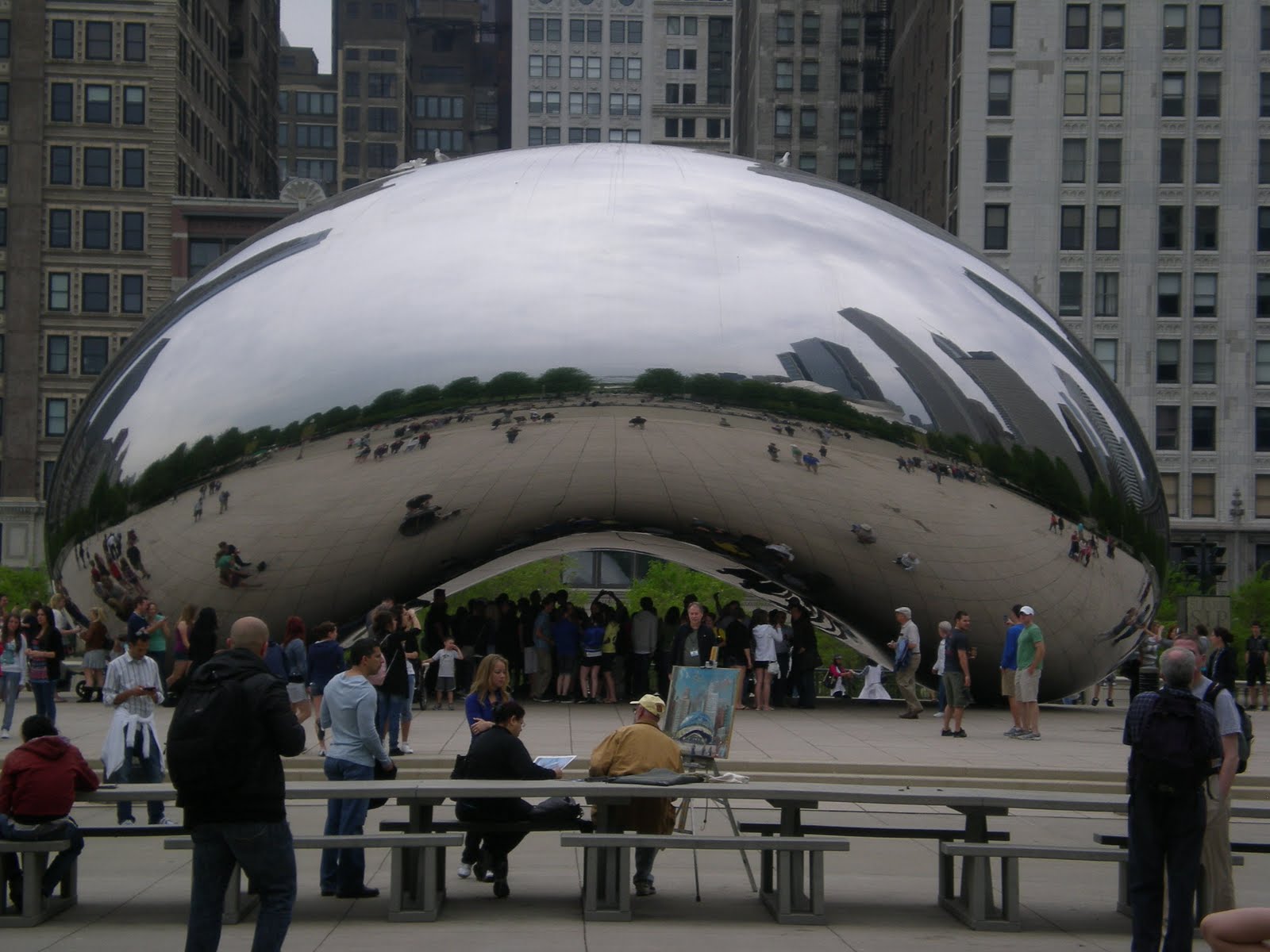
The Chicago Bean is easily the most popular public work of art in the city, and probably the most photographed one as well. On Saturday I stood next to the Bean for the first time in a few years, taking my own pictures, since who am I to reject the verdict of an adoring public?


I took a little extra time not only for pictures of the sculpture, but also of people taking pictures of the sculpture. I didn't capture it, but at one moment I counted no fewer than a half-dozen people on the same side of the Bean steadying themselves to take a picture of it. Of course it helped that, despite predictions of rain, it was a warm, dry day, although cloudy.


According to reports at the time it was built, artist Anish Kapoor disdained the nickname Bean, naming it "Cloud Gate" instead. That's the artist's prerogative, but if the public wants to ignore the formal name in its great admiration for the piece, he's a little churlish to complain about it. Maybe he's changed his mind since then. In any case, the girls were certainly fond of the silvery legume, and Lilly wanted me to take pictures of her near it, possibly to become her updated Facebook profile pic.


But we were only there a short time. Soon after we'd arrived, we heard that the graduation ceremony for the School of the Art Institute, which included my youngest nephew Robert, was under way. That's what we'd come downtown to see. Two nephews graduating from college within the space of eight days. How likely is that? From the Bean we made our way to the Great Lawn of the Pritzker Pavilion not far away. More on that tomorrow.

Labels: ,

Monday, April 04, 2011

Manmade Objects at Spring Valley Nature Sanctuary

This group of figures resides just outside the Vera Meineke Nature Center at Spring Valley Nature Sanctuary in Schaumburg.


It wasn't cold at all yesterday afternoon, so Ann suggested we go to Spring Valley, and we did. The figures were still dressed for winter by unknown hands. I don't think I've ever seen them dressed, but then again we usually don't go to Spring Valley in the winter. They're a Rockwellesque trio. No plaque or other marker describes who made them, and for all I know they're something you can pick up at a garden superstore.


Follow one of the footpaths into Spring Valley's grassland and eventually you'll find some large wooden spools. Probably they had an industrial use once upon a time. Telephone line? Electric cable? Whatever their former purpose, now they sit in a clearing and add visual interest to the place.


About 10 minutes' walk from the nature center is the Merkle Cabin, formerly an office for the peony farm that was once on the site of the nature sanctuary. Among other items near the cabin is this bench.


It's made entirely of cast iron.

Labels: , ,

Monday, February 28, 2011

The Chicago Municipal Device, Hidden in Plain View

RIP, Frank W. Buckles, the last doughboy. The nation salutes you, sir, or at least it should.


Woke up to an ice glaze this morning. On all the nearby sidewalks that is, and our deck as well. February's way of giving us a parting finger. It's been resentful for millennia now about being the shortest month. But the gesture was in vain, since the Sun emerged mid-morning and liquefied the ice. Good riddance, February, don't bother us again for 11 months.


I understand why people aspire to be snowbirds. I doubt that I will ever want to maintain two residences, but if I did, I wouldn't just go south for the winter, I'd really go south. Uruguay, maybe, or New South Wales, where it isn't just a mild winter, it's summer. Any fool can go to Arizona or Florida for winter.


For now, I'm looking forward to examining greater Chicago in more detail as the weather warms. Next time I go downtown, for instance, I'm going to look for the city's "Municipal Device," something I didn't know about until very recently. I've seen it, of course; the design is part of the bright lights of the Chicago Theater marquee, for instance. It just never occurred to me that it meant anything.


Essentially, the Municipal Device of Chicago is a Y shape, and it's been incorporated as a design element in a number of structures in the city. The device even has an official status. With certain exceptions, city-owned vehicles must be marked with it. The origin of the symbol is the Chicago River, which forks into North and South branches downtown. More of a T shape, if you asked me -- a T shape bent by blows from a hammer -- but Y works too.


The device's uses are well illustrated at the fine Public Art in Chicago blog as well as equally fascinating Forgotten Chicago. I especially like the way it's been worked into that steel framework of the Division Street bridge. That's about as Chicago as you can get.

Labels: , , ,

Thursday, February 17, 2011

Kup's Statue

Back again on Tuesday. I should take "Presidents Day" seriously, after all. Maybe even call it Washington • Adams • Jefferson • Madison • Monroe • Adams • Jackson • Van Buren • Harrison • Tyler • Polk • Taylor • Fillmore • Pierce • Buchanan • Lincoln • Johnson • Grant • Hayes • Garfield • Arthur • Cleveland • Harrison • Cleveland • McKinley • Roosevelt • Taft • Wilson • Harding • Coolidge • Hoover • Roosevelt • Truman • Eisenhower • Kennedy • Johnson • Nixon • Ford • Carter • Reagan • Bush • Clinton • Bush • Obama Day, but that seems like a mouthful.


The winding double-decker Lower Wacker Drive in downtown Chicago is unlike any other road I know. Astonishingly, Lower Wacker even has its own Yelp page. I didn't know that roads had Yelp reviews, but come to think of it, there's no reason they couldn't. Lake Shore Drive has even more reviews. The category is "local flavor."


I ought to write at greater length about Lower Wacker someday, but I didn't go to there on Tuesday. Instead I spent a while on Upper Wacker, where I took a close look at this statue, which is near the intersection of Wabash and Wacker. The lighting wasn't ideal in mid-morning, but I managed a passable image.


It's Irv Kupcinet, of all people. The world's a large place, but I suspect he's one of the few 20th-century newspaper gossip columnists to become a life-sized bronze on a major metropolitan thoroughfare. Just a hunch. The statue's not that new, having been dedicated in 2006, but Wacker hasn't been a haunt of mine since before that, so this was my first good look at it.


"Kup," as he was known professionally, died at 91 years of age in 2003. Evidently some well-connected Chicagoans wanted, or at least approved of, a statue in his honor. Mayor Daley probably had to sign off on it more than anyone, and he has a quote praising Kup on a plaque on the plinth. Donors are listed below Daley, including some instantly recognizable wealthy Chicago families and a handful of corporations. It's good to see that the Sun-Times chipped in, since in his heyday Kup helped them sell a lot of papers. Preston Jackson, a professor of sculpture at the School of the Art Institute, did the sculpture, though the plaque omits that information.


An article called "The Lost World of Kup," published by Chicago Magazine not long after his death, noted that "at his peak, Kup was a celebrity news machine -- producing six columns a week, moderating a late-night TV talk show, delivering color commentary on radio for the Chicago Bears."


That would have been 50 or 60 years ago. But Kup's Column in the Sun-Times was around long after that, as recently as at the time of his death, when his assistant was actually writing the thing. I don't know anyone my age or younger who paid any attention to it.


By the end, according to Chicago Magazine, " 'Kup's Column' had long since lost its spark... the column survived for the last decade and a half as an echo of another time and another city. That city came alive in the dark. It sparkled with glamour and intrigue and featured Hollywood stars, powerful politicians, mobsters who 'owned the night,' as one woman put it, and grateful press agents who sent crates of loot to accommodating reporters. Kup's Chicago existed largely in a handful of smoky venues with evocative names like the Chez Paree, the London House, the Black Orchid, and Club Alabam..." The entire article is here.


Now the statue carries on a struggle against obscurity on behalf of Kup, as new generations mature who have never heard of him. He stands across the river from where the Sun-Times Building used to be (Trump is there now), holding a bronzed version of a newspaper, a dying medium, under his bronze arm.

Labels: , ,