Sunday, August 19, 2012

Item From the Past: Everywhere a Sign

I've read speculation that someday outdoor signs as we know them will be quaint relics, or be gone all together, because your GPS cloud gizmo is going to tell you all the information you need about a particular place in granular detail. In this country, anyway, here's how it would play out: as complete connectivity spread down the income scale deep into the middle class, budgets to install and maintain physical signs would shrink and disappear, since only poor people and eccentrics would need physical signs.

The infrastructure of signs would, decade by decade, disappear. Much would be lost, and only poor people and eccentrics would care. Which means, in practical terms, that no one would care.

Fortunately, I don't expect to live to see such a nightmare. For now, I'll take notice of signs. The more unusual, the better. Last year in Washington I snapped pics of a few odds ones. Such as this one at a parking lot not from from the U.S. Capitol.


This one warned thirsty passersby that the water of the Tidal Basin would do you wrong if you drank it, and I don't doubt it. I suppose the Tidal Basin counts as a finger of the Potomac, hence "river."


And this is one of the more imperious signs I saw in the city, at the pedestrian crosswalk on Connecticut Ave., just in front of the National Zoo.


How would a sign like this work in a world in which people depended on GPS gizmos to know where they were at all times? Would it blare out a DANGER, DANGER, WILL ROBINSON sort of warning? That might be amusing. Once.

Labels: ,

Sunday, August 12, 2012

Item From the Past: Arlington National Cemetery

I took a lot of pictures at Arlington Nat'l Cemetery this time last year. Such as the memorial to the sailors lost on the Maine, built using one of the masts of their ship.


The Confederate Memorial is in a quiet corner of the cemetery, away from the tour bus route.


Pretty much by chance, I saw the graves of some noteworthy people. Such as Robert Fechner, director of the CCC for most of its existence.


Oscar York, a Tuskegee Airman.


Also, the two memorials to the lost Shuttles. First, Challenger. The lost crew should have a memorial – but one with bronze astronaut faces that all grin like jack o’ lanterns?


The Columbia memorial, with its flight-patch in bronze, is near Challenger. Much more dignified, I thought.


Labels: , , ,

Thursday, July 26, 2012

Gem of the Lakes © 1990

There’s a plaque at the foot of the larger-than-life bronze sculpture in the Winter Garden at 311 S. Wacker in downtown Chicago, which is also part of a fountain. The plaque says: GEM OF THE LAKES © 1990 Raymond Kaskey.

Kaskey is best known as the “principal artist” -- the detail man, in other words -- of the World War II Memorial in Washington DC, designing the bronze eagles, the wreathes, the many bas-reliefs, the haunting bronze star field on the Wall of Valor, even the flagpoles. As such, I’d say he did a fine job. It was the overall design by architect Fredrich St. Florian that didn’t greatly impress me.

I thought that © was odd, right there permanently on the bronze plaque. But then I read about another statue by Kaskey in Portland, Ore., called “Portlandia” (1985). Joseph Streckert writes in Not For Tourists, “Downtown Portland's Fifth Avenue transit mall has a lot of what you would expect -- buses, trains, and commuters, for instance. Look up, though, and you might notice a giant woman holding a trident.

“Sitting on the ledge of Michael Grave's postmodern Portland Building is 'Portlandia,' a symbol of Portland that never took root...  Most of this can be attributed to artist Raymond Kaskey's retention of 'Portlandia's' copyright. Kaskey never allowed his work to be put on key chains, t-shirts, shot glasses, or calendars. Portlandia was to be in the (not very good) Madonna film Body of Evidence, but Kaskey sued Paramount and had footage of his statue removed from the final cut.”

So the © is in character. If Kaskey feels that strongly about it, I won’t publish any pictures of his statue here, fair use though it may be, and it will just another (incredibly minor) step on the way to future obscurity for him and his work, despite the high visibility of the WWII Memorial. It’s a moot point anyway, since the light wasn’t right for good pictures, especially of the face. But of course other people have published images: Google Images reveals some, including the statue wearing a Blackhawks jersey, which must have been after that team won the Stanley Cup.

Emporis, at least, describes the work this way: “It depicts a large Neptunian figure drying himself over a seashell fountain.” I’ll go along with that. A buff dude with a long beard. And still very green after 20+ years, so building management must keep him nice and clean.

Labels: , ,

Wednesday, August 31, 2011

Washington Leftovers


On some days during our time in Washington, I would get up early and walk around by myself in the neighborhood around our hotel, which stands at the corner of 15th St. and Rhode Island Ave. I was among other walkers, joggers, bicyclists and dog-walkers and their dogs, and I passed shops, restaurants, the embassies of various nations, foundations, nonprofits, trade associations, churches, gardens and small parks. But more than any of those, restored row houses and mature trees gave the neighborhood its charm.


The still-blooming flowers helped, too, even this riot of past-prime sunflowers.


Just down the street from the hotel on 15th was Grace Reformed Church. While in Washington as vice president and president, Theodore Roosevelt was a member of this church, often walking to Sunday services from the White House, presumably in the company of barely necessary bodyguards, considering TR's big-stick personality. I passed by the church often, but never saw it open.


Neighborhood details, such as the green fire alarm boxes, were easier to access.


A sign on the box said, "Fire alarm boxes such as this one (originally painted red) were installed in the District after the Civil War. Telegraphs transmitted the box number (top) to a fire alarm center. This system was used until the 1970s, when the boxes were converted to a telephone system. By the 1990s, the callbox system had been replaced by the 911 system and was abandoned." As recently as that?


Not all statuary in Washington is of the memorial or monumental variety. This fellow exults across the street from Grace Reformed Church.


Still, some of our area's statuary was quite traditional, down to frequent visits by pigeons, which I saw atop the heads of Daniel Webster and Winfield Scott, both of whom have statues at Scott Circle. Also near the circle is this monument -- a highly aesthetic one, I thought, even if it honors an odd choice: Samuel Hahnemann (1755-1843), father of homeopathy.


I'll give Herr Dr. Hahnemann the benefit of the doubt, since standard medicine in his time was dodgy at best. "Like cures like" was probably as reasonable as most medical ideas of the time. In our time, there's no excuse for homeopathy. There might as well be an aesthetic memorial in Washington to Franz Joseph Gall for developing phrenology.


On one of my walks I discovered Trio, which is at the corner of 17th St. and Q St.
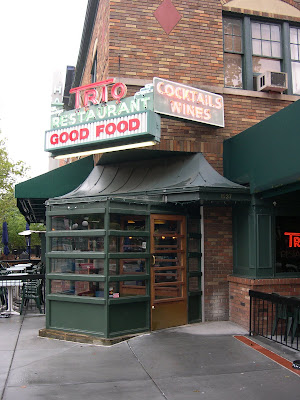


Make that re-discovered, because I'd eaten lunch there on May 8, 1982. There were few other eating options on that particular stretch of 17th at the time. I had veal, served by a waitress with intensely white hair. While not top-notch, the meal had satisfied me as greasy spoons often do.


In 2011, I recognized Trio instantly. The memory rushed back all at once. I hadn't remotely expected the place to still be there after almost 30 years, or even thought about looking for it before I chanced upon it again. The next day we all went there for breakfast, eating al fresco on a flawless summer morning. I had tasty French toast and felt a little of the old satisfaction return. As we were leaving, I spoke to the owner, a gentleman somewhat older than I am. His father, a Greek immigrant, had opened the restaurant in the early 1950s, and it had survived the decline of the neighborhood and later its gentrification -- no mean feat in either case.

"You know, I ate here almost 30 years ago," I told the proprietor.

"You ought to come back more often," he replied.

Early on, I also discovered an upmarket grocery store in our temporary neighborhood, part of a successful national chain. We foraged there a fair amount. One day as I was looking for a small container of milk at this store, standing there in front of a refrigerated case with one of the doors open, a face suddenly appeared in one of the gaps left by removed milk cartons. "You got everything you need, son?" said a man, visibly older than me. I was startled, but said I did. It was a retail experience unlike any other.


We often exited the Metro at Dupont Circle and walked back to the hotel from there. The area around the circle been gentrified. Or, as a native of the Washington area told me, it's "less stabby" than it used to be. But there still seem to be comedians roaming the area.


I like that post, but I don't think I was the first one. Note the building behind the post. It's the embassy of Iraq.


On the whole, the Metro proved reliable for getting around town, though I only speak as a tourist, not a long-time commuter. I'd forgotten the waffle-iron ceilings inside the stations and how often one changes at Metro Center, but it all came back to me. We noticed fairly quickly the high number of down escalators (and a few up ones) that weren't working -- broken due to deferred maintenance or off due to energy costs? Either way, it was annoying.


The voice of the people says so too. This was on a bench at I forget which station.


Dupont Circle's north entrance had the worst of the bum escalators -- 188 feet deep, with the down escalator not working. It's just a down escalator, right? What's the problem? Going down that many steps, especially steel-grooved escalator steps, was mesmerizing, and not in a good way. So we avoided that entrance for boarding the Metro from then on.


While walking around the Tidal Basin, the bottom of one of my shoes came loose. Not completely off -- but enough that I suddenly had a long rubber flap hanging from the bottom of the shoe, making walking a tricky business. Lilly lent me a hair band and I wrapped that around the shoe. It was a temporary fix. Every few hundred feet, the flap would come loose and I would have to re-wrap it. But I managed to see the Jefferson Memorial, the FDR Memorial and the line of cherry trees around the Tidal Basin in that condition. The next day I went to the posh retail nexus at Connecticut Ave. and L St. and found one of the street's non-posh retailers, Filene's Basement, where I scored some new and very comfortable shoes for $38.


Though famed for their brief flowering -- as they should be -- the Tidal Basin cherry trees are also remarkable in summer. The oldest ones are near the new MLK Memorial. Seldom have I seen such gnarled specimens in such profusion, almost blocking the path in places, hogging their patch of the ground tenaciously. It looks like the Park Service long ago planned for the time when these cherry patriarchs, a 1912 gift of the Japanese Empire to the United States, die off. In a lot of places I saw younger cherry trees planted a little further from the edge of the water.


The Reflecting Pool and much else besides between the World War II Memorial and the Lincoln Memorial is currently fenced off for renovation. The sun had already gone down by the time we headed toward the Lincoln Memorial, so the area beyond the those fences was dark and forbidding. But at one point I could see the outline of the District of Columbia World War Memorial off in the distance.


I stumbled across that memorial on a previous visit to Washington. Dedicated to the 499 residents of DC who died in World War I, it was forlorn and in bad shape when I saw it. But maybe someday it will be the national memorial for all the Americans who died in the Great War. The doughboys should have one. Go ahead, sign the petition.


Abner Doubleday is buried not far from Arlington House at Arlington National Cemetery. There's no mention of baseball on his stone, since that story was made up some years after his death. Elsewhere, we saw Audie Murphy. I told Lilly who he was.


As I've said before, pay attention to the famed of a cemetery, but don't ignore the obscure completely. While at the national cemetery, I took a look at some headstones at random. It's good for a moment's reflection, if you're in the right frame of mind. What was this soldier's story? I hope someone knows. He survived the war, but died young anyway.


We spent some time in Washington's Union Station, either buying things or eating things. It's a splendid beaux-arts structure by Daniel Burnham, mostly refashioned in our time to be a mall, though it's also Amtrak's main Washington terminal and connects with the Metro. Much history has passed through.


Because I'd read about them beforehand, I knew about the station's Roman soldiers. "The Main Hall... features a 96-foot high, barrel vault with a decorative, coffered plaster ceiling," notes the station's web site. "Standing around the ledge of the balcony is 36 figures of Roman legionnaires hollow cast in plaster with sand finish. The figures were originally cast as nudes, but railroad officials, fearing the public would be offended, ordered shields be strategically placed on each statue. The shields remain in place today."


Indeed they do.


Speaking of statues, there's a mess of them at the U.S. Capitol. We got in for the last tour of the day on a Saturday, which means we saw the crypt, the rotunda, the old House of Representatives chamber and a few other spots, but not the House or Senate chamber, which are closed on weekends. Getting in at all required a timed ticket, a pass through a metal detector and a bag inspection. Future generations will probably have to submit a DNA sample or undergo a retinal scan. I dimly recall passing through a metal detector and wandering around the U.S. Capitol on my own in 1982, as if it were a state capitol.


Among the National Statuary Hall Collection -- each state gets to place two, except Virginia, which gets an extra one for Washington -- I spied Ronald Reagan, Jack Swigert, Caesar Rodney, Kamehameha I, Dwight Eisenhower, Ephraim McDowell, Huey Long, Hannibal Hamlin, Samuel Adams, Gerald Ford, William Jennings Bryan, Po'pay, John Burke (of North Dakota), James Garfield, Andrew Jackson, Sam Houston, Washington and Jefferson. I looked in vain for Philo T. Farnsworth, since who wouldn't want to see him?


On a whim, I took a picture of Lilly at the foot of the John Burke statue. Now she's probably one of the few teenagers in America to have her photo taken with both Burkes, since I took one of her and Burke at the North Dakota Capitol in 2006. Looking at these pictures side-by-side, I see that they are the same statue.


In the Old House Chamber of the Capitol -- called Statuary Hall these days -- there are small plaques on the floor identifying the location of the desks of House members in the chamber (1807-57) who later became president: J.Q. Adams, Tyler, Polk, Fillmore, Pierce, Buchanan, Lincoln and A. Johnson. I found a few of them and had the satisfaction of standing where Millard Fillmore occasionally sat.


It's likely the only memorial in Washington to the 13th President of the United States. Sign the Compromise of 1850 and send Perry to Japan, and that's all you get. Whatever its other seductions, high office doesn't guarantee immortal fame.

Labels:

Tuesday, August 30, 2011

The National Sculpture Garden

I forgot to mention that the West Building of the National Gallery of Art now occupies the site formerly occupied by the Sixth Street Station (Pennsylvania Station) of the Baltimore and Potomac Railroad, built in the 1870s and demolished in 1908. On July 2, 1881, President Garfield went to that station to leave town, since anyone with any sense leaves Washington during summer, but instead was shot by Charles J. Guiteau there.


While the station stood, a plaque marked the spot. As I knew from reading Assassination Vacation (Sarah Vowel, 2005), nothing marks the spot now. But near the U.S. Capitol, Garfield has a statue. I didn't see it this time around.


Across 7th St. from the West Building is the National Sculpture Garden, bounded by 7th St., Madison Dr., 9th St. and Constitution Ave. It's a part of the National Gallery of Art, and relatively new, opening only in 1999. At its heart is a large fountain. Not an ornate one -- you might expect a little sculpture at such a place -- but still a great place to sit and soak your feet. Dozens of people were doing that on the warm late afternoon we visited. We all did too.


The garden has 17 works installed in the landscaped area around the fountain. Below is probably the best known of them, "Typewriter Eraser: Scale X" by Claes Oldenburg and Coosje van Bruggen (1999), with an orange traffic cone for scale. I don't think I've seen a regular-sized one in years. A typewriter eraser, that is. I suppose that's part of the charm.


These are two views of the stainless steel and concrete "Graft," by Roxy Paine (2008-09).


Next is "Moondog," by Tony Smith, who died in 1980. The painted aluminum work was created posthumously in 1990, based on versions done in 1964 and 1970.


Finally, "Thinker on a Rock" by Barry Flanagan (1997).


The rest of the works can be seen at the National Gallery's web site, except that it needs to be updated, since "Graft" seems to have taken the place of a work called "Cluster of Four Cubes," which is still listed.

Labels: ,

Monday, August 29, 2011

The National Gallery of Art

The old copy editor within me is always looking for mistakes in news stories. CNN published an article this morning called "Luxury, horror lurk in Gadhafi family compound," the gist of which is the shocking (shocking, I say) revelation that families of tyrants tend to live in gaudy palaces and abuse whomever is handy whenever the urge strikes, which is often. Anyway, the vanguard of the current Libyan regime change reached one of these palaces, and CNN was there to film it. "We filmed them quixotically studying the labels of Cristal champagne and fine St. Emilion Bordeaux, apparently not realizing each bottle is worth hundreds of dollars," the author wrote, referring to rebels ransacking the palace.

Quixotically studying? In the manner of Don Quixote? Waving the bottles at windmills, maybe? I think "quizzically" is what the writer needed here. I won't be too hard on the writer, because I do this kind of thing often enough -- think of one word and then write a similar one that's completely at odds with the meaning I wanted. But I will be hard on CNN because it's supposed to have someone to catch that kind of mistake. Then again, I checked the same story a few minutes ago, and an editor had removed "quixotically" all together, so someone caught it.

The National Gallery of Art in Washington, DC, isn't part of the Smithsonian. Yet it's housed in two large buildings on the National Mall and doesn't charge admission, so for tourist purposes, it might as well be. The museum also has a feature that many other large institutions of its kind should have more of: places to sit in the galleries with backs. Maybe it's a mark of my increasing age, or just that we walked a lot in DC and appreciated the National Gallery's seating more than backless benches, which seem more common in museums. Of course, the benches can be too comfortable. In one room I noticed a well-dressed middle-aged woman sitting on a bench, fast asleep. A few minutes later, a guard wandered in and gently woke her up.

Comfy benches or not, we didn't spend quite as much time at the National Gallery as we wanted (a persistent theme on this trip), but managed to take note of some noteworthy works, including items I remember seeing before, such as David's "The Emperor Napoleon in His Study at the Tuileries," and others I must missed before, such as "Ginevra de' Benci," which has the distinction of being the only Leonardo da Vinci painting in the Americas. No albino dwarfs in the service of Opus Dei attacked me while I was looking at the painting.

"Gallery of the Louvre" by Samuel F.B. Morse is also currently on loan to the National Gallery, and I spent a while looking that. Morse's backstory is just as interesting as the canvas. Not long ago I read "Henry, Morse and the Telegraph," a chapter in The Heroic Age of American Invention by L. Sprague de Camp (1961), which mentioned Morse's career as an artist, which was notable but not tremendously successful. So he made a career change. As an inventor, de Camp wrote, "Morse was not so much an outstanding inventor as a promoter of an invention and a manager of inventions." There's something to be said for that. It's Morse code, after all.

Done in the 1830s and newly restored, " 'Gallery of the Louvre' depicts masterpieces from the Louvre's collection that Morse 'reinstalled' in one of that museum's grandest galleries, the Salon Carré," says the museum web site. That is, he painted the salon like he wanted it to be, not like it was, and stacked it with paintings he admired.

It's an odd subject to modern eyes. Why paint a painting of paintings? But we're awash in instantly copied and transmitted images. They were not. Paintings of galleries weren't so unusual then, a time of greater scarcity of manmade images, and neither was the hanging of paintings floor-to-ceiling in a gallery, or for that matter, in private homes that could afford them. That was a detail that made me smile, the cluttered museum wall. We imagine that our way of doing things -- such as the spare, uncluttered formality of an art museum -- are timeless practices, but it isn't so.

Also temporarily on display at the museum, in its spacious West Building rotunda, is "The Capitoline Venus," on loan to the United States for the first time. I was glad to see her. She had her own guard, looking a little bored there in the rotunda because mostly people were wandering past the statue and not showing any interest, much less an urge to deface it.

For a statue 1,800-plus years old, the Venus in fine shape. Usually on display at the Capitoline Museums (Musei Capitalolini) in Rome, the work made me ponder certain questions, such as why the hell didn't I visit the Capitoline Museums? Just look at the "Gallery" section at the Wiki page. I've seen most of those works used to illustrate histories or other works about Antiquity, but not with my own eyes. I was right there in the Piazza del Campidoglio, surrounded by the Capitoline Museums, although that was during the evening and I guess they were closed. I did notice that the equestrian statue of Marcus Aurelius wasn't in piazza; air pollution had been eating at him, I think, and he had been taken inside the museums.

Just another reason to go back to Rome, though I suspect the clock might run out on me before I can make it. But if I do go back to the shores of the Mediterranean, maybe Leptis Magna will be easier to visit too, provided things have settled down in Libya. Mrs. Quarles, my Latin teacher in high school, told us of visiting the site in the days before Gadhafi came to power, and somewhere in my head ever since has been a synaptic-based index card reading LEPTIS MAGNA: GO THERE IF YOU CAN.

Labels: , , , ,

Sunday, August 28, 2011

The Church and the Basilica

Two weeks ago we attended 10:30 a.m. services at St. John's Episcopal Church, which happens to be on Lafayette Square in Washington. It's an elegant church inside and out, originally designed in the 1810s by Benjamin Latrobe, Surveyor of the Public Buildings of the United States and the architect who oversaw the restoration of the U.S. Capitol after it burned, among many other projects.


It's also a church steeped in presidential history, counting a number of sitting presidents since James Madison as members. It's been customary since the time of Madison for each president, whatever his denomination, to visit at least once during his term. According to the National Park Service's "A National Registry of Historic Places Travel Itinerary," that even includes William Henry Harrison. Maybe he was heard to be blowing his nose and coughing more than usual during a service in March 1841. There was a presidential visit as recently as this July.


Pew 54 is called the "President's Pew." When the service was over, I went to look for it. Not only is it so marked with a small brass plaque, the kneeling cushions at Pew 54 and a good many other pews in front of it -- there are no built-in kneelers -- have the presidential seal as part of their design, along with the name of an individual president. I suppose they're all represented, from Madison to Obama.


On our last full day in Washington, we rode the Metro to the Catholic University of America and crossed the campus to reach the Basilica of the National Shrine of the Immaculate Conception. It was either there or the National Cathedral, and the basilica won out because we could reach it without the extra bus ride that reaching the cathedral would have entailed. So the National Cathedral remains a sight to see, should I ever return to Washington.


The basilica is enormous. That isn't really the measure of a church, but it's striking all the same, even if you've read about it beforehand. At about 76,400 square feet, the basilica is the largest Catholic church in the United States. A cursory look at Wiki's "List of Largest Church Buildings in the World" puts it at 21st in the world and third in the United States, after the Cathedral of St. John the Divine in New York and the National Cathedral, both of which are Episcopalian. Other sources say it's the 10th largest church in the world. Another way to describe it is about half the size of the interior space of St. Peter's in Rome.


Done in a blend of Byzantine and Romanesque styles, and without structural steel, the Basilica of the National Shrine of the Immaculate Conception is also mind-bogglingly intricate, with dozens and dozens of chapels and side chapels and a few oratories on the main level and down in the crypt level too, many completed with funds from Catholic congregations around the world, such as Mary, Queen of Ireland; Our Lady of Guadalupe; Our Lady of Czestochowa; Our Lady of China; Our Lady of La Salettel; Our Lady of Siluva; Our Lady of La Vang; Our Lady of Bistrica; Our Lady of Lourdes; Our Mother of Africa, and more. Other chapels take their inspiration from the many and varied titles of Mary, such as Our Mother of Good Counsel, Mary Queen of Missions, Our Lady of Hope, Mother of Perpetual Help, Mary, Help of Christians, and more. All the various chapels are ornate, but so is pretty much every surface, nook and cranny of the basilica.


Vaulting overhead are large mosaics. Only one dome remains unfinished in this regard, and I understand plans are afoot to complete a design for it in some future decade. Among all the building's impressive mosaics, the most striking (fittingly) is the depiction of Jesus in north apse. According to the basilica, it measures 3,600 square feet and contains nearly 3 million tesserae. "Christ in Majesty has an apocalyptic nature," the basilica's web site says, "Jesus' strong youthful face and expression is consonant with the earliest images of Him in the Roman catacombs."


Even Roadside America has a take on this image, calling it "Mortal Combat [sic] Jesus." This is a good image of it -- better than on the basilica web site -- as well as a thoughtful blog posting. Jesus does have an unusually fearsome expression, at least to modern eyes, who are used to more placid views of the Savior. It reminded me of that bumper-sticker religious wisdom, "Jesus is coming, and boy is he pissed."


Labels: , , ,

Friday, August 26, 2011

I've Been Around the World and in the Washington Zoo

Actually it's the Smithsonian National Zoological Park, as mentioned on the banner at the Connecticut Ave. entrance on the warm afternoon of August 16. The prospect of an earthquake and then a hurricane wasn't on anyone's mind, I can assure you.


We didn't spend quite as long as we wanted for various logistical reasons, but we did take a look at a number of large animals and some smaller ones, especially in the Small Mammal House -- naked mole rats, meerkats, golden lion tamarins, lemurs, etc. -- where we lingered because of air conditioning.


We also experienced the full force of the zoo's panda cottage industry. Panda marketing begins with this innocuous bronze.


Since the zoo charges no admission, I'll cut the Smithsonian a little slack regarding its eagerness to sell panda gewgaws and gimcracks. But only so much slack. A panda shack near the entrance to the panda exhibit offered some panda merchandise, such as these panda umbrellas.


Stranger still, the shack also sells a t-shirt with the Hello Kitty character wearing a panda suit. For saccharinity, that's like putting honey on sugar cubes. But the shack was small potatoes compared to the indoor Panda Store across Panda Plaza. Pretty much all your panda needs can be met there.


In case shopping for panda merch makes you hungry, and willing to pay $10 for a hot dog with fries, there's always the Panda Plaza Grill.


Finally, the zoo is home to a couple of actual pandas, Mei Xiang and Tian Tian. Unlike the late Hsing-Hsing and Ling-Ling, which I believe played ping-pong (well, maybe not) and were given to the United States by the People's Republic of China in the early '70s, the current pandas are only borrowed from China under an agreement that runs until 2015, unless it's renewed.


As leisurely as a panda's life might seem, Mei Xiang and Tian Tian have to breed or risk being returned. "If... either panda is found unsuitable for breeding, the two institutions will discuss the possibility of exchanging them with breeding pandas from China," the zoo's web site says. So the bears need to get it on. Again. They had a cub about five years ago that was sent to China last year to do stud duty for the pandas there, in as much as that's possible,


The National Zoo pandas were visible during our visit in separate indoor spaces. They were doing what I understand pandas do most of the time, eating bamboo. None of our pics turned out even remotely well, so I'm not going publish them and pretend they're Hipstamatic. But the bears looked well. A lot better than the dirty, flea-bitten pandas we saw at the Beijing Zoo.

Labels: , ,

Thursday, August 25, 2011

Grazing at the Smithsonian

I seem to remember reading, or hearing, years ago that if you spent 10 seconds looking at each item the Smithsonian has in its collection, to the exclusion of doing anything else, you still couldn't see everything in a normal lifetime. Of course, that mass of holdings probably includes warehouses of specimen boxes collected during long-ago decades that no one has looked at since they were hastily cataloged -- after all, who would want a long look at 100,000 kinds of beetles?


Still, even the items on display stagger the imagination. How come there's so much stuff in the world? Do philosophies either ancient or modern deal with this important question? Well, maybe. In any case, the Smithsonian seems to have a sizable fraction of all that stuff.


That was a long-winded way of saying that despite the hours we devoted to the Smithsonian last week, I came away with the feeling that we'd only grazed on a negligible sample. The fact that we were roaming the Smithsonian halls with children added to that feeling. It's good to take your children to such places, but you can't to expect them to appreciate much of it in quite the way you do. They will weave what they see into their own selves according to their own lights. They will also pull you onward through the exhibits whether you're ready or not to quit examining those rare beetles.


"Lilly, look at this," I said. There in front of me at the National Museum of Natural History was some rai money from Yap -- the enormous stone doughnuts from that island that prove that just about anything can be a store of value. "It's stone money from Yap. Yap's a little island in the Pacific. They used to use these big stones as money."


Uh-huh, she replied. But I have to be fair about this. I'm not certain that a rai would have impressed me much in the summer of 1974. I would have gone looking for the collection of gold and silver coins. It helps to have heard about stone money occasionally over the years, to know someone who's actually been to Yap and sent you a postcard with a rai on it, and to have read about them -- including an article that told me that even though one such stone had fallen into the ocean near Yap, it still counted among the wealth of the owner, because everyone else still accepted it as a store of value (note to Ron Paul: that's how all money works, even gold).


Anyway, I'd never seen a rai before. I was impressed. Nearby was a smallish moai from Easter Island. I'd never seen one of those in person either, unless I saw the one at the British Museum and had forgotten about it. That's another thing about stuff. A lot of it gets lost in the tangled byways of memory.


The Hope Diamond is also at Natural History. Yuriko was keen to see that. Apparently it's famed among the Japanese for having passed through the hands of Marie Antoinette and maybe being cursed, though I suspect that Pierre Cartier made up the curse for marketing purposes. Whatever the truth of that, it was a lovely stone and surrounded by admirers the day we visited. We stuck around to see other gems as well, including the world's largest flawless quartz sphere (242,323 carats). Marie Antoinette could not have worn that.


Years ago I made the mistake of visiting the National Air and Space Museum on the day after Thanksgiving. The crowds were enormous and completely distracting. This time around we went on a Friday, and the crowding was significant but tolerable. Exciting things have been added in 20 years! (I told my family). Old friends are there, of course, such as the Wright Bros. plane, The Spirit of St. Louis, Friendship 7, the Apollo 11 CM Columbia, and a spare LM that never went on a one-way lunar mission.


But look! An SS-20 Soviet missile. Next to a Pershing II. Those couldn't have been there in the 1980s, since in those days they were probably fueled up and awaiting orders to destroy the world. There's also SpaceShipOne, the gondola of the first nonstop balloon flight around the world (Breitling Orbiter 3), and a lot of other machines of exploration.


I can see why the place is always so crowded. The collection is beyond cool. And while the rest of my family might not have been quite as impressed as I was, I'm sure they took something important away from the experience.


At the National Museum of American History I got to see another old favorite. One of my favorite presidential statues anywhere, in fact.


Yes, it's the 12-ton, 1841 Horatio Greenough marble of George Washington in Classical garb, offering his sword -- his military power -- to the people after his victory, as Lucius Quinctius Cincinnatus did. People find the statue strange, but they haven't read their Livy. Actually, it's still a little strange. All the more reason to like it.


Elsewhere in the museum is a presidential history display, so I had to see that. Ann was much impressed, maybe even more than me, by the top hat Abraham Lincoln wore to Ford's Theater. The exhibit had a lot else besides, such as Lincoln's rifle (not something you picture him carrying around, but he surely did at times), a trout fly that belonged to Grover Cleveland, a bowling pin from the Truman White House bowling alley, part of Eisenhower's coin collection, Bill Clinton's sax ("on loan," the sign said) and much more. None of these things are elegant enough to be on display at the White House, but they are just as presidential as the paintings and marbles there.


Another intriguing object at American History, a floor below the toga'd Washington, is the Vassar Telescope, a fine example of the 19th-century telescope-maker's art. It could also be a feminist icon, for any feminists who concern themselves with the history of science. "On view is the telescope used by Maria Mitchell (1818-1889), the first professional woman astronomer in the United States," says the museum's web site. "She gained recognition in scientific circles through establishing the orbit of a new comet in 1847. The following year, she became the first woman elected to the American Academy of Arts and Sciences and from 1865 to 1888 she served as professor of astronomy at Vassar Female College." More about her and the telescope is here.


We left American History to find lunch -- the Smithsonian cafeterias always looked crowded and expensive -- but before going I made sure everyone saw the Star-Spangled Banner. "Why is this flag so important?" Yuriko asked. A fair question. Because it's the Star-Spangled Banner, that's why. That wasn't quite a satisfactory answer, not if you didn't grow up hearing "that our flag was still there." But she has heard the National Anthem, and I told her that Francis Scott Key wasn't writing about flags in the abstract or in some poetic sense, but about this flag right here.


The flag is no longer hanging on a wall behind glass. I think it was the last time I saw it. I know that since 2008, it's been behind a new glass wall, dimly but visibly lit, at a slight angle. No rocket's red glare, but it is a luminous presentation.

Labels: , ,

Wednesday, August 24, 2011

The White House

On May 7, 1982, I saw the White House in person for the first time. But only from the outside, since I also saw a long, long line to get in for a tour, and decided to put off seeing the inside for another time. That other time turned out to be August 17, 2011.


Tourists no longer queue up for White House tours outside the property. These days, citizens query their representative in the U.S. House well in advance for a time to get in. This we did about six weeks ago, by e-mail. I will give my Congressman, or at least his staff, credit for getting us into the White House last week, even though as a member of Congress, I consider him a bonehead -- one of those who was fully prepared recently to see the United States of America default on its debt, and who in fact voted for that outcome.


Never mind. To enter the White House, you arrive a little before the appointed time (11 a.m. for us) at the Southeast Gate at Alexander Hamilton Pl. and East Executive Ave., which sound like streets, but have long been closed to public traffic. First a Secret Service agent makes sure you're on the list, and that the name on the list exactly matches your identification. Then you proceed to a room with metal detectors and another Secret Service agent who eyes your ID once again. After that, you're in.


A long list of items are verboten. These include cameras and video recorders; handbags, book bags, backpacks, and purses; food and beverages, tobacco of any kind; "personal grooming items," such as makeup and lotion; strollers; "any pointed objects" (I took that to mean pens, too); aerosol containers; and "guns, ammunition, fireworks, electric stun guns, mace, martial arts weapons/devices, or knives of any size." It's remarkable that the White House would feel the need to specify those last items, since any fool ought to know that trying to carry a weapon into the executive mansion would, at the very least and if you're very lucky, mean a long spell of detention for questioning by the Secret Service.


It isn't a guided tour. Once you enter, you can move along at your own pace, and look at whatever you want to within the carefully circumscribed path through the building. Secret Service agents occupy each of the rooms along the way, presumably to watch for mischief, but also to answer questions about the room. After listening to most of the agents talk, and asking a few questions myself, I got the impression that some of them considered this an excellent assignment ("l love the history of this place," one of them said), while others were grudgingly following their orders, but really considered this talking to tourists business beneath the dignity of a Secret Service agent.


One of the agents told me something I knew was wrong. Benjamin Harrison added electric lights to the property in 1891, and TR fully electrified it during the major renovations of the early 1900s. I asked the agent when gas light had been brought to the White House, and he told me that before electricity, only candles had been used. This is nonsense. Later I looked it up, and it turns out Washington Gas added gas lights to the White House in 1848, during the Polk administration. But I didn't call him on his mistake. I might have been wrestled to the ground for my trouble.


The tourist path through the White House begins on the ground floor at the East Wing and then proceeds through the East Colonnade -- a good many interesting photos of presidents doing things at the White House are displayed there -- to the executive residence proper, where visitors get glimpses of the Vermeil Room, the China Room, and the Library, which house vermeil tableware, china and books, respectively.


Then the path goes upstairs to the "State Floor," into the spacious East Room, the largest room in the White House, and currently undergoing a little repair work. Displayed there is the only artifact at the White House from before the 1814 fire, the Gilbert Stuart portrait of George Washington famously saved by Dolley Madison. From there you go through famed rooms of various colors: Green, Blue and Red. The State Dining Room is near the end of the path, after which you go downstairs again and out through the Entrance Hall, but not before passing the White House's Steinway, an ornate gift from that company in 1938 that's often in the East Room, but not at the moment. I asked the agent standing near the piano whether Truman had ever played it, and he said maybe, but it was impossible to know for sure. Later I read that he and Margaret preferred Baldwins, but that doesn't exclude presidential noodling on the Steinway.


I could go on about each and every room I saw -- the presidential portraits, the other artwork, the furnishings, the historic events associated with the various rooms -- but the details are easily available elsewhere. Enough to say the place was poshly gorgeous and a focus of American history. It was a highlight of the trip.

Labels: , , ,

Tuesday, August 23, 2011

A New Generation of DC Memorials

Washington DC felt an earthquake today and we missed it? A shaking but non-deadly sort of earthquake? Dang. I would have like to have been there for that.


Ah, well. One reason to visit DC, for me anyway, was to see its "new" memorials, though some of them aren't that new anymore, since it's been more than 16 years since my last visit. Still, a lot has happened in those recent years, such as the transformation of the Rainbow Pool -- I don't remember that name, but I do remember walking past it, there between the Washington Monument and the Lincoln Memorial -- into the National World War II Memorial, dedicated in 2004.


I'm not lacking in admiration for the critical part the United States played in defeating fascism, nor for the men and women who fought for that purpose, but I wasn't all together taken with the memorial. It's a pleasant plaza with a fine water feature, but the ring of columns seemed a little odd. They number 56, each with a 1945 U.S. state or territory name inscribed on it. Could be that's supposed to evoke the idea that soldiers from every part of the nation fought, but why is that fact so overwhelmingly emphasized? Seldom has the United States been so united as during World War II. The war required, and got, the blood and treasure of one nation, not a loose collective of 56 entities.


Maybe I was underwhelmed because I'd seen a different World War II memorial recently that I liked very much, namely the one at Oak Ridge Cemetery in Springfield, Ill. Compared to the memorial in Washington, the Springfield one is simple, but it still conveys the worldwide scope of the war by naming the major battles in which Americans participated and pinpointing them on a globe. The Illinois memorial encapsulates the geography of the war and places American fighting men where they fought, thus managing to be a testament to the individual men as well as the Herculean effort of the entire U.S. armed forces and the nation that sent them to such far-flung locations.


Still, the National World War II Memorial was worth a visit. Among all its various elements, I was struck most by a wall marked by thousands of gold stars -- 4,048, I later learned -- with each star representing 100 Americans who died in the war, or more than 400,000 out of a population of about 132 million (using the 1940 Census). The equivalent proportion of the current U.S. population (2010 Census) would be more than 930,000 war dead.


We entered the Franklin Delano Roosevelt Memorial from the fourth "room" end, at what might be considered the end of the memorial. It took me a while to figure that out, but once I did, I began to like the work. Rather than concentrate the memorial in one structure, designer Lawrence Halprin, a landscape architect who died about two years ago, made the memorial an outdoor, horizontal array of stones, waterfalls and other features. It's roughly organized into four "rooms," each corresponding to one of FDR's terms in office, and each with a broadly appropriate theme, such as the president's death in the fourth "room" (since he really didn't get much of a fourth term) and the New Deal vs. the continuing misery of the Depression during his second term.


One of the sculptures in the second "room" in particular caught my attention, "The Breadline" by George Segal.


Behind the bread-line men in this image is "Rural Couple" by the same artist, which is a grim portrait of rural poverty of the time. Nearby is "The Fireside Chat," also a work by George Segal, which depicts a fellow clearly listening to his radio, supposedly to a Fireside Chat. But I thought, how do we know he really isn't listening to Amos 'n' Andy?


The third "room" includes a nine-foot statue of FDR by Neil Estern. Note that countless visitors have, since the memorial's opening in 1997, worn the president's index finger shiny. We did our little part to keep it shiny.


Next to FDR is Fala. I was glad to see he hasn't been forgotten, and very likely he's the only presidential dog represented at a presidential memorial (though a stuffed Liberty might be at the Ford Museum; I forget). Looks like people have been petting the bronze Fala.


Eleanor Roosevelt has her own bronze in the fourth "room," complete with symbols of her association with the United Nations. Nowhere in the memorial itself is there a statue of FDR in a visible wheelchair, though one was added near the entrance in 2001 after money was privately raised for that purpose. I was a little disappointed that I saw no bronzed depiction of Mr. Roosevelt holding a smoke in a long, aristocratic cigarette holder. He was careful not to be photographed in his wheelchair, but had no qualms about holding a cig for all the world to see. Time flies, things change.


A discussion of the various "rooms" is here. At the memorial's web site, the National Park Service answers the question, "What's with all the water?" in a FAQ section. "Water was an important aspect of President Roosevelt's life," it says. "As a young man growing up along New York State's Hudson River, he enjoyed swimming and sailing. During the First World War, he served as Assistant Secretary of the United States Navy. Following his polio diagnosis, he established the Warm Springs Institute in Georgia to help rehabilitate others combating the same disease. As president, FDR pushed for the creation of the Tennessee Valley Authority and supported other water power projects. So this theme was incorporated into his memorial."


On the north edge of the Tidal Basin is the site of the spanking-new Martin Luther King Jr. National Memorial. Draw a line from the Lincoln Memorial to the Jefferson Memorial and MLK is right on that line, about halfway between them. When we walked by last week, a fence still blocked access to the almost-complete memorial, so we couldn't get a really good look at it. We missed its opening by a few days. In fact, I read that the memorial opened to the public just yesterday, with the dedication slated for Sunday, the 48th anniversary of the "I Have a Dream" speech.


I was able to capture an image through the fence: A Determined MLK Jr. and an Orange Traffic Cone. I expect the cones have all been removed by now.


Two women were looking through the fence at the same time we were, talking about coming back for the dedication. They might be among the half-million or so who do. "He's got some prime real estate," one of the women said. Yes, indeed.

Labels: , , ,

Monday, August 22, 2011

Here a Memorial, There a Memorial

The best map of Washington DC that I found during our trip -- unfortunately late in the game, on the second-to-last day -- was a federal government folding map called "Seeing the Nation's Capital." It's a National Park Service publication (GPO: 2011 365-615/80616) with distinctive black borders, a detailed map of central Washington on one side and some historic notes on the other. I enjoy just looking at it. Besides streets, railroad lines and bodies of water, the map features government buildings of all kinds, including the Smithsonian museums, greenspace and parks, easy-to-read street names, Metro stops in their precise locations, and of course memorials.


Washington is lousy with memorials. It's also one of the few places in this country where memorials get their due. Or at least the major ones do in the peak summer tourist season, though I recall a fair amount of tourist interest even during previous visits in November.


The ride to the top of the Washington Monument is so popular in the summertime that early in the morning the Park Service runs out of the free tickets it allots for each day. We stood at the base of the monument in the gathering dusk last week -- a literal and figurative golden time to do so -- and admired the 555-plus-foot obelisk, the tallest stone structure on Earth, but couldn't get in. A lot of other people were doing the same.


"Can I touch it?" Lilly asked when we arrived at the base of the monument. "Of course you can," I said.


Lilly thought of and executed that gag shot. I'm reminded of a photo I saw recently of three or four people posing for photos to look like they're holding up the Leaning Tower of Pisa, except that the photographer caught them at a completely different angle, so it looked like they were simply holding out their arms at random.


After dark, the Lincoln Memorial glows with soft light from the interior spilling out past the columns. Daniel Chester French's giant Lincoln looks down from his chair, as he always does. People look up at him. More people course up and down the steps. Even more people sit on the steps or wander around the front of the memorial. Under the main level of the memorial is a lower-level museum. A lot of people were there as well. I suppose the crowds thin out during the wee-est of the wee hours, but how many other memorials anywhere attract visitors well past the dinner hour?


Here's the crowd at the foot of Lincoln. It's a blurry image, but the best one I took. So let's call it my Hipstamatic shot of the Lincoln Memorial crowd, even though I don't have that app -- that way the picture's technical shortcomings are really just part of its retro charm.


Around the banks of the Tidal Basin, the most visible structure is the Jefferson Memorial. I walked up to it in the summer of 2011 trying to remember whether I had, in fact, visited before. You'd think I'd remember something like that, but no. It wasn't as crowded as any of the memorials on the National Mall, but still hosted a healthy contingent of sightseers, seen here admiring the central bronze statue of Jefferson, towering figure of the Enlightenment, or reading his words inscribed on the walls.


The 19-foot figure of Jefferson, I was interested to learn, wasn't present at the memorial's dedication on April 13, 1943, the bicentennial of his birth. It weighs about five tons, and not even a project so strongly supported by President Roosevelt could get that much bronze in the face of wartime restrictions. The statue, by Rudulph Evans, was finally installed in 1947.


John Russell Pope, who designed the memorial, apparently took inspiration from the Pantheon and, appropriately, the Jefferson-designed Rotunda at the University of Virginia and maybe Monticello too. Some sources (besides Wiki) note that when the memorial was new, its neoclassical design wasn't popular among critics besotted with modernism, but I shutter to imagine some modernist excrescence on the site instead.


I liked the fact that the Jefferson Memorial is open on all sides, which allowed a cooling breeze to waft in. The Lincoln Memorial, open only on one side, had no such amenity, and in fact felt extra stuffy during our summer-night visit, probably because of all the bodies generating heat.

Labels: , , , , ,

Sunday, August 21, 2011

DC '11

I pulled up the online Rand McNally mileage calculator the other day and entered our address here in the northwest suburbs of Chicago and an address on Rhode Island Ave. NW in Washington DC to see just how far it is between those points. The result: 732.2 miles or "12 hrs 08 min." Rand McNally doesn't explain its methodology that I can see, but I'll take the answer as close enough to correct.


That's a driving result, presumably the time if you don't made any wrong turns or hit a traffic jam or get distracted by a tourist trap. Maybe you also need to drive nonstop like a diapered astronaut mad with jealousy. We traveled from our house in metro Chicago to a hotel on Rhode Island Ave. in Washington on Friday, August 12, and made the return trip on Friday, August 19, but we didn't drive. Instead we flew, the first time we've all flown together as a family in about six years.


The trip had one focus: Washington DC. Since we didn't have a car, that focused things even more. We went everywhere either on foot or by Metro, the DC-area subway system. Given a week, a Metro pass and some good walking shoes, you can cover a fair amount of ground, even if it's hot and sticky, as it was -- there's a reason Congress always recesses in August.


The trip encompassed places so iconic that it's a little strange to be in their physical presence, such as the White House, the U.S. Capitol, the Washington Monument, the Jefferson Memorial and the Lincoln Memorial. Everywhere you turn in DC, lesser memorials pop up too, and we chanced on some of these -- what's a memorial to Samuel Hahnemann, father of homeopathy, doing near Scott Circle in the company of Winfield Scott and Daniel Webster? -- while others remained intriguing spots on maps.


We also wandered through a number of the Smithsonian's enormous museums and one of its smaller ones. One day I persuaded the rest of my family to come with me to Arlington National Cemetery, despite their usual aversion to visiting graveyards, and they didn't regret it. But they declined to walk through the heat with me to the lonely grave of President and Chief Justice William Howard Taft, preferring to rest at the cemetery's air-conditioned visitors center.


Our hotel, a comfortable Holiday Inn at the intersection of Rhode Island Ave. and 15th St., was a little too far from the nearest Metro stations to be ideal for our kind of non-car tourism. Still, the place had a rooftop pool to jump into on warm afternoons after long walks. It also had proximity to a lively, gentrified neighborhood sporting shady sidewalks and restored row houses, and including a grocery store that provided us with the raw material for a number of meals around the small table that hotel rooms always provide. Not far away stood a restaurant that I re-discovered nearly three decades after my last visit there, and which provided us with two memorable breakfasts.


It wasn't my first visit to Washington by a long shot, but for everyone else in my family, it was. Still, the last time I came to town was so long ago that the tiff between President Clinton and Speaker Gingrich had shut down the federal government just before I arrived. After such a long span, any place as interesting as DC is a fresh destination again. I did my best to revisit the place by putting one foot in front of the other.

Labels:

Wednesday, January 21, 2009

The 44th Ever-Green Pine of the United States

In high school, a friend of mine once told us that "Hail to the Chief" had lyrics, but no one ever sung them for good reason, like the theme to Bonanza. He wasn't quite sure what the words were, however, and actually looking them up wasn't anything any of us bothered to do. I think he told us that the first line was, "Hail to the Chief we've elected for our country," which does scan.


Now it's easy to look up the lyrics. He was close, but no cigar: "Hail to the Chief we have chosen for the nation," is the first line. The rest of it is found here, along with a discussion of the song's origin, and why it's just another thing we have to thank President Polk for (actually Mrs. Polk.), besides the fact that we can use dollars in places like Phoenix and Santa Fe.


If you really want to stretch all the way back, the song started as Sir Walter Scott's "The Lady of the Lake" (1810), which goes in part like this:


Hail to the chief who in triumph advances!
Honoured and blessed be the ever-green pine!
Long may the tree in his banner that glances,
Flourish the shelter and grace of our line!


The Tribune had a special inauguration section on Wednesday, heavy with photos, including a remarkable image on a two-page spread, an image better on a large square of paper than it could ever be on a computer screen. The photographer's vantage was above the swearing-in platform, right before the oath of office or right after (including one detail not shown by TV cameras: seven-year-old Sasha Obama is standing on a block to boost her height by about a foot). Mainly the shot captures the long view from there at the Capitol out to the Washington Monument -- with every bit of open space in between full with people.


A million is a good guess at the number of people in the picture, whether the image actually caught the light reflected off a million human heads or not. Certainly the idea of a million people captures the imagination. But, as I pointed out to Lilly, if you were to capture every American in this kind of image, you'd need 300 or so photos. If you wanted every human being alive, you'd need well more than 6,000.

Labels: , ,