Monday, May 21, 2012

The Butt-End of the Eclipse

What could the recent eclipse augur? The death of disco music stars, maybe.

Yuriko tells me that the Japanese media were all atwitter about the annular eclipse over the islands. As well they should be, since apparently the last time Japan saw a ring-of-fire eclipse was nearly 1,000 years ago. Yamato Japan, that is, since Okinawa caught one only a few decades ago.

Not long ago I bought a few pairs of eclipse glasses. Were these even on the market in the mid-80s, the last time I experienced a partial solar eclipse? I don't remember. I didn't have any anyway. Actually I bought the glasses for the Transit of Venus next month, but they came in time for the partial eclipse.

Except that I didn't think we'd get to see any of the eclipse, since it rained much of yesterday afternoon. But at about 7 o'clock some of the clouds cleared away. Since the sun was pretty low, we went to the nearby park and stood on some of the playground equipment. It was still hazy, but even so a slightly clipped Sun was just visible through the glasses for a few minutes, before dropping below the trees.

The transit is near sunset, too. We're going to have to find a place with fewer trees, or a higher elevation.

Labels: , ,

Monday, April 23, 2012

The Gabuttø Burger

The Gabuttø Burger, according to the place that serves Gabuttø Burgers, is a "special blend of ground beef and ground pork. By adding pork we have achieved a juicier meat patty than traditional all-beef patties." Could be. The patty was tender and flavorful, especially with the addition of the demi-glace sauce that comes with a regular Gabuttø, making it something like the teriyaki burger that Mos Burger serves, but not quite the same. I see that Gabuttø also offers something it calls a teriyaki burger, which may be much closer to that much-liked Mos creation. (Much liked by me.)

I noticed the Gabuttø stand at the Mitsuwa food court in Arlington Heights some time ago, but never got around to trying it until Saturday when Ann and I were there. It's a brightly colored stand, mostly red and yellow, located between a coffee-and-tea shop and a stand that serves tonkatsu and the like. Gabuttø has about a dozen varieties of burger, and offers "flavored fries," which are much like you'd get in a lot of places, with one difference.

The novelty of the fries is that you add the flavoring yourself, not in the form of sauces, but from individually labeled shakers the shop provides -- shake one and out comes a flavored seasoning: original, wasabi, garlic and butter, corn soup flavor, ranch, sour cream and onion, nacho or curry. I tried the original. The concept was a little more interesting in conception than execution, since it took a lot of shaking to make the fries only a little more flavorful, but the seasoning was good, once I figured that out.

I checked later to see whether this is a chain I've never heard of. The one in Arlington Heights seems to be the only one, but maybe they dream of franchising.

What's with the ø? I don't believe the proprietors are Danish or Norwegian -- it seems they're Japanese, or perhaps Japanese-Americans -- and at their web site they use the phrase "støre infø," and "flavøred fries," so my guess would be that it's just a way to distinguish the name. I didn't ask. Maybe the next time I go, very likely for the teriyaki burger and a different seasoning on my fries, I'll ask.

Labels: ,

Sunday, February 26, 2012

Item From the Past: Cachi the Falling Poodle

In late February 1992, I saw a short article in one of the English-language newspapers in Japan with the attention-getting headline: Poodle's plunge fatal to 3 people. It was a Reuter-Kyodo story with no byline, but a Buenos Aires dateline.


"A dog that fell from a 13th-floor balcony Friday night triggered three deaths in a row in central Buenos Aires, police and witnesses said. The dog, a poodle named Cachi, hit 75-year old Marta Espina on the head and both the woman and the dog died instantly..." the article began, citing anonymous police sources. Another woman in the crowd watching the incident died when a bus hit her, and a man at the scene had a fatal heart attack, according to the article, which ended: "It was not immediately clear why Cachi fell."


Twenty years later, the way to share an article like that would be to hit the forward button. In 1992, I photocopied it a few times and, since the article was short, used the blank parts of the pages to write letters. At the time I'd recently visited Toba, Japan, the place where cultured pearls were invented, so that was the subject of the first part of the letter. The main thing I can say about that visit now is that at Mikimoto Pearl Island, you can see a one-third-sized replica of the Liberty Bell, made out of cultured pearls.


I added my own comments about the article to the letter, in the form of paragraphs in between the description of Toba and other things.

"Not clear why Cachi fell, indeed. I say these are more drug-related deaths. Remember puppy uppers?"

"Why did the cop request anonymity? Maybe he's afraid of the poodle gangs of Buenos Aires. They're mean and they look out for their own."

"Surely you heard about the attempted coup in Venezuela. Poodle gangs had infiltrated the military's office corps in that country, you know. It's a problem all over South America."

"Remember the Shinning Path in Peru? Perhaps you don't remember their quaintly Stalinist slogan, 'All Power to the Workers' and Poodles' Soviets!' "


Just now I ran Chaci poodle Buenos Aires through Google, something not possible in 1992, and it seems that the story of the falling South American poodle is lost to the Internet. Rather, I got hits like this: Tom Bosley Dead at 83.... Oct 20, 2010 ... Condolencias para Buenos Aires de @elReydeInternet ... The chicks loved the poodle skirts and the '50s styles, the dudes loved the cars and ... Days were "Laverne & Shirley", "Mork and Mindy", and "Joanie Loves Chachi."

Labels: , ,

Wednesday, January 04, 2012

The Wasabi Kit Kat

January brought winter cold, but no snows yet. Odd how I've been acclimated to snow. It seems like something is missing, and I guess it is. But I expect we'll get slapped with a blizzard before too long -- just not this weekend, which will be in the 40s, they say.


Nestle does not make wasabi-flavored Kit Kat chocolates for the U.S. market, but I got a hold of "fun-sized" one recently, a genuine example of made-in-Japan-but-not-for-export candy. That's true even though there's an English slogan on the package: Have a break, have a Kit Kat.® Japanese packaging is peculiar that way, and I've given up trying to figure it out.


At first, the taste is standard Kit Kat chocolate. But then you sense a faint but unmistakable hint of wasabi, the same spice as on sushi, though dialed down considerably. It's strange. It's completely out of place. It must be an acquired taste. I don't think it's ever going be exported to this country, so few will be the Americans who acquire the taste. I will not be one of them.

Labels: ,

Sunday, December 18, 2011

Item From the Past: Urakami Cathedral

We happened to be in Nagasaki around Christmastime in 1993, and visited St. Mary's Cathedral, better known as Urakami Cathedral, after the district in the city in which it's located. We were there during the day and then in the evening on Christmas Eve, to attend church.


The place has a melancholy history. Begun in the late 19th century after the legalization of Christianity in Japan, the cathedral was finished in the early 20th century. On August 9, 1945, it was only about a third of a mile away from the atomic bomb blast, and so destroyed. The current structure dates from 1959, with a renovation in 1980 to make it more closely resemble its original French Romanesque style.


Not far away is the Nagasaki Peace Park, where you can encounter this 30-foot fellow, created by Sculptor Seibou Kitamura, a Nagasaki native.


I'm not versed on Buddhist iconography, but I'd guess that the sculptor took inspiration from it. In any case, the Nagasaki Tourism Guide says that "the raised right hand points to the heavens to signify the threat of atomic weapons while the left arm is raised horizontally to represent the wish for peace."

Labels: , ,

Wednesday, December 07, 2011

Vocal Refain By Glee Club

Up in the southeastern sky at about 10 p.m. this evening was Orion, trailing a fairly bright Moon. But he was bright in the winter air. So winter's here.


Is anyone recording topical songs any more? I suppose someone must be, but I'm too out of touch with contemporary recording to know. So I look around a little and the answer is "yes." If you can call "Osama bin Laden Is Dead!!!" a song. I don't have the urge to listen to it.


Today I did listen to a few of the songs listed at "Pearl Harbor - Popular Songs" by the UMKC University Libraries. It seemed like the thing to do. All of them have long faded, but I did know "Remember Pearl Harbor" by Don Reid and Sammy Kaye. Recorded 10 days after the attack and a best-seller in its time, it's the World War II song that sounds the most like a college fight song. "Go to meet the foe?" How gallant.


I knew it already because it was on the soundtrack of Radio Days. Which I acquired while living in Japan. Life's peculiar sometimes.

Labels: , ,

Sunday, November 20, 2011

Item From the Past: Ishiyama-dera

November 30, 1991

"Warm and sunny day, flawless weather to visit the exquisite Ishiyama-dera. I went with Ed and Lynn, two former fellow teachers, and Americans as it happens, to the temple, which is in Otsu, Shiga Prefecture. It's near the shores of unscenic Lake Biwa, the sludgepot that provides greater Osaka with its drinking water.


'No, that's not the best way to begin to describe Ishiyama-dera, which is set in the forested hills not far from the lake. You forget about Biwa while visiting the fine old wooden structures, which manage to convey their great age through their smell, somehow, maybe redolent of centuries of incense. This time of year, the temple also has the aesthetic advantage of seasonal reds and yellow. It augments the aura of esoteric objects honoring esoteric gods on remote shores."


Not much of a description, but I can fortify it with more information. "Ishiyama Dera was established in 749 by a Kegon priest named Ryôben at the request of Emperor Shômu (701-756; reigned 724-749) to enshrine an image of Nyoirin Kannon," says the Yamasa Institute's Japan Travel Guide. "At the time, the Emperor was praying for the discovery of gold to assist in his undertaking of the construction of the great Buddha of Tôdai-ji Temple in Nara.


"The Hondo, or Main Hall, designated a National Treasure, was built upon a great megalith, which contributes to the temple’s fame as one of the eight scenic views of Ômi, the Autumn Moon from Ishiyama-dera. The Hondo was built architecturally in a veranda construction style called 'Butai Zukuri'. The Tahoto Pagoda (treasure tower) was built by Minamoto Yoritomo in 1194 in the Kamakura period, and is the oldest of its type in Japan.


"Inside the Hondo is the Room of Genji, where Shikibu Murasaki created the plot of the
Genji Monogatari or the The Tale of Genji, a famous court story of the Heian period and believed by many to be the world's first novel. Murasaki is said to have begun writing The Tale of Genji, at Ishiyama on the night of the full moon in August 1004. The temple is mentioned in the Ukifune chapter of the story. A life-size figure of the author at work is displayed in this room."


I remember seeing the Lady Murasaki mannequin, looking pale and mannequin-like. Years ago I read the first few chapters of The Tale of Genji, a Charles E. Tuttle Co. publication (Tuttle Publishing these days) of a translation by British orientialist Arthur David Waley. My copy, a two-volume paperback boxed set, resides in one of the bookshelves near the desk, quietly reminding my that I'll never get around to reading everything I'd like to.

Labels: , , ,

Sunday, November 13, 2011

Item From the Past: The Tokyo Metropolitan Government Building

Near constant wind today, but not the blustery, cold blow you usually get in November. It was an unusual day, more springlike than anything else. But it's a trick. Winter is bearing down on us.


Oddly enough, I have a soft spot for the Tokyo Metropolitan Government Building in the Shinjuku district of that city. During my very first walkabout in Japan in March 1990, I rested for a few minutes in a small green spot -- and there aren't that many of those in Tokyo -- not far from structure, which is about 800 feet high. It's an impressive skyscraper, designed by Kenzo Tange, and for a number of years the tallest building in the country.


At that moment the building wasn't finished. The skin was on, but there was still a lot of construction noise coming from the interior. In November 1993, when Yuriko and I visited Tokyo for a long weekend, we looked at the building from the same vantage. This time, I had a camera.


If the observation deck had been open then -- and I don't think it was at the time -- we would have certainly gone up for a look. These days not only is it open, it's free. Can't say that about to many things in Tokyo.

Labels: ,

Wednesday, June 29, 2011

John Anderson, Hoichi Kurisu, Justin Bieber & Elvis Presley

I'm used to reading that such-and-such Japanese garden was ordered built by so-and-so daimyo during this or that remote century. So even though I knew the Anderson Japanese Gardens pretty much had to be a 20th-century creation, it was still a mild surprise to learn that the gardens were created in my lifetime.


"John Anderson, a third generation Rockford industrialist, started the garden in the fall of 1978," an article posted by WIRF ("Rockford's #1 News Source) tells us. "He was motivated to build a Japanese garden by a visit to Japan after graduating from the University of Wisconsin. The Japanese people, their culture, their appreciation for nature and their landscape design philosophy -- left a lifelong impression on him."


Being from a family of industrialists -- I've also seen him described as a venture capitalist -- Anderson thus had the scratch to hire Hoichi Kurisu to design a garden in Rockford. Kurisu had come to the United States in 1968 to become director of landscaping at the Japanese garden complex in Washington Park Gardens, Portland, Oregon. "Mr. Kurisu continues to this day to ensure continuous improvement of the grounds and design of Anderson Japanese Gardens," the garden's web site says. "The placement of every rock, alignment of every tree, and layout of all paths has been made with careful consideration by Mr. Kurisu over the last 32 years."


So not only are the gardens recent, they're still being overseen by the first generation, though WIRF did say that John Anderson's son (another John Anderson) is now executive director of the property, but only since earlier this year. The designer still comes to do design work every year. So "work in progress" is no lazy description of the place, though maybe "work across the decades" might fit better.


Since we were there last in 2002, the gardens have opened a new visitor center, larger than the previous one and also including event space. Preparations were being made for a wedding in the garden and a reception in the visitor center as we started to leave, right before the gardens closed for the day. The bride and the bridesmaids were outside, posing for photos, while the groom and groomsmen were goofing around in the visitors center.


The DJ was getting ready too. Part of his gear included life-sized standup cutouts of certain singers, present and past. Ann asked for her pic with a certain heartthrob of the day.


Yuriko preferred a heartthrob of an earlier era.


Labels: , , ,

Tuesday, June 28, 2011

A Shishi Odoshi for All to See

This is a shishi odoshi (鹿威し). I'd seen one before, but did not know the name until we encountered this one at the Anderson Japanese Gardens in Rockford recently.


It's a hollow bamboo tube balanced on a small upright, with one end sealed. Water from another bamboo pipe fills the tube, and when it's close to full, it pivots on the upright and dumps its collection of water. The tube then drops back down, sealed end first, to make a pop against a rock below. Its traditional function was to scare off animals (deer, mainly) who might want to feast on the garden's plants. These days it serves the visual and aural aesthetic of the garden.


I'm not an authority on Japanese gardens, or even an enthusiast, but I know I like that feature. The big-picture bridges and ponds and trees and water features at Anderson please the senses as they should, but I also made an effort to see some of the details too -- the smaller bits of Japanese garden artistry, such as the shishi odoshi but also another fountain:


A stone pagoda nestled in the trees and undergrowth.


And a spheroid stone cat. With emblems of primate fertility?


Labels: , ,

Monday, June 27, 2011

Anderson Japanese Gardens

This June has offered northern Illinois an unusually large number of cool, cloudy days, some rainy. In between are more standard summer-like days. Mr. Blue Sky never does tell us why he has to be away for so long, but then again rain has its underrated charms. Despite cool conditions, crickets have started singing by night, and I've even spotted a firefly or two.


During one of those summer-like days recently we went to Rockford to visit the Anderson Japanese Gardens. We'd been there before, but it was like going somewhere new because the last time was nearly nine years ago, and that was during the fall. It was time to experience the gardens in the summer. In both seasons, Anderson remains one of my favorite Japanese gardens, and I've seen a few.


The one that impressed me most is still Ritsurin Koen in Takamatsu on the island of Shikoku. But part of that was circumstance. The morning I visited Ritsurin Koen, a heavy summer rain had just fallen, adding luster to the already artfully lush setting. Even better, I had the place to myself, a rarity in Japan.


Anderson has artful lushness too, and is only a little more than an hour away. It has bridges.


And waterfalls.


And expansive ponds.


And much more. Yuriko feels that Anderson is very much like a garden in Japan, and I thought the only thing missing was an on-site temple, complete with monks periodically ringing temple bells.

Labels: , ,

Sunday, April 10, 2011

Item From the Past: The Sakura of Suminoe

Twenty springs ago, I visited the Osaka Gogoku Shrine in Suminoe Ward. I'd been told that the shrine's cherry blossoms (sakura) were well worth seeing. For one thing, they're cherry blossoms. A grove of cherry trees in bloom is arrestingly beautiful, something I already knew, having first visited Kyoto during cherry blossom season in 1990.


Just as importantly, no crowds. Everywhere else I saw sakura I had to deal with crowds, especially at the grounds of the Japan Mint, which happens to be in Osaka and happens to be planted with cherry trees.


No one else was at Osaka Gogoku Shrine that morning.


Note the headstones, featuring a shell, a warplane propeller and a cavalry horse, among other martial emblems. The web site of the city of Osaka says of the shrine: "Established in May 1940 and dedicated to Emperor Nintoku and all soldiers from Osaka who died in battle from the Meiji era onward. The surviving families of the fallen soldiers had wished for such a monument since 1900... Some volunteers formed a cherry tree donation committee, finally donating approximately one thousand cherry and paulownia trees, covering... the holy site and giving it a peaceful, serene atmosphere."


Because of their brevity, sakura have long been associated with mortality, and before 1945, the Japanese government promoted an association with the war dead in particular. But it's a fitting association, considering that most of the war dead would have had very short lives indeed.

Labels: , ,

Thursday, April 07, 2011

551 Horai Butaman

The following are some links to the drama and comedy of history. First, the drama. About all I can say about these color photos of small towns and rural settings from 1939 to 1943 is: wow. Take a good look at them.


Then there's comedy. I was glad to see "Undergraduate Gems" online. I remember it circulated pre-Internet as a photocopy in the 1980s. It remains one of the funniest things I've ever read. Some of my favorite lines include:


In the 1400's most Englishmen were prependicular.

Europe was full of incredible churches with great art bulging out their doors.

The German Emperor's lower passage was blocked by the French for years.

Russian nobles wore clothes only to humour Peter the Great.

A new time zone of national unification roared over the horizon.


I had a steamed pork bun for lunch today, the kind available in the frozen food section of one of the mom-n-pop Oriental grocery stores not far from my home. The buns are pretty good. Good if you actually steam them, tolerable if you lazily microwave them. But they aren't 551 Horai butaman. No steamed pork bun could be as good as they are.


I didn't realize until some years after leaving Japan that 551 Horai (551 蓬莱) brand steamed pork buns, butaman (豚まん) that is, aren't a Japanese specialty. And by that, I mean they aren't a Japanese interpretation of a Chinese item, the steamed pork bun. They are an Osaka take on the Chinese steamed pork bun. They aren't even available in other parts of Japan.


A large shop in the Namba district, deep in the heart of Osaka, makes the buns. I used to pass the shop often enough, but didn't need to buy my butaman there. 551 Horai kiosks also operate in various other parts of town, including major train stations, which is where I usually bought them. Butaman, each about as big as an adult human fist, came in Chinese red-colored boxes in even numbers: two, four and I think six.


The numeral part of the name, incidentally, is pronounced "go-go-ichi," meaning "five-five-one," not "go-hyaku go-ju ichi," meaning "five hundred fifty-one." I asked more than one Osakan about why that might be, and the answer boiled down to "dunno." A blog called About Food in Japan says that the 551 name was originally taken from part of the shop's phone number.


About Food in Japan has photos. The bun's exterior swirl makes it instantly recognizable as a real-deal 551 butaman, because you can buy other, inferior brands. Those were known, at least to gaijin, as nikuman, a kind of generic designation. Niku = meat; man = bun. By contrast, buta = pork.


Pork indeed on the inside, along with some egg and a smattering of onion, all mildly but deliciously seasoned. I wish I could fully convey the pleasure of bringing home a box of butaman -- two before I married, four afterward -- opening them up, and eating them warm right away with something cool to drink. Gets your senses working overtime.

Labels: ,

Sunday, March 27, 2011

Item From the Past: Mt. Fuji & T-Shirt

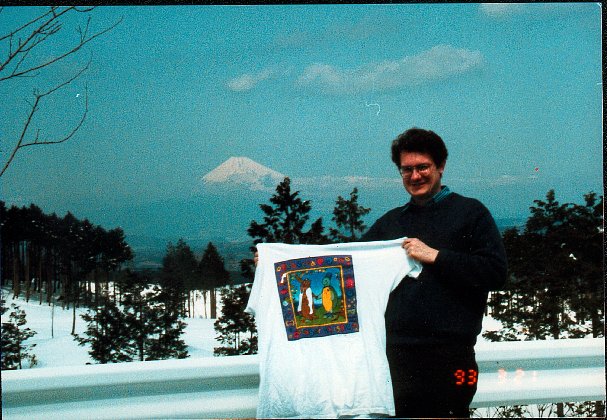
This is about as close as I ever got to Mt. Fuji, during a short visit to the area around the spring equinox in 1993. The remarkable thing was that the peak was actually visible, rather than obscured by clouds.


A short while before, a graphic artist friend of mine created a t-shirt to commemorate her wedding, and she sent one to me (note the cartoon characters holding hands). I told her in a fit of exuberance that I would have pictures made featuring the shirt in famous places, and send her copies. This was one of the first such pictures, if not the first, and I made a few others, but eventually the notion fell by the wayside.


A decade later, I received a Route of Seeing cap from Ed, and not-quite-seriously had the idea to do the same as with it as with the wedding t-shirt. Except now, in the age of digital photos and e-mail, it would be much easier to send him the images. During our trip in '05, whose ultima was Yellowstone NP, I managed to take a few pics featuring the cap.


The next year, I took it to Canada and documented its visit with a few more pictures. The cap seemed to have a penchant for continental divides.


And then I lost the cap.

Labels: , , ,

Monday, March 14, 2011

Tsunami

We've been following the terrible news from Japan, as you'd imagine. From Friday to Sunday, we received a number of e-mails and phone calls asking about Yuriko's relatives. I'm glad to report that they live at quite a distance from Miyagi Prefecture, which is up on the coast from Tokyo and roughly 400 miles from Osaka -- a little further than San Francisco is from Los Angeles.


Some of the early reports of the disaster on US TV, at least, seemed to offer no clear information on just what part of the country had been hit by the earthquake and tsunami. If you'd never heard of Miyagi Prefecture or Sendai, it would be easy to imagine that was pretty much anywhere in the Japanese archipelago.


At this point, we can only hope the nuclear part of the disaster is more Three Mile Island than Chernobyl. At least the Japanese didn't go with the "we don't need no stinkin' containment building" school of nuclear power plant design favored by Soviets of yore.

Labels:

Thursday, February 10, 2011

Crunky Vessel in the Fog

Unreasoning, stupid cold today. But they say it will be above freezing beginning sometime over the weekend. That will seem like resort weather. People will start wearing shorts until the next arctic blast (and there's bound to be at least one more).


Actually, even single-digit temps don't discourage a handful of shorts-wearing fanatics. Last Saturday, temps about 10° F., I was in line at a post office when in walks a fellow in a reasonably suitable winter coat but also shorts and tennis shoes. A shortish but stocky fellow, he must have been about my age, with short, vaguely military hair, a fair number of forehead wrinkles and an enormous, unlit cigar stuck in his mouth the entire time he was in line behind me. For some reason, he reminded me of Sgt. Fury, someone I hadn't thought about in years, but I doubt this guy was ever on a secret mission to kidnap Hitler.


When I scanned Temmy's Sweet Flakes yesterday, I couldn't stop at just one scan -- who can? -- especially when I had an empty box of Crunky around the house. Usually I don't want one enough to pay $2+, but I spied one at a serious discount at an Asian grocery store not long ago.


Unlike Temmy's, I've known about Crunky for many years. It didn't take me long to find Crunky at convenience- and grocery stores in Japan, along with a lot of other native confections. Except that, as a Lotte product, Crunky isn't quite native to Japan, but to Japan and Korea.


Lotte HQ might be in Japan, but it was established by a Korean who grew up in Japan, and its presence is much larger in South Korea than Japan. Except for its delightfully fractured name, Crunky is something like Nestle's Crunch, though not as sweet.


The founder of Lotte, one Shin Kyuk-Ho, is apparently still alive at 89. This is my favorite line in his Wiki stub: "He currently resides in South Korea for odd months and in Japan for even months. [citation needed]" If I had more energy for research tasks that don't pay, I might try to find that citation. I hope it's true. A billionaire without some eccentricities is no fun at all.


Crunky's OK. But it never was my favorite East Asian chocolate. Another Lotte product, Vessel in the Fog, was. I've never seen it for sale in the United States. It's a smooth confection with a great, inexplicable name.

Labels: , , ,

Sunday, November 07, 2010

Item From the Past: Osaka Subway Kids

November 3, 1991

I was in my stride last week and the week before as an amateur tour guide, showing Steve around. My four-day work week left plenty of time for that pleasant task. The high points of his visit sometimes came unplanned, such as the two-station subway ride in Osaka with a swarm of elementary school kids.


Swarm is the right word. School field trips in Japan often aren't by bus, but by subway or train, if you can imagine that -- a whirlpool of little uniforms and monocolor caps and animated Japanese faces. Most of the time, I can dodge subway cars packed with such a group, but last week Steve and I walked unawares right into one. He became an instant celebrity among the kids when he decided to take a few pictures.


My own instant fame, because I could speak some Japanese to the kids, was only a little less. We focused those kids like iron filings to a north and south pole, but it didn't last long. We got off to change trains after a few minutes, while the kids continued on their field trip. Since it isn't really possible to acclimate yourself to the experience of Japanese-style mass humanity after only a week in country, Steve was a little flabbergasted by the moment. It was a good flabbergast, though.

Labels:

Sunday, October 31, 2010

Halloween '10

Halloween has arrived at last. Merchants and broadcasters and advertisers are doing their best to stretch the damn thing out deep into October, something like the way Christmas has consumed December, and I say resist. One day is enough for Halloween. If we want more holiday, we North Americans should add Día de los Muertos to the festivities. It would be a fine cultural import. Early November seems like a good time to visit relatives in graveyards and feasting back home to their memory, complete with sugar skulls.


Japan has a multiday holiday to honor the departed: O-bon (お盆). The Kansai area celebrates O-bon in August. There were festivities and visits to grave sites. But mainly it meant that nearly everything shut down and that everybody had a week's vacation at the same time. Long-distance travel at the time was difficult at best, so each year I spend my mandatory week off poking around places I could reach on local trains. One year, I went to see the lighting of the Gozan-no-okuribi Daimonji in the hills outside Kyoto, which was a cool thing to see, but that's as far as I ventured during O-bon.


A Wall Street Journal blog posting (which may or may not be available now) includes this assertion regarding Halloween creep: "Many families started with parties last weekend, and will continue celebrating through Sunday night, extending what used to be a one-day holiday over more than a week. Moreover, some parents are taking time off of work [Friday] for school parties and parades, or on Monday to recover."


Oh, really? The blog is about how stressful it can be to raise a family while working in the money economy, too. (That isn't quite how the writer phrases it.) Oddly, there's no suggestion in this particular posting about how much less stressful it is let Halloween be a one-day holiday; or better, a two- or three-hour holiday. To paraphrase my eldest daughter, "The candy's the thing."


That and fond memories of one's own Halloweens. Some of my earliest memories of Halloween involve hearing stories, already current in the late 1960s, about poisoned candy or razor blades (or pins) in apples that were dispensed to unlucky children. My own favorite was, and is, the tale of kids who received chocolate Ex-Lax while trick-or-treating. As literal fact, the poison-candy stories are almost all nonsense. But since we moderns generally disbelieve stories of evil spirits roaming the land on All Hallow's Eve, we need some other kind of menace out there on October 31.

Labels: ,

Thursday, July 22, 2010

Mugicha

I don't want ComEd, our electric utility, to get any more of my money than strictly necessary, so there are often summer days that I leave the air conditioner off. Today was one of those days, especially because it was cloudy in the morning. The house has good insulation, so it takes all day to heat up on a day like that. I don't usually notice as the inside temp slowly rises. Yuriko notices after she comes home from an air-conditioned office, however.


"Why is it so hot in here?" she says.

"We didn't notice," I answer.

"What?"

"You know, like lobsters in a pot that's beginning to boil."


Drinking something cold during the day also helps. There's Kool-Aid (see July 8) and other kid beverages around, which I leave for the kids mostly, as well as carbonated soda, which I drink but never as much as the rest of my family -- the family I grew up in, nor the one that grows up around me now. Beer has its place, but largely as special-occasion drinking. Long ago, Yuriko brought home a 24-pack of one of the mainstream brews because it was on sale cheap, and it must have taken me about three years to get through it.


I also drink "roasted barley tea" in the summer. That doesn't sound like a good drink, but I never call it that. No one else in the house calls it that either. It goes by its Japanese name, mugicha (麦茶), around here. I've been drinking it for so many summers now -- as far back as the hot, AC-less Osaka summers -- that it's a flavor of summer for me. Drinking it any other time seems odd.


Currently we're working our way through a 52-bag package of Shirakiku brand mugicha, product of Japan. Since it's an import, it has an ingredient panel in English. It says, "Ingredients: Barley."


"It has a toasty taste, with slight bitter undertones, but much less so than tea made from tea leaves," writes the Japanese food blogger at Just Hungry, and a lot else besides about mugicha. She continues: "To me, it’s much more refreshing to drink than plain water."


I'll go along with that. But mugicha is an acquired taste. It looks like regular tea, and if you're expecting it to taste like regular iced tea, you'll be surprised. On their first try many Occidentals don't seem to care for it. That might have happened to me, but I don't remember, since I've taken to it so completely in the years since.


The simplicity of how it's made also appeals to me. Put a mugicha bag into a pitcher; fill it with cold water; put the pitcher in the refrigerator for a few hours. Drink. That's it. Perfect for summer.

Labels: ,

Monday, July 19, 2010

Meditations on a Box of Korean Waffle Mix

Not long ago, Yuriko brought home a box of Korean waffle mix, acquired at H Mart, a Korean supermarket. Many basic ingredients of Japanese cuisine are available there at lower prices than at Japanese grocery stores, or for that matter, most small stores specializing in East Asian goods. Waffles aren't native to either Japan or Korea that I know of, but both have adopted them.


It's an artful box, sporting a studio-lit photo of a Belgian waffle topped with fruit, powdered sugar and ice cream. Since it's an import from Korea, almost everything on the box is written in Korean, as you'd expect, but there are splashes of English as well -- mainly "European Waffle Mix" and "Enjoy Home Baking." Why "European" and not "Belgian," I don't know. Either Belgium has no cache in Korea when it comes to waffles, or South Korea and the EU have some kind of trade agreement that bans calling waffles Belgian if in fact they're from somewhere else. Stranger things have emerged from the EU, I think.


Those are exactly the kind of English phrases you might also find on a Japanese box of waffle mix. A fair number of packed items in Japan -- and I suppose in Korea, too, from the evidence of this box -- include English not because they were created by English-speakers or bought by English-speakers but because (this is what Yuriko says) it makes the box look more exotic to Japanese-speakers.


It's like splashing a French name on a product, though it's a little hard to imagine a product for English-speakers using non-roman characters to make itself more exotic. People would eye the thing suspiciously and register a WTF moment, which usually isn't good for sales. Imagine if you saw the following on your waffle mix:


That's largest Hangul on the waffle-mix box, and whether it says the brand or "waffle mix" in Korean, I can't say. But would you ever find it on a box of Aunt Jemima or Bisquick pancake mix?

Labels: , ,